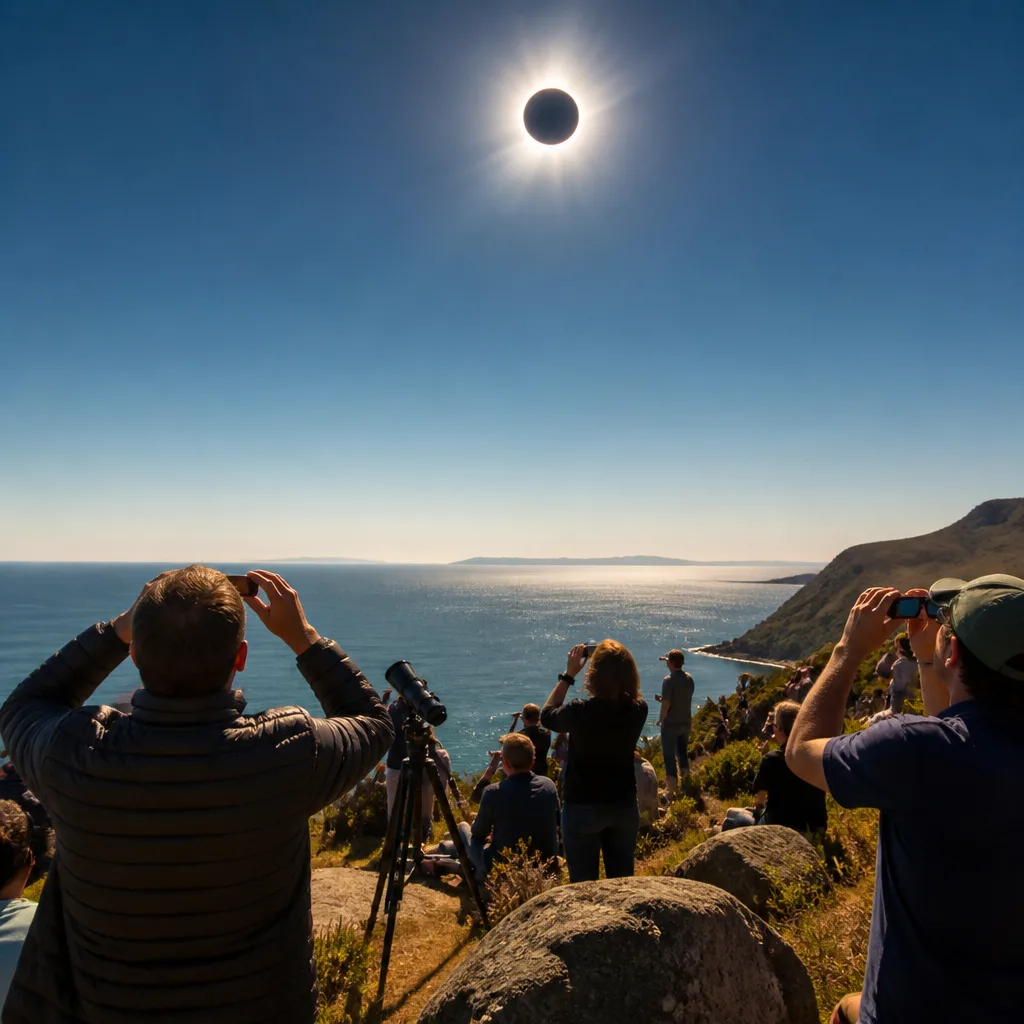
12 August 2026 will bring a total solar eclipse across parts of Spain and other areas of Europe, an astronomical alignment in which the Moon completely covers the bright disc of the Sun and the Sun’s faint outer atmosphere becomes visible. That outer layer, called the corona, usually cannot be seen because the Sun’s bright surface outshines it.
Why an eclipse matters to scientists
During totality — the minutes when the Moon entirely obscures the Sun — observers gain a rare direct view of coronal structure and dynamics. The corona is where the solar wind originates and where complex magnetic processes drive phenomena such as coronal mass ejections. Observations made during a total eclipse can therefore yield useful information about solar magnetic fields, the distribution of hot plasma around the Sun, and how energy is transferred outward from the solar surface.
Because the corona is extremely faint compared with the Sun’s photosphere, the brief darkness of totality provides researchers with an opportunity to capture images and measurements that are otherwise possible only with specialised instruments on spacecraft or with coronagraphs that artificially block the bright disc. These ground‑based snapshots can complement spaceborne data and help scientists study how coronal features change over minutes to hours.
What scientists hope to learn
Although full scientific campaigns are typically led by groups with precise instrumentation, several broad objectives drive eclipse research:
- Map coronal structure and fine-scale features to better understand the Sun’s magnetic field topology.
- Measure coronal brightness and temperature variations to study how plasma is heated in the Sun’s outer atmosphere.
- Observe transient events — such as small eruptions or dynamics in coronal streamers — that inform how the solar wind is launched.
These observational goals are valuable because the corona directly affects near‑Earth space weather. Changes in coronal structure can influence the solar wind and the likelihood of eruptions that, if directed at Earth, may disrupt satellites, communications and power systems. Eclipse observations therefore form part of a broader effort to understand solar activity and its potential impacts.
Practical notes for observers
The eclipse path for 12 August 2026 crosses parts of Spain and other European territories. Outside the narrow path of totality, observers will see a partial eclipse in a much wider region. Safety remains essential: looking at the Sun without appropriate eye protection can cause permanent eye damage. Only during the short interval of totality is it safe to view the eclipsed Sun with the naked eye; at all other times, certified solar filters or eclipse glasses are required for direct viewing.
| Item | Detail |
|---|---|
| Date | 12 August 2026 |
| Visible | Parts of Spain and other areas of Europe; partial phases over a wider region |
Even for those not in the path of totality, many scientific teams will livestream observations and share data from remote instruments and spacecraft. Such coordinated efforts allow researchers to combine ground‑based eclipse images with continuous monitoring from solar observatories in orbit.
It is important to distinguish what an eclipse can and cannot do. A total eclipse gives a short, high‑contrast view of coronal features and is particularly useful for capturing fine detail across a narrow time window. It does not replace continuous monitoring by satellites, which provide long‑duration measurements of the Sun’s activity and its immediate effects on the near‑Earth environment. Instead, eclipse observations are complementary — snapshots that can reveal structure at resolutions and wavelengths sometimes difficult to obtain otherwise.
For the public, eclipses are also an important outreach moment. They offer a way to engage people with basic solar physics, the nature of light and the scale of the solar system. For scientists, the event on 12 August 2026 represents one of those infrequent but valuable opportunities to study the Sun’s corona directly from the ground.