Ruthenium dioxide (RuO2), a material long regarded as non‑magnetic in its bulk form, may show a recently proposed and unconventional kind of magnetism known as altermagnetism when prepared as an ultrathin film only a few atomic layers thick, researchers report.
What the team found
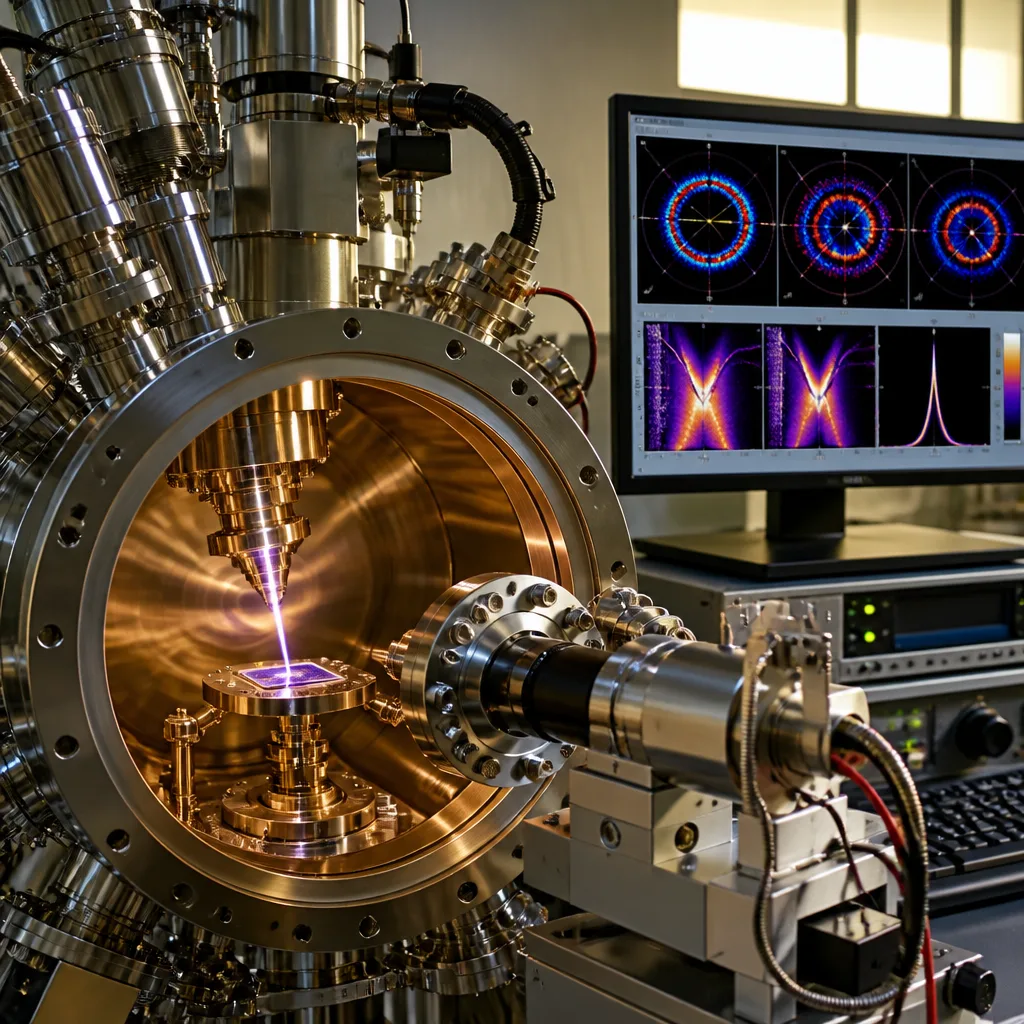
Physicists led by Ming Yi at Rice University, working with Bharat Jalan of the University of Minnesota and Milan Radovic of the Paul Scherrer Institute, published experimental results in Science Advances that indicate unusual magnetic behaviour in ultrathin RuO2. The study’s first author, Yichen Zhang, a recent Rice graduate, said the group measured the material’s spin texture — the spatial arrangement of electron spins that reveals magnetic order — using spin‑resolved angle‑resolved photoemission spectroscopy (spin‑ARPES).
Spin‑ARPES maps how electron spins depend on momentum and energy. According to the paper, the measured spin textures in the ultrathin films were consistent with unconventional magnetism, suggesting that the material’s magnetic character can change dramatically when it is reduced to only a few atomic layers.
"Ruthenium dioxide was one of the first materials to be proposed as an altermagnetic candidate, but studies on its bulk form didn't return evidence of magnetism... Our research shows that its ultrathin form, on the other hand, may be the key in making it magnetic."
Role of lattice strain
The researchers emphasise that the altermagnetic‑like behaviour appeared under specific conditions. In particular, the ultrathin RuO2 had to experience lattice strain — a deformation of the atomic lattice that alters the electronic structure. The team reports that without such strain, as is the case in the material’s natural bulk form, the magnetic signature was absent.
The study combined the experimental spin‑ARPES data with theoretical calculations to interpret the observed spin patterns. The authors conclude that, under the experimental conditions they used, bulk and ultrathin RuO2 can display markedly different magnetic properties.
Why this matters
Altermagnetism is a recently proposed class of magnetic order that differs from familiar ferromagnetism and antiferromagnetism. It can, in principle, offer ways to manipulate electron spins without large stray magnetic fields — an attractive quality for future spintronic devices and memory technologies that aim to be smaller, faster and more energy‑efficient.
The Rice team frames their result as an early but promising demonstration that dimensional reduction (making a material ultrathin) and controlled strain can act as practical knobs to induce or tune magnetic states in materials previously judged non‑magnetic.
- Material: Ruthenium dioxide (RuO2)
- Form tested: Ultrathin films, a few atomic layers thick
- Technique: Spin‑resolved angle‑resolved photoemission spectroscopy
- Condition required: Lattice strain
- Published in: Science Advances
| Property | Bulk RuO2 | Ultrathin RuO2 (with strain) |
|---|---|---|
| Magnetic evidence | None reported | Spin textures consistent with unconventional magnetism |
| Control parameter | Not required | Lattice strain |
Limits and next steps
The findings are initial and specific to the experimental conditions described by the authors. They do not establish immediate device applications. As the study’s wording recognises, the magnetic signatures appeared only under particular sample preparation and strain conditions; reproducing and controlling those conditions will be essential before any technological benefits can be realised.
Future work will need to confirm the origin of the spin textures, demonstrate reproducibility across different laboratories, and explore whether the effect can be harnessed at scales and temperatures relevant for devices. If those steps succeed, ultrathin RuO2 or related materials could join a growing roster of quantum materials that engineers might exploit in next‑generation memory and spintronic circuits.
For now, the result highlights a broader lesson from condensed‑matter physics: reducing dimensionality and applying strain are powerful strategies to reveal emergent phenomena that are simply not present in bulk crystals.