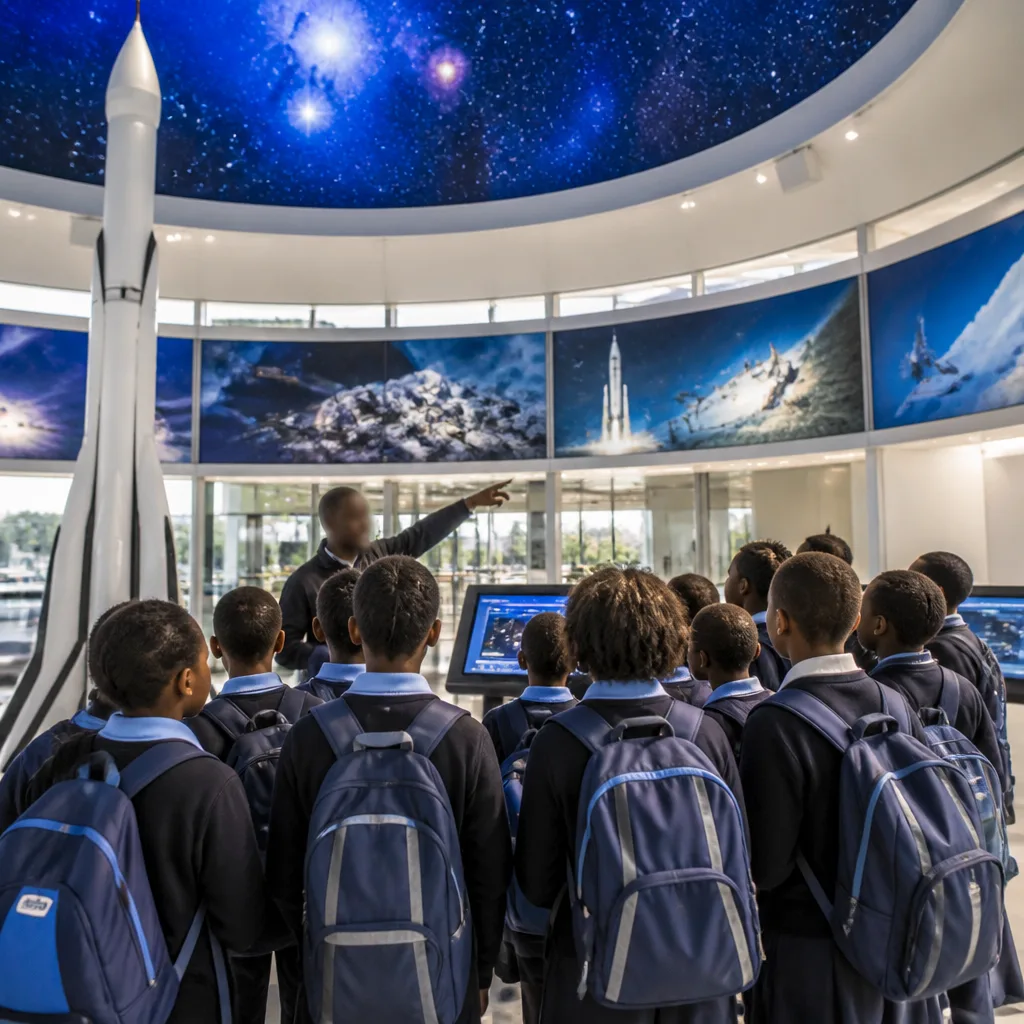
The Binzhou Aerospace Exploration Centre opened to the public on 25 September, presenting a purpose-built venue that blends aerospace science education with cultural tourism and leisure activities. According to the report, organisers intend the centre to serve as a hub for youth study tours and public engagement with the history and future of human spaceflight, while celebrating national achievements in aerospace.
What the centre offers
The facility occupies a total built area of 9,456 square metres and provides nearly 15,620 square metres of exhibition space, organised into a Visitor Service Centre and five themed exhibition zones. Those zones are listed as:
- Planet Paradise — family-friendly exhibits aimed at younger visitors;
- Beyond the Dome — material on the evolution of human spaceflight;
- Interstellar Voyage — immersive presentations on exploration beyond Earth;
- Touching the Stars — interactive exhibits designed to give hands-on experience with aerospace concepts;
- Mars Base — displays and themed experiences centred on Mars exploration.
The centre is designed to provide a comprehensive and immersive aerospace science education system suitable for a broad age range. The organisers have positioned it as both an educational resource and a tourist attraction that can anchor study tours and family visits.
Why this matters
Science centres and museums play a specific role in public understanding of science: they translate technical achievements into accessible stories and experiences, and they offer opportunities for informal learning outside school. By integrating themed, interactive exhibits with a visitor-centred service area, the Binzhou centre aims to combine entertainment and learning — a model increasingly common in large-scale science museums.
There are a few practical consequences to note:
- Centres such as this can increase local tourism drawcards and create jobs in museum operations, education and hospitality.
- They provide a venue for outreach to young people, potentially supporting pathways into STEM (science, technology, engineering and mathematics) education.
- By emphasising national aerospace achievements, they contribute to public narratives about a country’s scientific and technological progress.
| Feature | Area (square metres) |
|---|---|
| Total built area | 9,456 |
| Exhibition space | 15,620 |
It is important to distinguish between the promotional framing of such centres and the measurable impacts they produce. While the organisers expect the centre to be a focal point for science education and patriotic commemoration of aerospace milestones, research would be required to quantify outcomes such as changes in student interest in STEM or longer-term impacts on regional tourism figures.
Context and limits
The report positions the centre within broader efforts to stimulate science and cultural tourism. However, the announcement does not provide details on operating budgets, anticipated visitor numbers, ticket pricing or specific educational partnerships with schools and universities. Those operational details influence how effectively a centre can deliver on its educational ambitions.
For readers interested in public science infrastructure, the Binzhou project is an example of how municipalities and cultural planners are investing in experiential science venues. Such investments can yield benefits when paired with clear educational programmes, community access policies, and evaluation plans that measure learning outcomes.
Visitors and educators will watch how the Binzhou centre balances spectacle and substance: whether exhibits remain scientifically accurate and pedagogically useful, and whether the centre sustains engagement beyond the initial novelty of opening day.
“The centre aims to engage visitors with interactive experiences that highlight the evolution of human spaceflight and China's aerospace accomplishments,” the report said.
As with all new science attractions, the long-term value of the Binzhou Aerospace Exploration Centre will depend on careful curation, partnerships with scientific institutions, and transparent reporting on its educational impact.