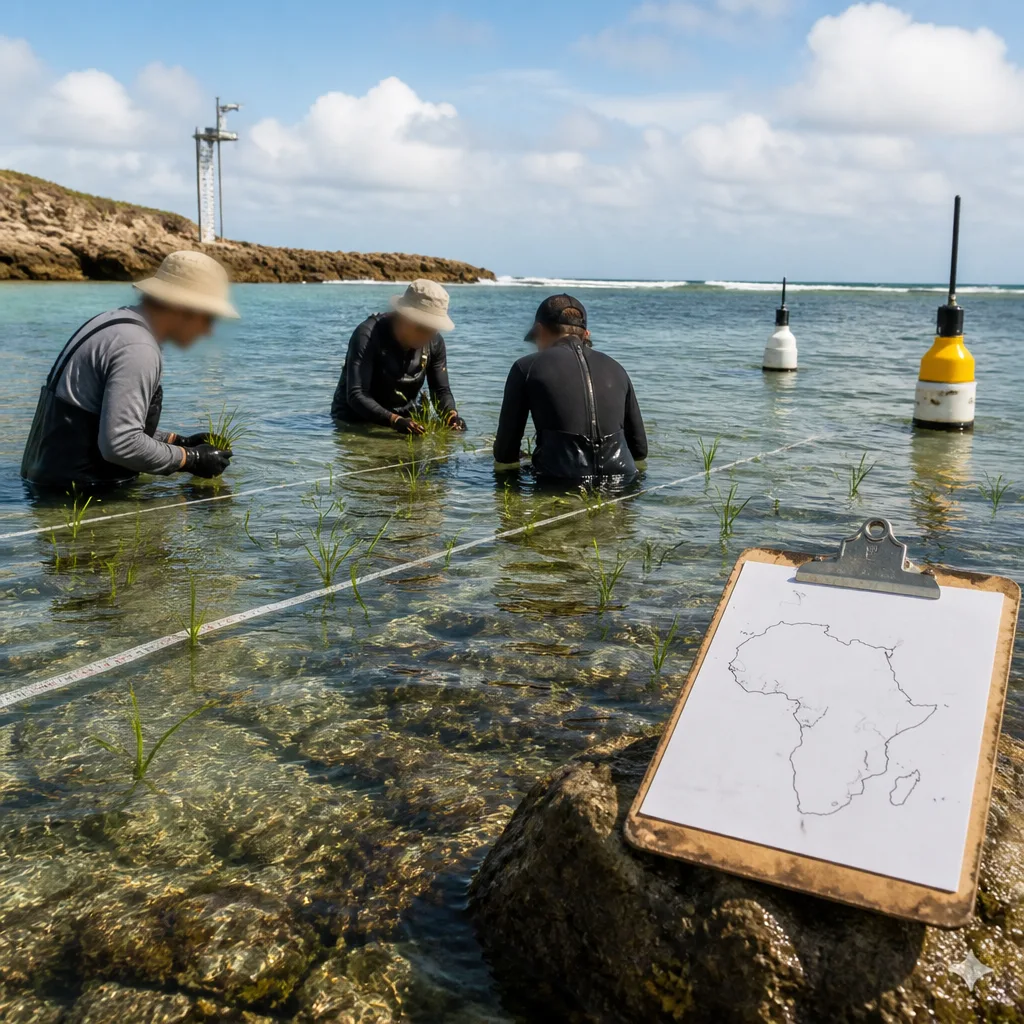
Africa’s seagrass meadows — shallow-water flowering plants that form underwater carpets and sustain fisheries, store carbon and protect shorelines — are receiving renewed scientific attention after a first comprehensive review of restoration efforts along the continent’s coastline found progress is fragmented and under-resourced.
Review highlights gaps and opportunities
The review, led by Professor Sophie von der Heyden of Stellenbosch University’s Department of Botany and Zoology and published in the Journal of Applied Ecology, collated published restoration studies from North, West, East and southern African countries with known seagrass meadows. The authors identify several persistent obstacles to effective restoration across the region, from weak long-term monitoring to methods that are highly species-specific and therefore difficult to transfer between regions.
Seagrasses are often overlooked in marine research and conservation. The review notes that, although global seagrass research has increased in the last two decades, there is substantially more work on coral reefs than on seagrasses — a disparity that limits evidence-based restoration in African waters.
“Seagrass restoration is an important part of maintaining seagrass meadows as they decline globally, but seagrass restoration science is fragmented and species-specific, meaning that what works in one region cannot be applied elsewhere,” the review says.
Why seagrasses matter to South Africa
Seagrasses such as Zostera capensis along South African shores form meadows that provide food, habitat and nursery grounds for many coastal species. They also deliver ecosystem services to people, including supporting small-scale fisheries, supplying materials and medicines in some communities, and contributing to shoreline stability. The authors link their work to international policy momentum, noting alignment with the United Nations Decade of Ecosystem Restoration (2021–2030) and the classification of seagrasses as an "Essential Ocean Variable," which recognises their relevance to global ocean monitoring.
Key recommendations from the review
- Improve and standardise long-term monitoring to assess restoration success and inform adaptive practice.
- Develop transferable, regionally appropriate restoration protocols rather than one-off, species-specific trials.
- Strengthen collaboration across African research institutions to share methods, data and capacity.
- Link restoration work to community needs and livelihoods, recognising the cultural and material importance of seagrasses.
- Increase investment and policy support to scale up restoration in line with international restoration targets.
Challenges for implementation
The review notes that restoration science for seagrasses is still nascent in many African countries. Practical barriers include limited baseline data on distribution and status, a shortage of trained practitioners, and the dominance of site-level, species-specific experiments that do not easily generalise. The authors call for concerted efforts to harmonise methods so that restoration outcomes can be compared across sites and over time.
| Issue | Implication |
|---|---|
| Fragmented science | Difficulty scaling successful methods across regions |
| Inadequate monitoring | Uncertainty about long-term restoration success |
| Limited capacity | Slow progress and missed opportunities for community benefits |
Policy and conservation implications
For South Africa and neighbouring countries, the review provides a blueprint to move from isolated projects to coordinated restoration efforts that deliver measurable benefits. Improved monitoring and shared protocols would allow conservation agencies, universities and coastal communities to track recovery, account for carbon and biodiversity gains, and design interventions that bolster food security and coastal resilience.
While restoration is only one part of the solution — protecting remaining meadows from pollution, trampling, coastal development and destructive fishing is critical — the authors argue that systematic restoration, grounded in robust science and community engagement, can help reverse declines. The review positions seagrass recovery as complementary to broader marine conservation goals and to international commitments to restore ecosystems by 2030.
South African researchers and policymakers now face the practical task of translating the review’s recommendations into funded programmes, regional collaborations and monitoring frameworks that can ensure seagrass meadows continue to support biodiversity and coastal communities.