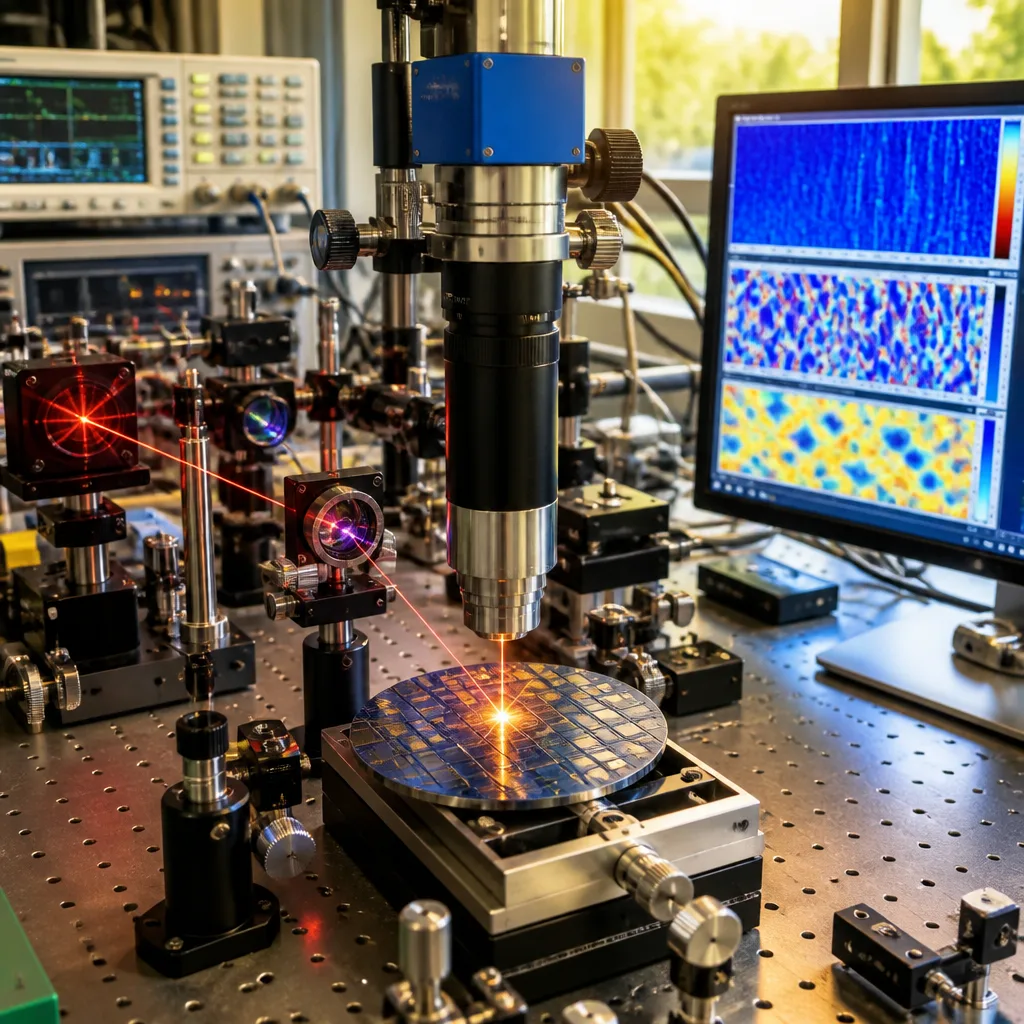
Engineers at the University of California, San Diego have demonstrated that carefully shaped ultrafast laser pulses can reverse the magnetisation of platinum–cobalt multilayers without applying an external magnetic field. The work, published in Nature Communications, shows that by shrinking and tailoring the distribution of light across a microscopic spot researchers can change the mechanism that flips magnetic bits, potentially opening a new control knob for future magnetic memory technologies.
What the experiment did
Magnetic memory encodes information by the direction of magnetisation in tiny regions of a material. Traditional writing of a bit uses a magnetic field to push the magnetisation from one stable orientation to another. The UC San Diego team instead used ultrashort laser pulses — lasting only femtoseconds (10−15 seconds) — shaped into tightly focused vector beams. These pulses deposited energy in a microscopic area and were able to reverse magnetisation in Pt/Co multilayers without any applied external field.
By progressively reducing the illuminated spot size and changing how the light was distributed across that spot, the researchers found they could switch between two different optical reversal mechanisms. Importantly, this approach produced polarisation-independent reversal in some multilayer structures, including samples containing as many as nine Pt/Co repeats.
Why this matters
All-optical switching — the control of magnetisation using light rather than magnetic fields — has been a subject of research for years because light can deliver energy extremely rapidly and be focused tightly. The UC San Diego results extend previous optical-switching demonstrations by working with thicker magnetic films and showing that the shape of the light beam itself can determine switching behaviour. The authors argue that optical beam design can therefore act as an additional parameter when engineering magnetic memory devices.
- Material: platinum–cobalt (Pt/Co) multilayers
- Light source: femtosecond laser pulses shaped into vector beams
- Key outcomes: magnetisation reversal without external magnetic fields; polarisation-independent switching in repeated structures up to nine Pt/Co layers
Laboratory demonstration, not a product
The researchers emphasise that the experiments remain a laboratory demonstration. The switching was observed using repeated femtosecond pulses rather than in a finished memory device comparable to commercial magnetic drives. Translating such optical switching into practical memory hardware will require further work on speed, energy efficiency, device integration and repeatability under operating conditions.
| Aspect | Reported result |
|---|---|
| Beam shaping | Tightly focused vector beams; control of spatial energy distribution |
| Material system | Platinum–cobalt multilayers, up to nine repeats |
| External field | Not required for switching |
Context and limitations
Optical approaches to magnetic switching are attractive because light can act on sub-picosecond timescales and can be tightly localised. However, the current experiments relied on repeated femtosecond pulses to achieve reversal and used a specialised optical setup designed to shrink and concentrate laser light on the sample. That means the result is an important proof-of-concept rather than an immediate route to faster or denser commercial memory.
Important follow-up questions include whether single-shot switching is possible in these thicker multilayers, how thermally robust the written states are, and how readily the optical system could be implemented in a scalable device architecture. The paper indicates the beam profile is itself a parameter engineers can tune, which could help optimise speed and energy use if the technical hurdles are overcome.
For South Africa and other countries watching developments in memory technology, the study is a reminder that advances can come not only from new materials but also from novel ways of delivering energy to those materials. Optical beam engineering — changing the spatial and polarisation structure of light — may become as important as the magnetic stack design when future high-speed, high-density storage technologies are developed.