
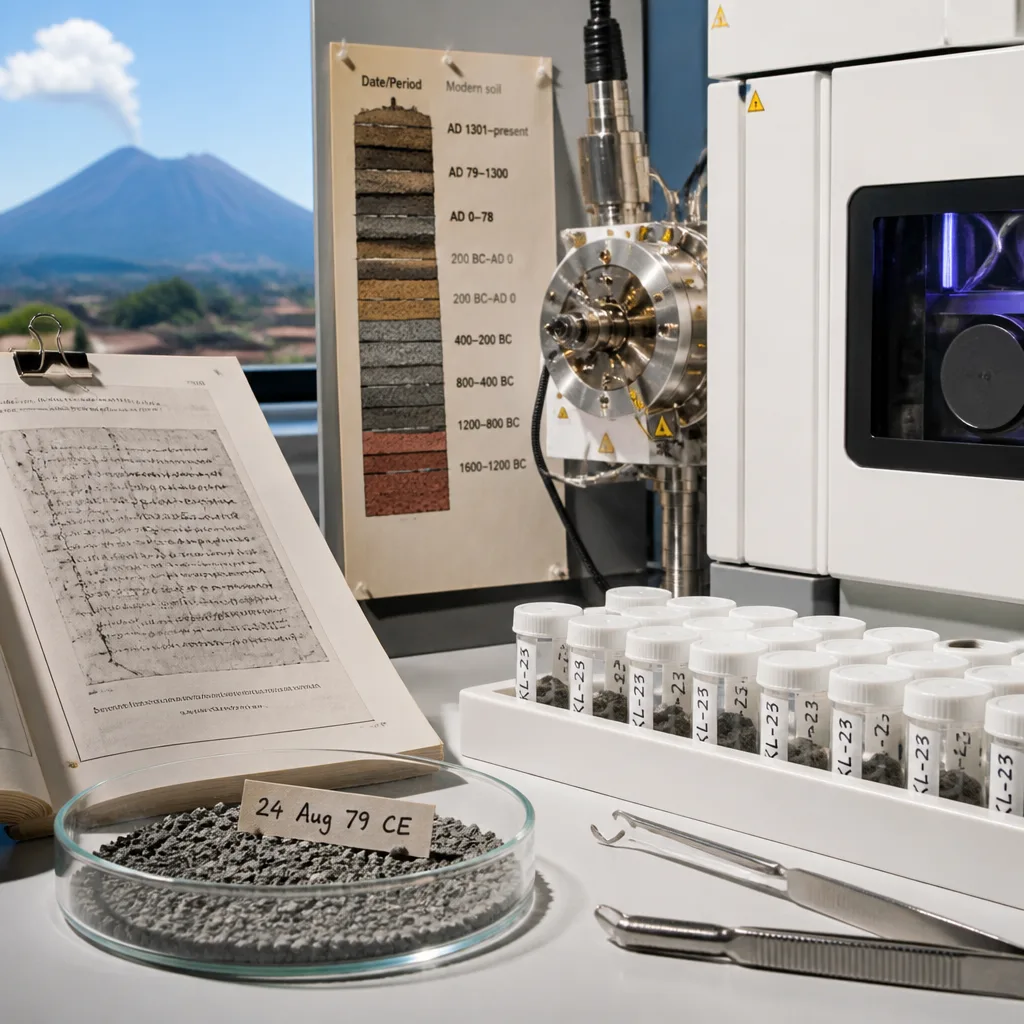
Researchers report in Science Advances that argon-argon dating has been recalibrated using the historically recorded eruption of Mt Vesuvius that buried Pompeii nearly 2,000 years ago. The team used details provided by Pliny the Younger about the eruption, which is conventionally dated to 24 August 79 C.E., to benchmark and sharpen the method’s precision.
Why the Pompeii eruption matters to geochronology
The study, carried out by scientists at the Berkeley Geochronology Center, the University of California, Berkeley and the University of Padua in Italy, shows that coupling a well-documented historic event with modern mass-spectrometry techniques produces a more precise timeline for geological events. The authors say this increased precision makes argon-argon dating one of the most versatile tools available for placing volcanic eruptions and other geological events in time.
“If you want to put together the eruptive history of a volcano in relatively recent time, precision and accuracy really count,” said study leader Paul Renne, a Berkeley professor in residence of earth and planetary science and director of the independent Berkeley Geochronology Center.
The terms being used by the authors are important. Accuracy describes how correct a date is compared with the true age, while precision describes how reproducible a measurement is. Recalibrating argon-argon against a dated historical eruption improves both attributes in the time interval covered.
Practical payoffs
The recalibrated method will help scientists assign tighter age ranges to geological and palaeontological records. The paper highlights several concrete uses:
- Improved eruptive histories for active volcanoes, which is crucial where large populations live nearby, such as around Mexico City, Naples (close to Vesuvius) and Yogyakarta in Indonesia.
- Better cross-checking, or "ground-truthing", of other dating techniques such as carbon-14 for organic material and uranium–lead for very old rocks.
- Greater confidence in placing geologic events in the recent, historically accessible past where documentary records exist.
The authors used modern argon-argon mass spectrometry at the Berkeley Geochronology Center to refine the technique by tying it to the eruption date inferred from Pliny the Younger’s first-hand account. That allows argon-argon results to be reported with narrower uncertainty when applied to eruptions and deposits of similar age.
A tool for multiple timescales
Although argon-argon dating is especially useful for volcanic materials, the study notes it also plays a role in calibrating and validating other dating systems. The paper explicitly points to two other widely used methods:
| Dating method | Example application mentioned |
|---|---|
| Argon–argon | Dating volcanic eruptions in the historical to geological past (recalibrated using the 79 C.E. Vesuvius eruption) |
| Carbon‑14 | Dating organic material; used for younger, archaeological and palaeontological samples |
| Uranium–lead | Dating billion‑year‑old rocks from the early Earth |
By strengthening argon-argon’s precision in the historical interval, researchers gain a more reliable anchor that can be used to compare results across laboratories and methods. This helps build a coherent, multi-method chronology for events ranging from archaeological layers to volcanic episodes.
Limitations and the conservative reading
The study emphasises that its improvement applies where a clear historical anchor exists or where comparable materials are available for dating. It does not replace other methods but complements them by providing a robust calibration in the time window around the Pompeii eruption. The authors caution that precision and applicability still depend on sample quality, the suitability of materials for argon-argon analysis, and laboratory practice.
For countries and regions with major population centres near active volcanoes, the recalibrated method offers a practical enhancement to hazard assessment and to the scientific understanding of eruption rhythms. For broader Earth science, the improved argon-argon calibration strengthens links between distinct dating methods and across very different geological timescales.









