
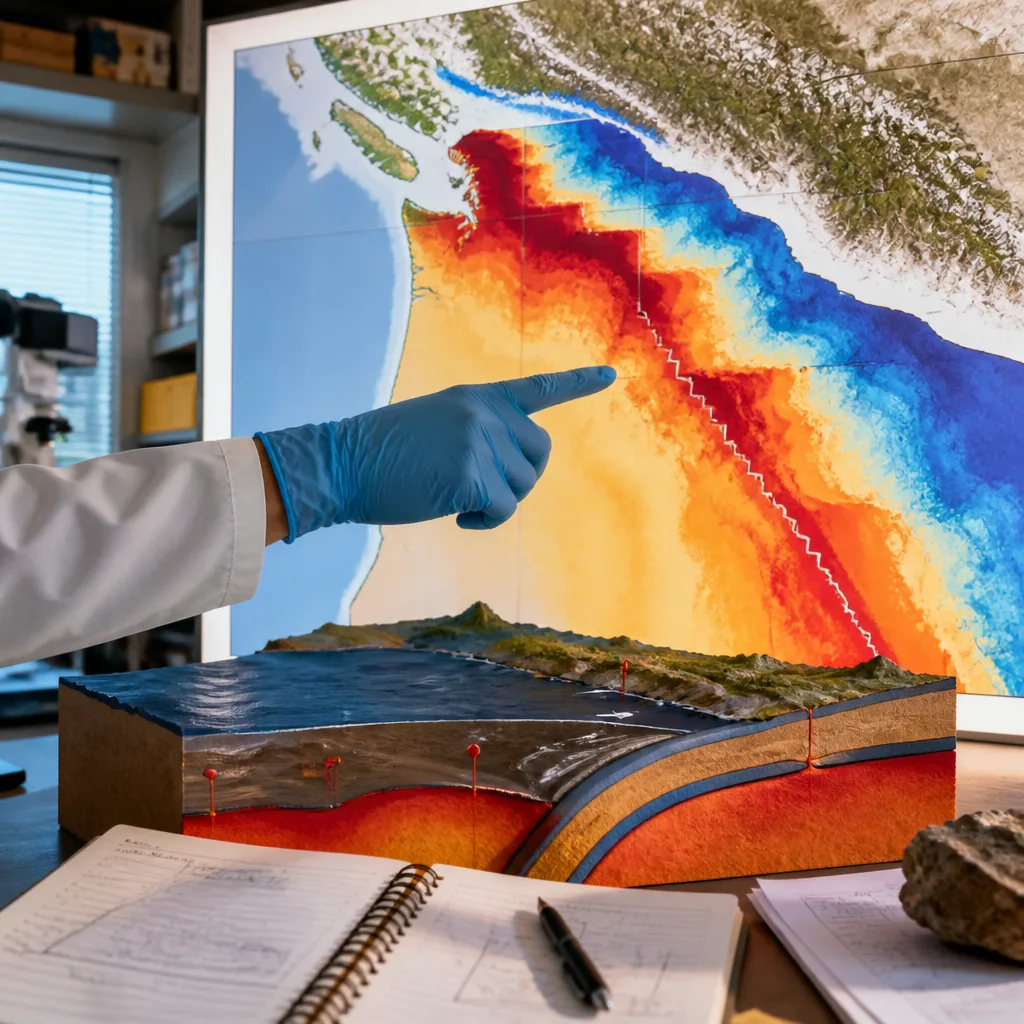
Researchers report that a subduction zone beneath the Pacific Northwest is actively fragmenting, offering an uncommon view of how these major plate‑boundary systems end their life. The finding, published in Science Advances, sheds light on processes that drive some of Earth's largest earthquakes and most powerful volcanic eruptions.
What is a subduction zone?
A subduction zone forms where one tectonic plate—typically oceanic crust—dives under another plate and sinks into the mantle, the hot, deformable layer beneath Earth's outermost shell. These regions concentrate deformation and fluid‑driven chemical changes and are central to long‑term changes in continents and ocean basins.
Why this discovery matters
Subduction can remain active for millions of years. Over those timescales it transports crustal material downward, fuels volcanic arcs, and creates large faults capable of producing great earthquakes. But subduction does not continue forever: if it did, continents would collide relentlessly and oceans would vanish. Direct observations of how an active subduction system reaches its end are rare.
The new study provides evidence that parts of a subduction system can break apart during this winding‑down phase. Observing that fragmentation in progress gives scientists a clearer picture of the mechanics that cut short subduction, and helps explain how plate boundaries reorganise over geological time. That knowledge refines our view of the long‑term evolution of Earth's surface and the lifecycle of mountain belts, volcanic arcs and ocean basins.
Key concepts and consequences
- Plate interaction: As an oceanic plate descends it drags crustal material into the mantle and changes the stress and thermal structure of the overriding plate.
- System lifetime: Subduction systems can be sustained for millions of years, but must eventually end; fragmentation is one mechanism for that termination.
- Hazard implication: The breakup of a subduction zone can alter patterns of seismicity and volcanism by changing where and how stress is released.
Because subduction zones host some of the planet’s most destructive earthquakes and volcanic eruptions, understanding how they evolve, slow down and stop helps refine long‑term hazard assessments. While the study describes a deep geodynamic process rather than an immediate surface threat, it contributes to the scientific basis used to interpret earthquake and volcano histories in affected regions.
A cautious interpretation
The published observations are an important piece of evidence, but they represent a snapshot in a complex, long‑running process. Geological systems operate on timescales far longer than human lifetimes. The report clarifies a mechanism — fragmentation — that terminates subduction, but it does not imply sudden or imminent changes at the surface. Scientists distinguish carefully between identifying a process and predicting specific future events.
| Term | Meaning |
|---|---|
| Subduction zone | Where one tectonic plate sinks beneath another into the mantle |
| Mantle | The hot, partially molten layer beneath Earth's crust |
| Fragmentation | Breaking of a continuous subducting plate or system into separate pieces |
The authors of the study combine geological, geophysical and conceptual arguments to make their case. Studies like this also guide model development and motivate further measurements — seismic imaging, geodetic observations and geological fieldwork — aimed at testing how widespread such fragmentation is and what surface signals it produces.
For South African readers, the immediate takeaway is one of perspective: the processes described operate at plate boundaries such as those that ring the Pacific Ocean, not at South Africa’s stable continental interior. Nevertheless, the research improves the global understanding of how the solid Earth recycles its crust and how tectonic hazards evolve on million‑year timescales.
In short, the Science Advances paper provides rare direct evidence of a subduction zone in the act of disassembling. That insight helps geoscientists map the full lifecycle of plate boundaries — from birth and growth to decline and death — and better understand the long‑term forces that shape our planet.









