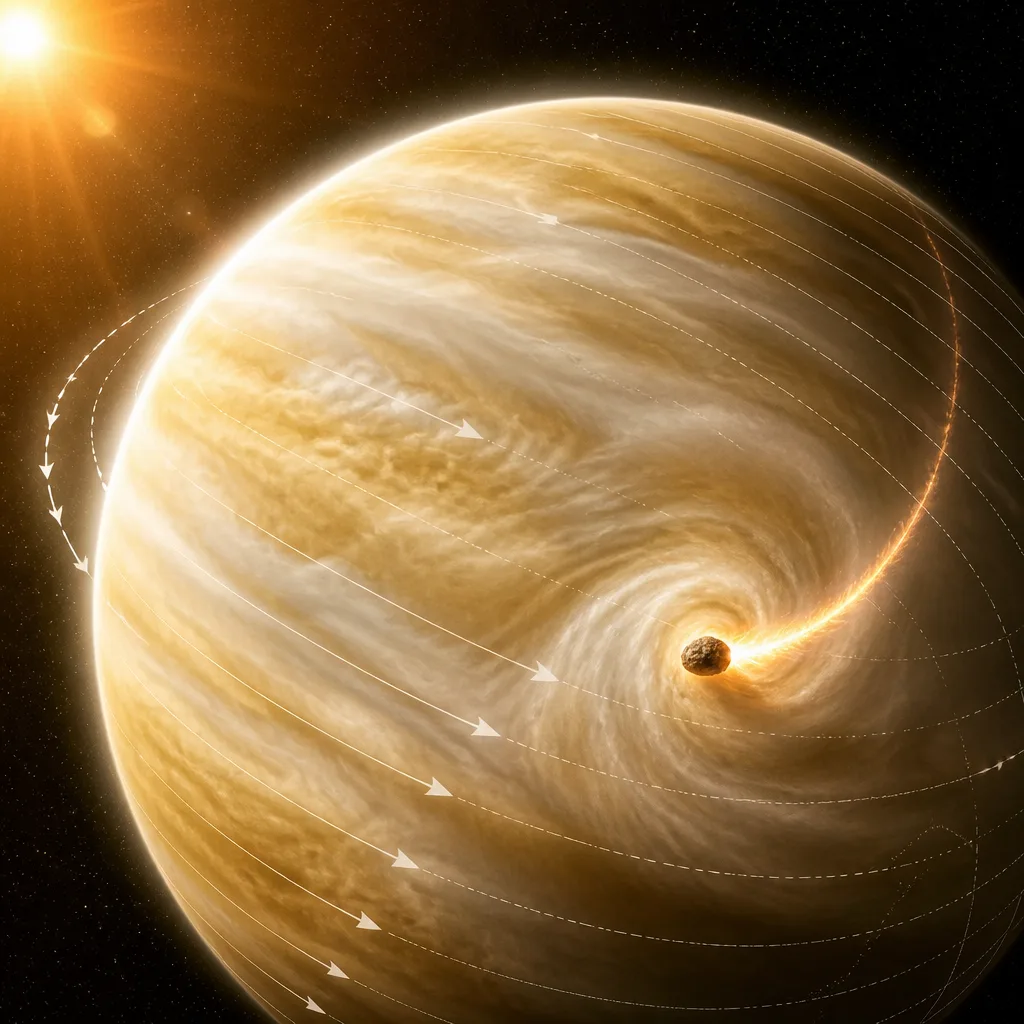
A new study published in The Astrophysical Journal argues that Venus may once have had a natural satellite that did not require a catastrophic collision to be lost; instead, the moon gradually spiralled inward and struck the planet as a consequence of Venus’s slow rotation and its gravitational interaction with the satellite.
How a moon can fall
The authors, led by astrophysicist Stephen Kane of the University of California, Riverside, model how a planet’s rotation rate and gravity influence the long‑term evolution of a moon’s orbit. Their work counters prior views that Venus either never formed a substantial moon or lost one only through a violent impact event.
"My study shows Venus didn’t require a catastrophe to arrive at what we can see today," Kane said in a statement accompanying the paper.
Moons do not always maintain stable orbits indefinitely. The Earth’s Moon, for example, is receding from Earth at roughly two inches per year (about 5 cm annually) because of tidal interactions driven by Earth’s relatively rapid spin. Venus, by contrast, has an extremely slow rotation: it completes one rotation about its axis every 243 Earth days. That sluggish spin alters the tidal torques between planet and satellite, opening a route by which a moon’s orbit can decay rather than expand.
Implications for planetary science and habitability
The study’s conclusions carry broader consequences for how astronomers assess the habitability of Earth‑like exoplanets. A moon can stabilise a planet’s axial tilt and influence tides and climate; losing a moon, whether by collision or orbital decay, can therefore change a planet’s long‑term environmental trajectory.
Kane highlighted this point in the paper’s statement: the process he describes suggests that if an Earth‑like planet around another star rotates slowly, any moon it formed or acquired may not survive in the long term. That in turn could affect the planet’s climate evolution and its prospects for hosting life as we know it.
- Mechanism: Slow planetary rotation can cause tidal interactions that pull a moon inward.
- Outcome: The moon spirals down and ultimately impacts the planet without an external catastrophic event.
- Broader relevance: Moon loss through tidal decay may be relevant when evaluating exoplanet habitability.
Comparing Earth and Venus
| Property | Earth | Venus |
|---|---|---|
| Rotation period | ~24 hours | 243 days |
| Moon behaviour | Moon receding (~2 in/5 cm per year) | No confirmed moon today; study suggests inward spiral and impact |
The table summarises how different rotation regimes produce contrasting tidal outcomes. On Earth, tides transfer angular momentum outward, pushing the Moon away; on the slowly rotating Venus modelled by the authors, the transfer can operate in the opposite sense.
Context and next steps
The paper revises prior explanations for Venus’s lack of a substantial moon. Earlier scenarios typically rested on either a failure to form a satellite during planetary accretion or loss through a collision with a large impactor. This new work provides an alternative pathway rooted in long‑term tidal dynamics.
As with all single studies, these findings will be tested and refined by follow‑up research. Further modelling that explores different moon masses and initial orbital distances, and comparison with observational constraints on Venus’s ancient history, will be needed to assess how widely applicable the mechanism is to other planets.
For South African readers interested in planetary science, the study is a reminder that small differences in rotation and gravity can have outsized effects on a planet’s environment — and that those effects must be considered when we search for potentially habitable worlds beyond the Solar System.