
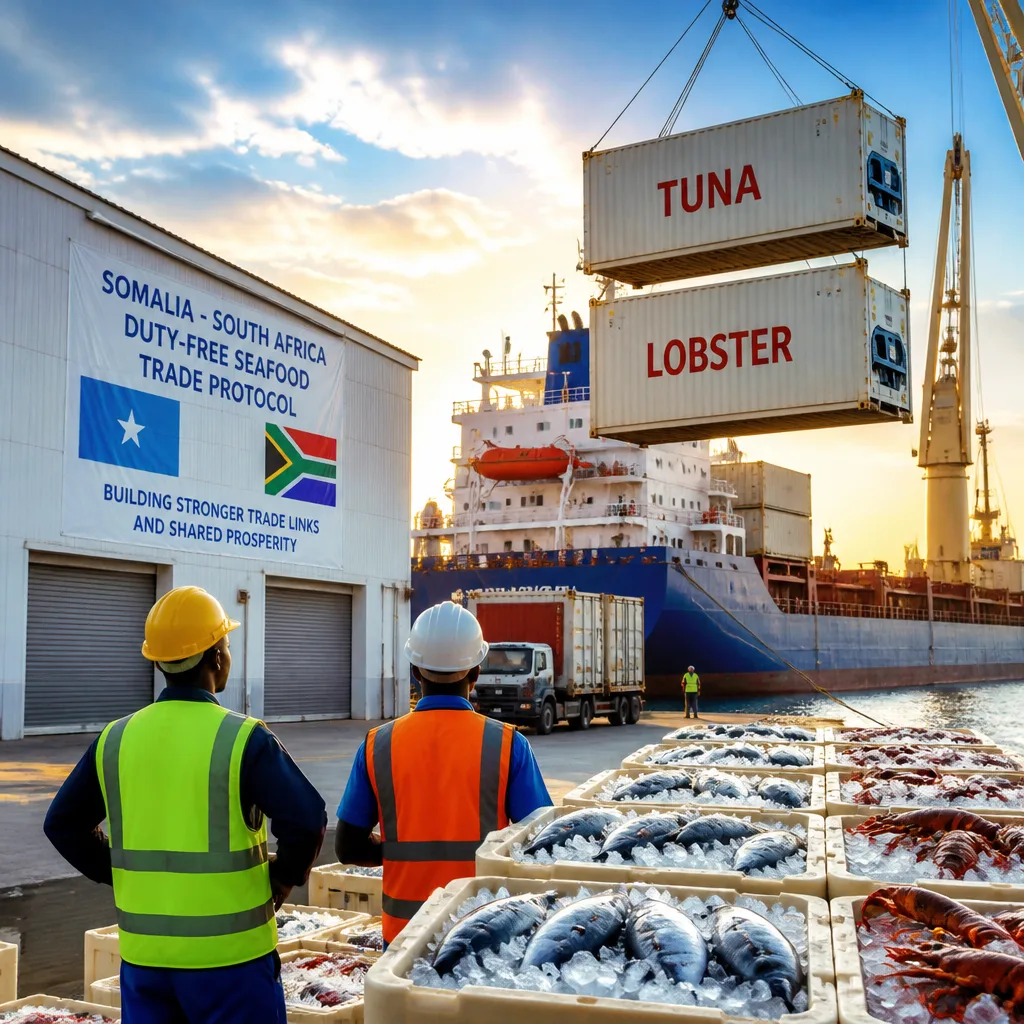
Somalia will begin exporting seafood products to China next month under a zero‑tariff arrangement signed in July, Mogadishu announced after hosting its inaugural maritime conference. The protocol, the Somali government says, covers items including tuna and lobster and aims to develop the country’s blue economy, generate employment and draw cold‑chain investment.
What was agreed and who signed
The protocol was signed in Mogadishu on 13 July by Somalia’s Minister of Fisheries and Blue Economy, Ahmed Hassan Aden, and China’s Ambassador Wang Yu, according to reporting of the ceremony. The Director‑General of the Somali ministry, Abdi Dirshe, described the deal as “a historic development.”
“Safeguarding territorial waters, boosting the blue economy, and utilising the country’s vast Exclusive Economic Zone (EEZ) is crucial,” Somali President Hassan Sheikh Mohamud said at the conference.
Policy context and Beijing’s wider offer
The tariff waiver is part of a broader Chinese approach, under which Beijing has, since May, allowed certain goods from African countries that recognise the People’s Republic of China to enter China duty‑free. The initiative has been offered to about 53 African countries that maintain relations with Beijing; only eSwatini continues to recognise Taipei, the reporting noted.
Analysts and policymakers have long flagged a large imbalance in Sino‑African trade. Last year, reported trade volumes between Africa and China reached about $380 billion, with Africa exporting roughly a tenth of that total. The new fisheries protocol seeks to increase Somali exports into the large Chinese market and to capture a greater share of value from marine resources.
Local benefits and Chinese responsibilities
Mogadishu highlighted two strands it expects to advance through the deal: domestic benefits from legal, higher‑value fishing activity and stronger regulation of foreign fleets. The government said it will issue special licences to foreign vessels and ensure fishing gear meets legal standards—an attempt in part to address longstanding accusations that Chinese vessels have illegally fished in Somali waters.
Somalia’s long coastline—reported at more than 3,800 kilometres—is central to the pitch. Officials argued that access to China’s market could stimulate investment in cold‑chain logistics, processing facilities and export infrastructure, which in turn could create jobs onshore.
- Start of exports: next month, under the zero‑tariff protocol.
- Protocol signed: 13 July by Somalia’s fisheries minister and China’s ambassador.
- Key products: tuna, lobster and other seafood to enter China duty‑free.
Risks and unanswered questions
While duty‑free access offers potential for higher export earnings, the immediate challenges are practical and regulatory. Somalia will need to scale up cold‑chain capacity to preserve perishable catches for distant markets and to meet Chinese import standards. It must also demonstrate effective monitoring and enforcement of licences to ensure legal fishing and to reassure both domestic constituencies and international partners.
For China, the deal addresses two objectives: increasing imports from Africa to reduce the trade imbalance and formalising access to valuable fishing grounds. For Somali households, the agreement could translate into more jobs if shore‑based processing and logistics investments follow. But those gains depend on private investment and governance capacity to manage and sustain higher‑value fisheries exports.
| Item | Detail |
|---|---|
| Coastline | 3,800 km |
| Protocol signed | 13 July |
| African countries offered scheme | 53 |
The protocol is presented by Mogadishu as a step toward unlocking Somalia’s maritime potential and reaping more of the value from its Exclusive Economic Zone. Implementation will determine whether tariff relief alone is sufficient to convert fish in the sea into sustained incomes on land.













