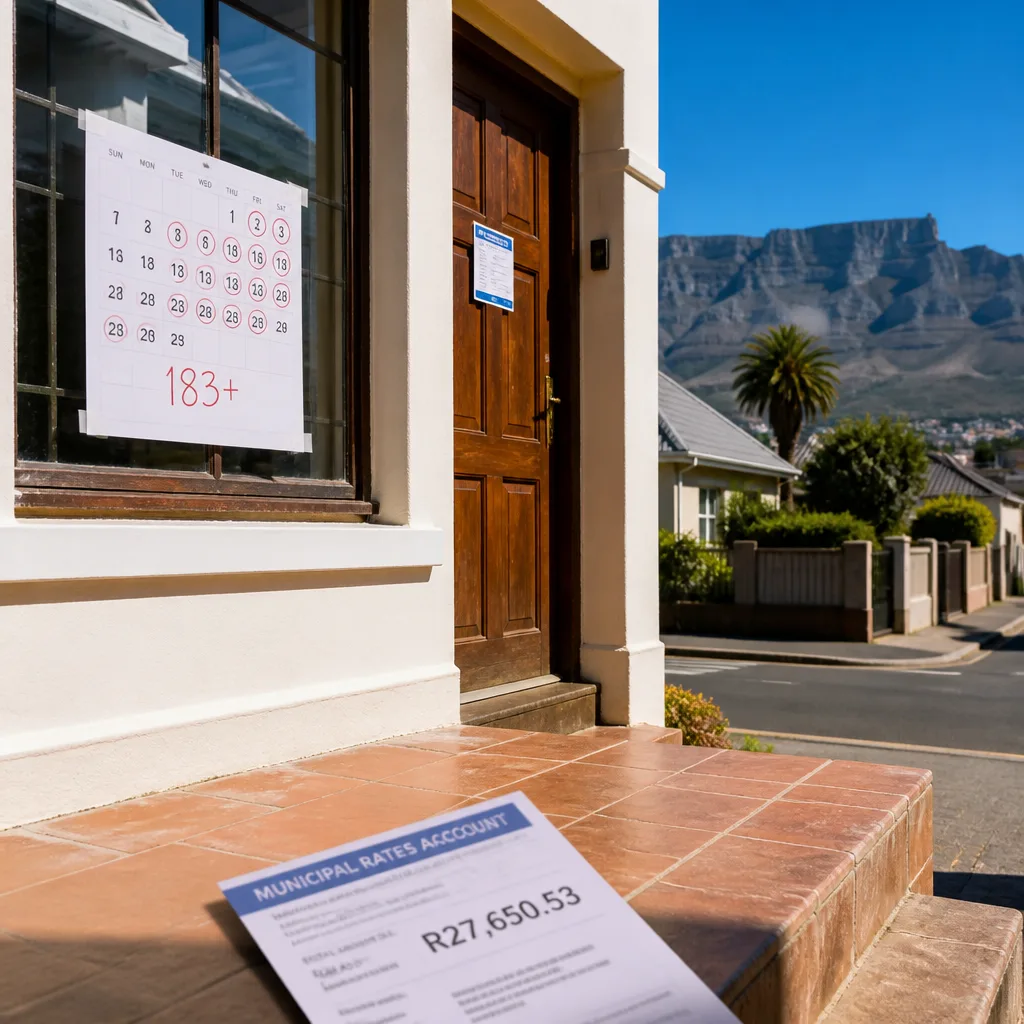
The City of Cape Town is proposing a new Short‑Term Letting By‑law that would require all properties advertised on platforms such as Airbnb, LekkeSlaap and Booking.com to be registered with the municipality and could see many hosts moved from residential to commercial rates.
Key change: 183 nights a year
Under the draft by‑law, any property listed on short‑term letting platforms must display a city registration number. Crucially, a property that is available for short‑term letting for more than 50% of nights in a year — defined as 183 nights — would be deemed commercial rather than residential. The by‑law is open for public comment via the city’s website until 5 October.
The practical implication for owners is straightforward: the municipality will calculate rates for such properties using the commercial tariff bands, the same approach applied to hotels and guesthouses. The city’s own rates calculator demonstrates how steep the difference can be. For an inner‑city property valued at R2.8 million, the current monthly rates bill as a residential property is R1 274, while the commercial equivalent is R3 945 — more than three times higher.
“Commercial accommodation” is “a property used for the purposes of providing accommodation … where a primary place of residence is used or available to be used for short‑term letting for more than 50% of the total annual room nights”.
Residential property is defined as a “property used or available to be used for short‑term letting for 50% or less of the total annual room nights”.
Who is affected — and who is not
The by‑law targets properties listed on formal booking platforms; it does not apply to rooms or units that are rented privately without being advertised on these sites, nor does it affect parts of properties that are not listed. The source notes explicitly that properties or parts of them, such as a granny flat, that are rented out without being listed on short‑term letting platforms will not require a registration number and will not be reclassified under this rule.
- Platforms covered: Airbnb, LekkeSlaap, Booking.com (and other listing services).
- Registration: All listings must show the municipal registration number.
- Threshold: More than 183 nights per year (over 50% of nights) triggers commercial status.
Revenue and household impacts
For households using short‑term letting to supplement income, a move to commercial rates can materially increase outgoings and change the economics of hosting. Using the city’s example, a homeowner paying R1 274 a month for rates could face R3 945 monthly — an extra R2 671 a month, or R32 052 a year. For part‑time hosts or people relying on letting income to cover bond or maintenance costs, that shift will reduce net returns substantially.
At a city level, the policy appears aimed at levelling the playing field between short‑term lets and formal hospitality providers by ensuring that properties effectively operating as guest accommodation pay rates on the same basis as hotels and guesthouses. The draft by‑law’s main principles were already reflected in the city’s latest rates policy adopted on 29 June, which introduced the formal definitions quoted above.
Next steps and public participation
The by‑law is in draft form and the public can submit objections and comments until 5 October. The final scope and implementation timeframe will depend on consultations and any amendments arising from the public comment period. The city has not published a tariff schedule in the material summarised in the source, so the precise extra cost for every property will vary depending on municipal valuation and the commercial rate applied.
| Example | Valuation | Residential monthly rates | Commercial monthly rates |
|---|---|---|---|
| Inner‑city example | R2.8 million | R1 274 | R3 945 |
Owners who regularly rent their homes to tourists should check their listing status and consider whether their property will exceed the 183‑night threshold. Those who do not list on booking platforms are not affected by the registration requirement, though other municipal rules may still apply.
Note: This article summarises the provisions and examples set out in the City of Cape Town’s draft Short‑Term Letting By‑law and the rates policy adopted on 29 June. It does not offer financial advice.