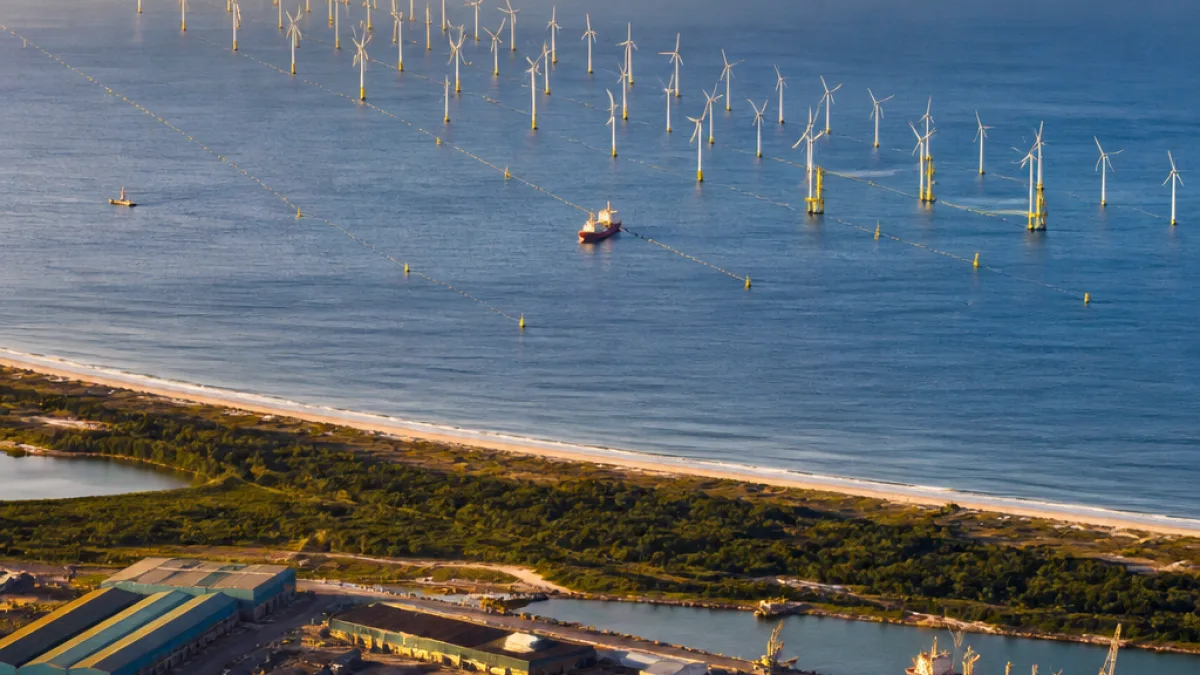
Project could start supplying power in about five years if approvals progress
The GenesisHexicon joint venture is pushing ahead with plans for the 810MW Gagasi offshore wind farm off the coast of Richards Bay, with preparatory work underway to resubmit environmental documentation, finalise a seabed lease and engage potential offtakers.
If timelines hold, construction could begin in 2030 and the project could be supplying electricity to the grid in about five years, the JV’s portfolio managers said. The development would comprise 54 turbines, with roughly 600MW from fixed‑bottom technology and the remainder from floating turbines.
The Gagasi site is planned as a rectangle running parallel to the shoreline, with the southern end opposite Richards Bay port. In the southern section the nearest turbines would be about 16km offshore and the furthest about 22km. The northern section lies closer to shore, with turbines roughly 5–6km to 10km from the coast.
| Section | Distance from shore |
|---|---|
| Southern | Approximately 16km to 22km |
| Northern | Approximately 5–6km to 10km |
| Planned turbines | 54 (about 600MW fixed‑bottom; remainder floating) |
GenesisHexicon has been developing Gagasi for about two years. The JV welcomed the government–World Bank Strategic Framework for Offshore Wind Development in South Africa, which quantified the country’s offshore wind opportunity at 95GW — a figure the JV says underscores the scale of the broader opportunity for power generation and investment.
“While it is clear that the seabed belongs to the South African government, various authorisations are required from several entities at national and provincial level,” said Benjamin King, one of the JV’s portfolio managers.
King and his colleague Madrè Delport said the team withdrew an earlier environmental scoping report to incorporate technological advances and are now preparing to resubmit. In parallel they are finalising the seabed lease agreement and talking to potential offtakers, signalling progress on three fronts that are central to unlocking the project.
However, the managers warned that regulatory and governance questions remain. Because Gagasi would be one of the first applications of its kind in South African waters, the roles and responsibilities of national and provincial bodies — and the sequence and timing of required approvals — still need to be clarified. That could add time to the consenting and permitting process, they said.
- Resubmission of environmental scoping report, to reflect technological changes
- Finalisation of seabed lease agreement with government
- Engagement with potential offtakers for power purchase arrangements
- Coordination with national and provincial authorities to clarify permitting roles
For Richards Bay and the surrounding coastal municipalities, the proposed location — with part of the array opposite the port — raises a set of practical considerations. These include marine spatial planning, navigational safety, fishing and ports interfaces, and the order in which different state authorities will consider licences and leases. The JV has said it is proceeding while engaging with the relevant agencies.
The mixture of fixed‑bottom and floating turbines reflects both waters‑depth considerations and recent technological advances in floating foundation design. While fixed‑bottom foundations are established for shallower offshore sites, floating turbines enable wind energy development in deeper waters closer to the continental shelf edge.
At a national level, the Strategic Framework’s estimate of 95GW of offshore wind potential has prompted renewed interest in accelerated permitting and clearer governance arrangements. For Richards Bay, a commercial port with existing heavy industry and mineral handling facilities, siting an offshore wind farm nearby could present opportunities for marine services, supply chains and secondary industry — but only if the consenting process and grid arrangements are resolved.
GenesisHexicon’s planned timetable is ambitious. The next 12–24 months will be critical for clearing regulatory uncertainties and securing seabed rights and offtake agreements. For residents and stakeholders in Richards Bay, the project signals longer‑term change on the horizon: a substantial wind farm located offshore that would contribute to South Africa’s renewable capacity if it clears the regulatory and commercial hurdles.
Local residents and businesses with interests in fishing, tourism, port operations and marine services will be watching the permits and environmental studies closely as the Gagasi proposal moves through the next phase.