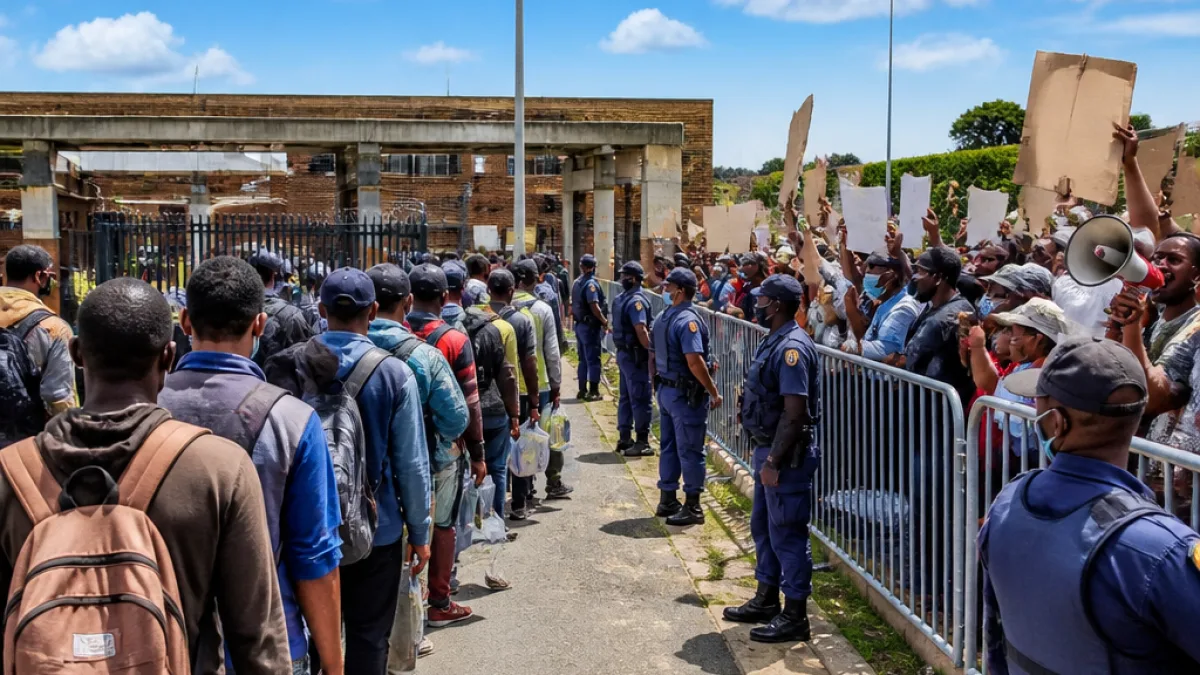
Tensions ran high on Wednesday outside the Department of Home Affairs’ Refugee Reception Centre in Durban, where a group of South African protesters gathered to demand an immediate halt to asylum application processing at the facility. The demonstration unfolded as hundreds of foreign nationals — mainly from Ethiopia, Somalia, Bangladesh and Pakistan — queued to submit claims following a Constitutional Court judgment earlier this year that reopened access to the asylum system.
Protesters call on court to reconsider ruling
March and March leader Jacinta Ngobese-Zuma joined the protest and urged the Constitutional Court to overturn its July judgment that effectively invalidated parts of the Refugees Act. Ngobese-Zuma told the crowd that the influx of mainly men seeking to legalise their stay was unacceptable and called on Home Affairs to press the court to revoke its decision.
“Right now, we are seeing thousands and thousands of men who are coming here because they want to legalise their stay in South Africa…If you want refugees then bring women and children. Today we want our voice to be heard,” the leader said, as reported by SABC News.
Demonstrators said they feared the country’s immigration laws would be ignored and expressed concern about the social and economic impact of a sudden increase in asylum applications. Organisers described their action as a bid to make their grievances heard by both Home Affairs and the judiciary.
Queues swell after court ruling; judges seek clarity
Home Affairs staff at the Durban reception centre have been processing large numbers of applicants since the Constitutional Court decision reopened the asylum process to new applicants. The centre saw queues dominated by men from the east and horn of Africa as well as South Asia.
Meanwhile, legal proceedings elsewhere continue to produce conflicting outcomes. Gauteng Judge President Aubrey Ledwaba has approached a Full Court seeking clarity on how courts should handle matters involving undocumented asylum seekers who are detained and facing deportation. SABC News reported that two Gauteng High Court judges reached opposing conclusions in separate matters: one ordered immediate release after an intention to seek asylum was expressed; another did not.
- Primary nationalities queued at Durban centre: Ethiopia, Somalia, Bangladesh, Pakistan.
- Protest leaders want the Constitutional Court ruling overturned and asylum processing halted.
- Judicial uncertainty persists: a Full Court review has been requested in Gauteng to harmonise approaches.
| Issue | Local impact |
|---|---|
| Increased asylum applications | Longer queues at the reception centre; pressure on local services |
| Public protests | Heightened tensions, potential for disruption in the vicinity of the centre |
| Judicial disagreement | Inconsistent detention and release decisions across courts |
The combination of large numbers at the reception centre and public demonstrations raises concerns about public order, service delivery and the safety of both applicants and residents in surrounding communities. City services and the Department of Home Affairs face the operational challenge of managing long queues while ensuring the safety and dignity of applicants.
Local residents and businesses close to the centre reported a heightened police presence and an anxious atmosphere, though SABC News did not report any large-scale violence at the time. The demonstration underscores the sensitivity of migration issues in Durban, a city that has long been a gateway for cross‑border movement and a home to diverse immigrant communities.
Legal observers say the outcome of the Full Court process in Gauteng could have immediate practical implications for detention and release procedures nationwide, including in KwaZulu‑Natal. Until judges produce a uniform approach, confusion will likely continue over how to handle detainees who express a desire to seek asylum.
For now, the Durban reception centre remains a focal point for competing pressures: a stretched public service implementing constitutional rights, and local residents demanding greater control over immigration in their communities. The Department of Home Affairs has not issued a public statement in response to the protest as of the latest reports.