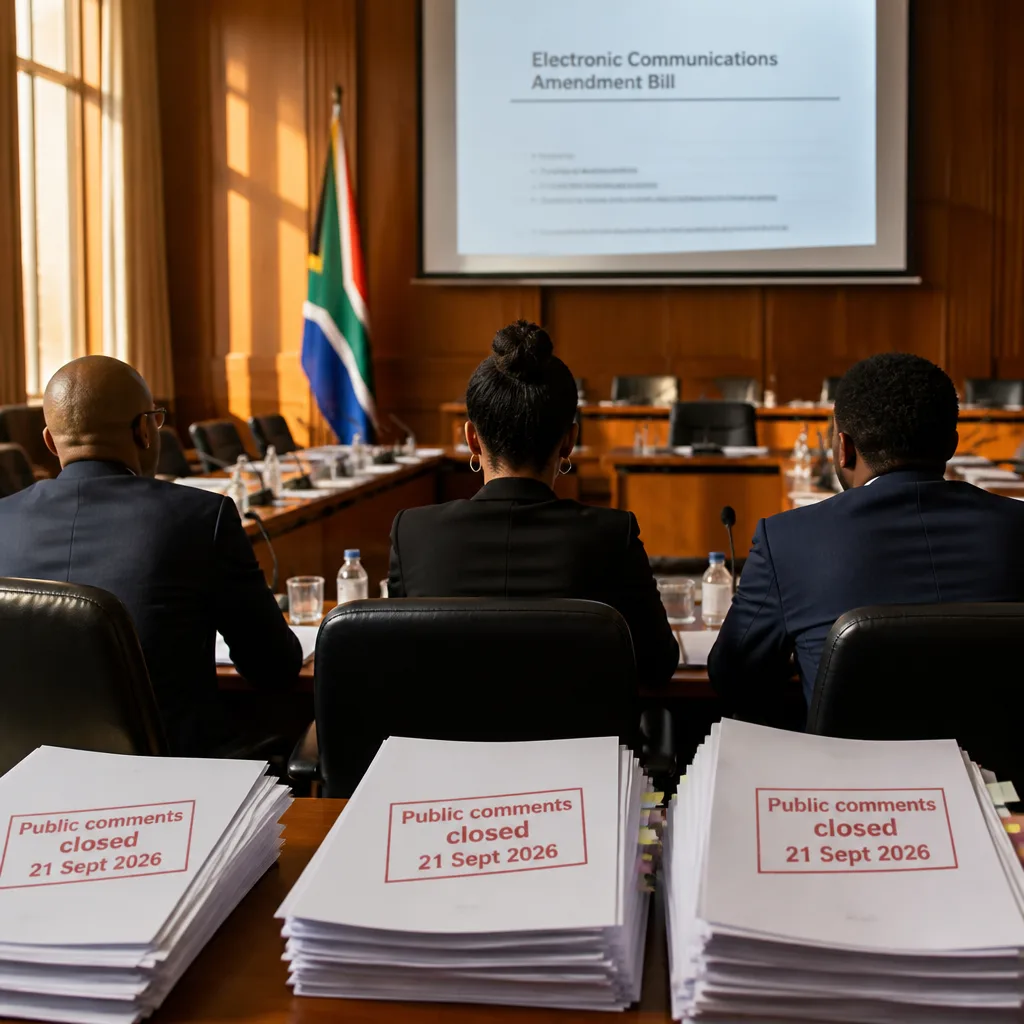
SpaceX, the company behind satellite internet service Starlink, is among the organisations that lodged submissions on South Africa’s proposed Electronic Communications Amendment Bill, the Portfolio Committee on Communications and Digital Technologies was told on Tuesday.
Starlink, licences and parliamentary scrutiny
Dr Jacob Medupe, the committee’s content adviser, presented a high-level summary of comments received after the public comment period closed on 21 September 2026. His presentation confirmed that SpaceX had engaged with the legislative process as Parliament prepares to consider amendments to the Electronic Communications Act, originally enacted in 2005.
The appearance of SpaceX among submitters amplifies an already fraught national debate. The company has been unable to obtain the licences required to roll out Starlink in South Africa. Elon Musk’s business has argued that ownership requirements in South African telecommunications law act as a barrier to its entry; government officials have countered that any operator is welcome provided it complies with empowerment and licensing rules.
Who else weighed in
Medupe’s summary listed a range of public and private sector stakeholders that also sent written comments to Parliament. They included major network operators, a provincial government, a national utility and civil society and sector organisations.
- MTN, Vodacom, Telkom and Cell C — South Africa’s incumbent mobile and fixed operators.
- Eskom — the national power utility.
- City of Cape Town — a metropolitan municipality.
- Helen Suzman Foundation — a public interest organisation.
- Progressive Blacks in ICT, Dynamic Spectrum Alliance, SABC — sector bodies and the public broadcaster.
Medupe did not indicate whether other large metros — including Johannesburg, Tshwane, Ekurhuleni and eThekwini — had submitted comments.
| Type of submitter | Examples named |
|---|---|
| Satellite/tech firm | SpaceX |
| Telecommunications operators | MTN, Vodacom, Telkom, Cell C |
| Public bodies | City of Cape Town, Eskom, SABC |
| Civil society / industry groups | Helen Suzman Foundation, Progressive Blacks in ICT, Dynamic Spectrum Alliance |
What is at stake
The proposed bill seeks to amend the framework that governs spectrum, licensing, ownership and the delivery of electronic communications. The contested points are both technical and political. On the one hand, government officials stress transformation objectives — ownership and empowerment rules intended to ensure historically disadvantaged South Africans benefit from the telecommunications sector’s growth. On the other hand, foreign entrants and some industry participants argue that current requirements can deter investment and delay rollout of services that could improve connectivity in underserved areas.
For households and small businesses, the outcome of this legislative process matters in practical terms: faster approval of new services could lower the cost of connectivity and expand access in rural areas; stricter controls could protect local participation but potentially slow market entry and keep prices higher for longer.
Key issues likely to feature as Parliament considers the submissions include:
- Spectrum allocation and licence eligibility rules;
- Requirements for local ownership and empowerment;
- How satellite-based services like Starlink are regulated compared with terrestrial networks;
- Implications for competition, pricing and rural broadband rollout.
Next steps and wider implications
Parliament must now consider the written submissions as the committee prepares to finalise recommendations on the Bill. The presence of SpaceX in the written record will increase scrutiny of how satellite internet services are treated under South African law and could complicate the balance legislators must strike between transformation imperatives and attracting foreign capital.
For consumers, the debate will determine whether and how quickly services such as Starlink can offer alternatives to terrestrial broadband — particularly where fixed-line or mobile coverage is weak. For incumbent operators, the amendments could affect competitive dynamics and investment strategies in the years ahead.
The parliamentary summary does not provide the content of SpaceX’s submission, nor does it disclose whether the company sought specific changes. The committee’s deliberations will be watched closely by industry, civil society and municipalities as they weigh the trade-offs between transformation, national regulation and the potential gains from expanded connectivity.
WE NEWS does not provide financial advice.