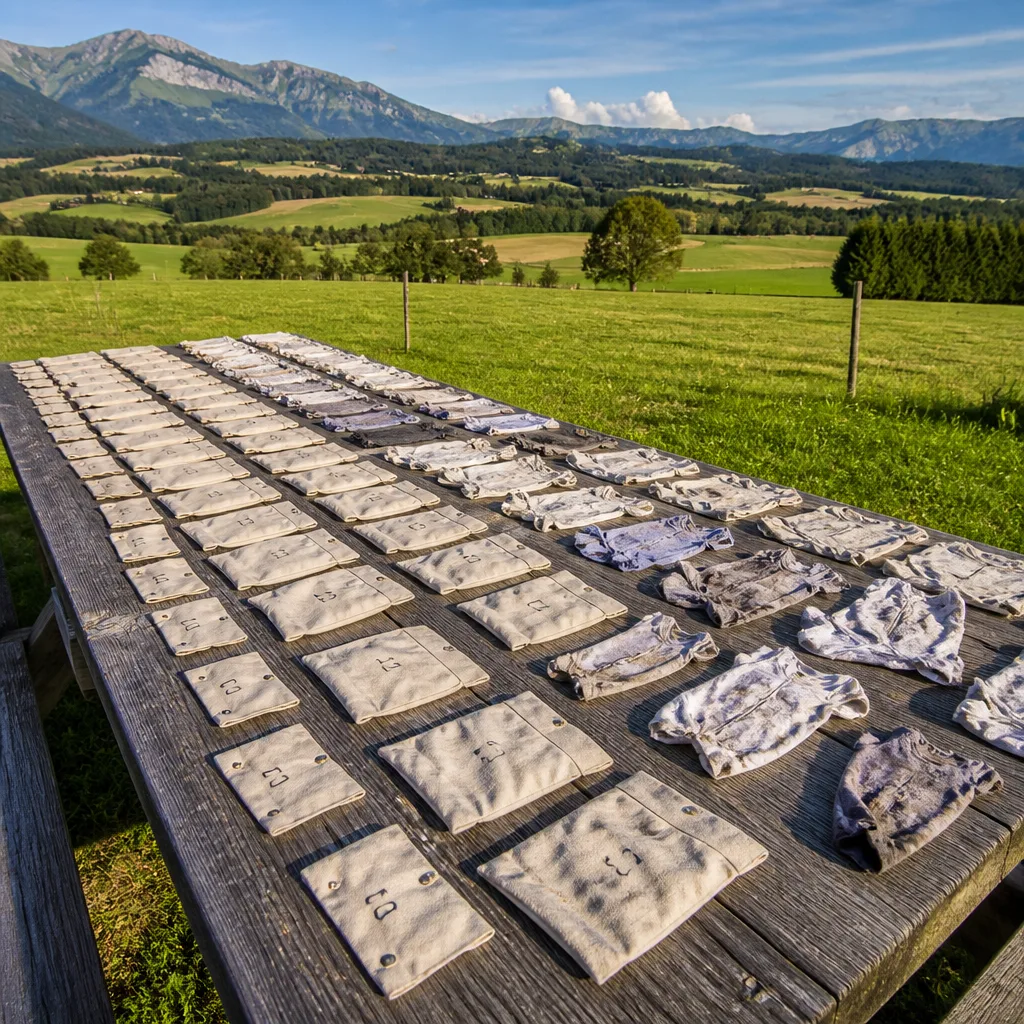
Scientists in Switzerland have buried more than 2,000 pairs of cotton underwear across gardens, meadows, fields and lawns to test how active soil ecosystems are at decomposing organic material. The research, published in the journal Plants, People, Planet and led by researchers at the University of Zurich with collaborators at Agroscope, used the visibility of decomposition as a simple proxy for soil biological activity.
Simple test, clear message
The project, named "Proof by Underpants", retrieved the garments after two months. Results ranged from underwear reduced to only seams to items displaying a few holes, and many with little change. The researchers argue that such variation is a striking and accessible way to show the public that many soils may be losing the biological vigour needed to sustain fertility.
"Overall, this project demonstrates that underpants can serve as a simple and easy-to-interpret tool, providing informative insights into the state of soils. Moreover, they are perfectly suited to raise attention in society for soil."
Agroecologist Franz Bender, one of the contributors described the hands-on study as both intense and rewarding. The group has proposed an Underpants Index — a public-facing metric that would score soils by how quickly and completely buried cotton decomposes.
Why decomposition matters
The scientific rationale rests on the role of soil organisms — bacteria, fungi, insects and other invertebrates — in breaking down organic matter. The faster and more complete the decomposition, the more active the soil food web and nutrient cycling. The authors frame the experiment within a larger, worrying context:
- Topsoil underpins 95% of global food production.
- Soils host about 59% of terrestrial biodiversity.
- The soil is the second-largest carbon reservoir after the oceans.
At a time when soils are experiencing widespread degradation, the researchers say the problem often receives insufficient public attention, limiting effective action for protection and restoration.
| Metric | Value (from study context) |
|---|---|
| Share of food produced from topsoil | 95% |
| Share of terrestrial biodiversity in soils | 59% |
| Relative carbon reservoir rank | Second (after oceans) |
What the findings imply
The study's central point is not the novelty of using underwear for theatre, but that a low rate of textile breakdown signals a lack of biological activity. That can indicate nutrient-poor, compacted or chemically degraded soils — conditions that reduce fertility, impair plant growth and weaken ecosystem resilience.
Because the experiment is visually arresting and easy to explain, the researchers propose the Underpants Index as a tool for science communication and rapid screening. They suggest it could mobilise public concern and encourage policymakers and land managers to prioritise soil health.
However, the authors are careful to present the underwear test as a complement — not a replacement — to established soil assessments such as chemical analyses, microbial biomass measures and physical structure surveys. The index is meant primarily as an outreach device and a simple indicator rather than a comprehensive diagnostic.
Relevance for South Africa
While the experiment took place in Switzerland, the message resonates globally. Healthy soils are central to agricultural productivity, biodiversity conservation and climate mitigation everywhere, including South Africa. The study highlights the need for accessible ways to alert the public and decision-makers about soil degradation and to promote restoration practices.
Practical steps to improve soil biological activity commonly include increasing organic matter inputs, reducing excessive tillage, maintaining ground cover, and diversifying crop rotations — measures already familiar to farmers and land managers. The Underpants Index offers a striking way to communicate why such practices matter.
As the authors note, raising public awareness is a necessary step towards stronger soil protection. The underwear experiment demonstrates that simple, memorable tools can help make a complex ecological problem tangible to a wider audience.