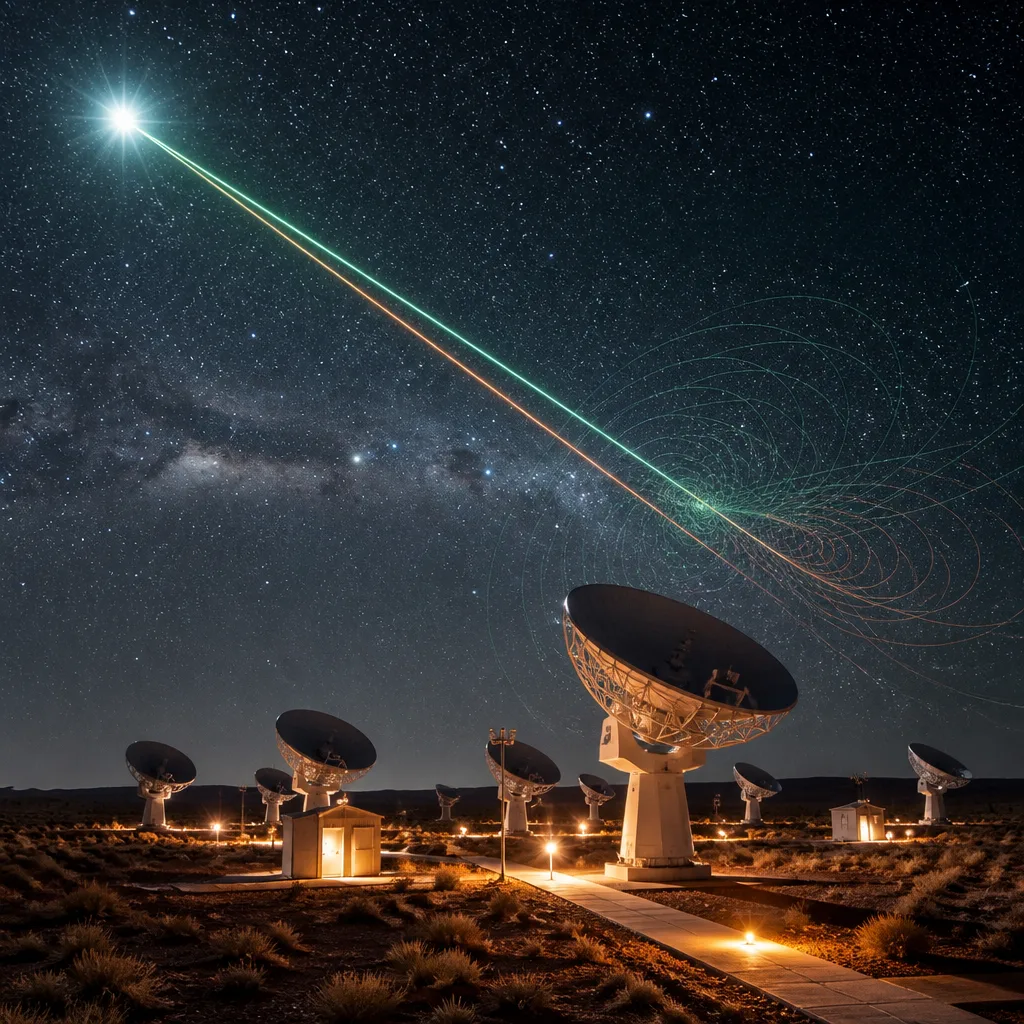
Observations of a distant magnetar may have captured the first signs that seemingly empty space changes how light travels, researchers report in a paper published in Nature. The result, led by a graduate student at George Washington University and involving the South African Radio Astronomy Observatory (SARAO), offers a possible observational test of a quantum effect first proposed by Werner Heisenberg in the 1930s.
What is vacuum birefringence?
Vacuum birefringence (VB) is a prediction from quantum electrodynamics that a perfect vacuum is not truly empty. Instead, it is expected to teem with transient or "virtual" particle–antiparticle pairs that pop into and out of existence. In extremely strong magnetic fields, these virtual particles should cause the vacuum to behave like a birefringent material — meaning it affects light’s polarisation depending on the direction of travel and the field. The effect is extremely small and has eluded laboratory detection because the magnetic fields required are far stronger than anything humans can produce on Earth.
Why magnetars?
Magnetars are a rare class of neutron star with magnetic fields among the strongest known in the Universe. Such intense fields provide a natural environment in which vacuum birefringence might become observable. The international team behind the new study used observations of one such magnetar to search for the polarisation signatures VB would imprint on light as it escapes the strong field.
The project brings together researchers from multiple institutions, including the Center for Space Sciences and Technology, SARAO, Los Alamos National Laboratory, NASA’s Marshall Space Flight Center, CRESST, and the Astrophysics Science Division at NASA Goddard, together with universities worldwide. The paper was led by Rachael E. Stewart, a graduate student in physics at George Washington University; Dr Marcus Lower of the Swinburne University of Technology helped lead the observations.
What the observations show — and what they do not
The team reports polarimetric measurements of light from the magnetar that are consistent with the changes expected from vacuum birefringence. If confirmed, the result would be the first observational evidence that the quantum vacuum can alter light’s polarisation in the way Heisenberg’s theory predicts.
It is important to be cautious. The paper describes evidence that may represent the first detection of VB; it does not claim an unequivocal, final confirmation. Astrophysical observations in extreme environments often carry complex systematic uncertainties, and alternative explanations must be explored and ruled out before the effect can be declared proven beyond reasonable doubt.
- Why the result matters: It opens a path to test quantum electrodynamics under magnetic fields unreachable on Earth.
- Why magnetars are useful: Their magnetic fields naturally reach the intensity needed to make vacuum effects observable.
- Why caution is needed: Observational complexities and possible astrophysical confounders mean further work is necessary to reach firm conclusions.
Broader implications
If subsequent observations and independent analyses corroborate the finding, the measurement would provide a new empirical window onto quantum field behaviour in extreme conditions. That matters both for fundamental physics — testing long‑standing theoretical predictions — and for astrophysics, because it improves our understanding of how light propagates in the magnetised environments around neutron stars.
SARAO’s involvement highlights the growing role of South African facilities and researchers in cutting‑edge astrophysical investigations. Instruments capable of precise polarimetry and international collaborations between ground‑based radio observatories and space agencies were essential to this study.
| Element | Detail |
|---|---|
| Predicted effect | Vacuum birefringence (quantum vacuum alters light polarisation) |
| Historic origin | Werner Heisenberg, c. 1930s |
| Target object | Magnetar (a highly magnetised neutron star) |
| Lead author | Rachael E. Stewart (George Washington University) |
| Key collaborators | SARAO, Los Alamos, NASA Marshall, CRESST, NASA Goddard, universities |
In short, the paper presents a promising observational step towards detecting a subtle quantum phenomenon in nature. The claim remains provisional: further observations, independent analyses and consideration of alternative astrophysical explanations will be needed before the scientific community accepts vacuum birefringence as definitively observed.
For now, the study emphasises how extreme astrophysical objects can act as natural laboratories for testing physical laws in regimes far beyond Earthly reach.