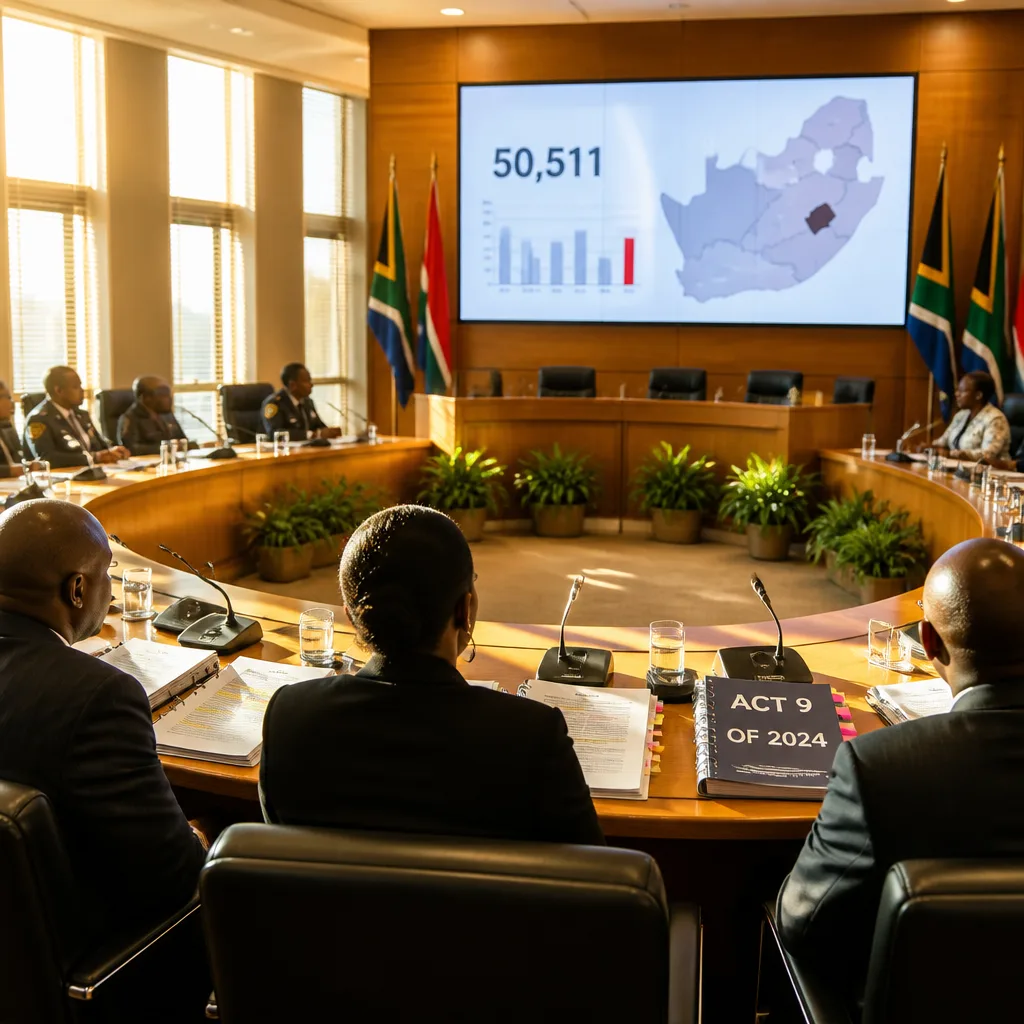
The statutory National Council on Gender-Based Violence and Femicide met for the first time in Pretoria on Monday to begin implementing a framework intended to co‑ordinate and oversee the government’s national response to gender‑based violence and femicide (GBVF).
Mandate, priorities and context
Established under the National Council on Gender‑Based Violence and Femicide Act 9 of 2024, the council’s inaugural sitting set immediate priorities that include developing a Shareholder Compact, drawing up a costing framework for the national GBVF response and strengthening governance and oversight of the national strategy.
“Our inaugural meeting today is mandated by the National Council on Gender‑Based Violence and Femicide Act 9 of 2024. By convening this morning, we have effectively set the long‑overdue ball rolling,”
The remark was made by the Minister in the Presidency responsible for Women, Youth and Persons with Disabilities, Sindisiwe Chikunga, who described the meeting as the start of the council’s work after sustained pressure from survivors, women’s organisations, civil society and other sectors for a permanent co‑ordinating body.
Magnitude of the problem
The council convened against a backdrop of alarming data on the prevalence of GBVF and police reporting for the most recent financial year. The Human Sciences Research Council’s first national prevalence study, published in November 2024, provided updated estimates of lifetime and intimate‑partner violence. Key findings cited at the meeting include:
- about 7.3 million women aged 18 and older have experienced physical violence in their lifetimes;
- more than 2.15 million women have experienced sexual violence;
- around 3.2 million women have suffered physical intimate‑partner violence;
- approximately 2.5 million men reported perpetrating physical intimate‑partner violence;
- women with disabilities experienced sexual violence by a lifetime partner at a rate of 14.6%, compared with 7.2% for women without disabilities.
Police figures for the 2025/26 financial year show that 50,511 GBVF cases were reported to the South African Police Service (SAPS). Of those, 30,736 resulted in arrests and/or were referred to the National Prosecuting Authority (NPA).
| Measure | Figure |
|---|---|
| GBVF cases reported to SAPS (2025/26) | 50,511 |
| Arrests/referrals to NPA | 30,736 |
What the council must deliver
At the outset the council faces a range of tasks that will shape how government and partners respond to GBVF in practical terms. These include:
- agreeing a Shareholder Compact that sets roles, responsibilities and accountability mechanisms across national and provincial stakeholders;
- developing a comprehensive costing framework to quantify resources required for prevention, victim support, policing and prosecutions;
- strengthening monitoring and oversight arrangements for the national GBVF strategy to ensure implementation and measure impact.
The council’s formation responds to commitments made at the 2018 Presidential Summit Against Gender‑Based Violence and Femicide and long‑standing calls for a permanent coordinating structure to replace ad hoc arrangements. The work ahead will require coordination across multiple departments, the justice system, civil society and community‑level actors.
By institutionalising oversight, the council aims to address financing shortfalls and accountability gaps that have been identified as obstacles to a sustained and co‑ordinated national response. Ministers and officials at the meeting underlined the need for evidence‑based planning, adequate resourcing and clearer performance measures to translate strategy into results for survivors.
How quickly the council can convert its priorities into concrete programmes, funding commitments and enforceable accountability mechanisms will be a key measure of its early effectiveness. The SAPS reporting and the HSRC prevalence figures presented at the inaugural meeting frame a large and complex challenge for the new body.