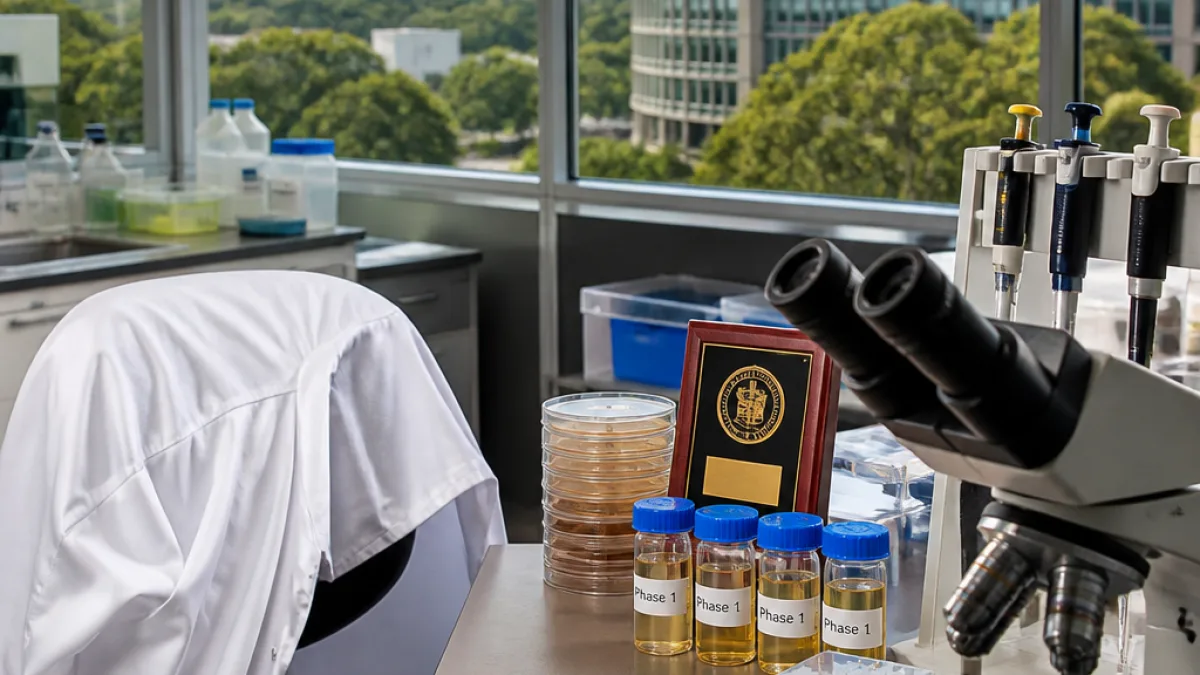
Durban — A chemistry-led approach to the country’s growing antimicrobial resistance problem has reached a major milestone: compounds developed at the University of KwaZulu‑Natal (UKZN) have entered Phase 1 human clinical trials, and the work has earned its lead scientist a national award.
Local lab idea moves into human studies
Professor Tricia Naicker, director of UKZN’s Catalysis and Peptide Research Unit, was recently presented with the Distinguished Young Woman Researcher Award at the 23rd South African Women in Science Awards in Johannesburg, News24 reported. The recognition comes as her team’s novel compounds begin first-in-human testing, an early but crucial step in clinical development focused on safety and dosing.
Naicker, who returned to South Africa after a postdoctoral fellowship in Denmark to build research capacity locally, told News24 she and her colleagues are pursuing a strategy that aims to protect and restore the activity of existing antibiotics rather than to replace them entirely.
“What excites me about our approach is that we are not necessarily trying to replace all of the antibiotics we already have. We are trying to find ways of protecting and restoring their activity. In simple terms, if we can stop the resistance mechanism from destroying an antibiotic, an antibiotic that has been around for years may become effective again,” said Naicker, according to News24.
Why this matters in South Africa
Antimicrobial resistance (AMR) allows bacteria to survive treatments that previously killed them. The consequence is infections that are harder to treat, require longer or more complex therapy, and incur greater costs for patients and the health system. Naicker highlighted this reality, saying AMR is particularly acute in South Africa and affects everyday infections clinicians manage.
“When antibiotics stop working, treatments become more complicated, more expensive and sometimes much more prolonged,” she said.
Moving a chemistry concept to Phase 1 trials is notable: these studies primarily evaluate safety, appropriate dosing ranges and how the human body processes a compound. Naicker emphasised that clinical development remains lengthy and that reaching this stage is one important step, not the end point.
Interdisciplinary approach and next steps
The research integrates chemistry, microbiology and clinical science: chemists design and prepare the molecules; microbiologists test how those molecules affect bacteria and resistance mechanisms; and clinical teams ultimately evaluate safety and pharmacology in people. News24 reported Naicker’s team follows this interdisciplinary path as their compounds proceed through early trials.
- Stage: Phase 1 clinical trials (safety, dosing, early pharmacology)
- Objective: Restore or protect the activity of existing antibiotics
- Institution: University of KwaZulu‑Natal, Catalysis and Peptide Research Unit
What this means for KZN and patients
For KwaZulu‑Natal, which hosts a large share of the country’s medical research infrastructure through universities and tertiary hospitals in Durban and Pietermaritzburg, the advancement of locally developed compounds into human testing underlines the province’s role in tackling national health challenges. The work also signals investment in research capacity: Naicker returned from abroad to establish and grow the lab that produced the compounds.
While the timeline to an approved treatment is long — most investigational agents that enter Phase 1 do not reach market — the strategy of preserving the utility of existing antibiotics could, if successful, extend the life of current therapies and reduce the immediate need for entirely new antibiotic classes.
Quick reference
| Fact | Detail |
|---|---|
| Research lead | Professor Tricia Naicker |
| Unit | Catalysis and Peptide Research Unit, UKZN |
| Award | Distinguished Young Woman Researcher, SAWiSA (23rd awards) |
| Development stage | Phase 1 clinical trials |
| Primary aim | Protect/restore activity of existing antibiotics |
News24 reported the award and the trial milestone. The university provided background on Naicker’s role and the focus of the research, while she reiterated the caution that clinical development is protracted even when early progress is promising.
As the trials proceed, clinicians, researchers and health planners in KwaZulu‑Natal will follow the outcomes closely. Any advance that can curb the damage of antimicrobial resistance would have broad implications for patients, hospitals and community health services across the province.
Reporting from Durban.