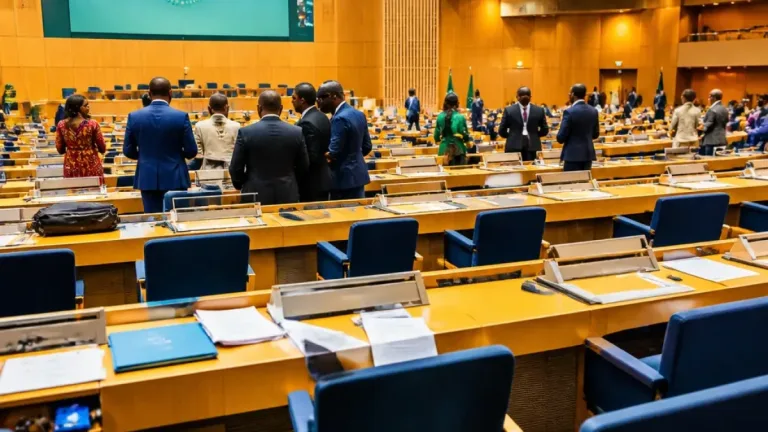
Artificial intelligence could allow human scientists to supervise an enormous number of automated researchers, fundamentally altering the way scientific work is organised and the cost of discovery, Anthropic co‑founder Jack Clark warned at the IMF‑World Bank Annual Meetings in Bangkok on 17 October.
From rising costs to a new scaling tool
Clark opened his Per Jacobsson Foundation Lecture, titled Inside the Event Horizon: Why Everyone Should Take AI Progress Seriously, by pointing to a familiar problem in science: as discoveries advance, each incremental idea typically costs more to find than the last. He cited evidence that, over decades, sustaining progress in semiconductors and drug development has required ever larger research efforts.
For example, Clark noted two long‑running trends often used to illustrate slowing research productivity: sustaining the historical doubling of chip density has taken roughly 18 times more researchers than in the early 1970s, and the number of new drugs approved per billion dollars of R&D has fallen by about half every nine years — a pattern sometimes called "Eroom's Law".
| Metric | Long‑term change cited |
|---|---|
| Chip research productivity | ~18× more researchers needed vs early 1970s |
| Drug approvals per $1bn R&D | Halved roughly every 9 years |
"A billion virtual scientists"
Clark argued that the principal remedy to rising costs has been to add more human researchers — an approach that is slow because training new scientists takes years. He suggested AI may change that arithmetic by enabling a dramatic scaling of labour through software copies of expert reasoning. Clark asked a rhetorical question that summarised his scenario:
"How would my work change if I could make copies of myself and order them to do work under my supervision?"
He went further, asking the audience — which he described as economists, bankers and policymakers — to imagine a world in which roughly 10 million human scientists could direct a billion virtual scientists or more. In that framing, progress could accelerate in areas that now slow because of scarce expert time.
Context and caveats
Clark presented his view as a forecast rather than an established fact. He described the possibility of rapid AI‑driven acceleration of science as the start of an event he labelled the singularity: a period when machine‑led scientific and technical advances outpace human ability to keep up. He also made his personal trajectory and qualifications plain: he covered data centres as a journalist, joined OpenAI in 2016 and later co‑founded Anthropic. The full text of his lecture was published in his Import AI newsletter two days after the speech.
It is important to distinguish between potential and current reality. Many parts of science already face rising marginal costs for new discoveries; that is well documented for semiconductors and pharmaceuticals. Whether AI will enable the kind of supervised multiplicative labour Clark described depends on progress in several technical areas — model reliability, task alignment, experimental automation and reproducibility — and on institutional responses such as funding, regulation and workforce planning.
- Scale: Clark imagines existing human scientists supervising orders of magnitude more automated agents.
- Speed: If realised, this could compress timelines for some research programmes but also create management and verification challenges.
- Policy implications: Governments and funders must weigh how to support safe, productive uses of AI in research while guarding scientific integrity.
Implications for South Africa
For South Africa — where investment in research capacity, training pipelines and laboratory infrastructure already competes with pressing social needs — the prospect of AI‑augmented scientific labour raises practical questions. If validated systems allow fewer humans to oversee more experiments, policy makers will need to consider whether to invest in computational infrastructure, data policy and skills development rather than expanding traditional laboratory headcount alone. Equally, scientific quality control and ethical oversight will remain central as automated agents take on more of the day‑to‑day work.
Clark’s lecture is a prompt for science ministries, universities and funders to plan for multiple possible futures: one in which AI is a transformative multiplier of research capacity, and others in which technical, institutional or safety constraints limit its impact. Clear evidence will emerge only with time and careful evaluation; for now, his warning is a call to prepare rather than a proof that a wholesale change has already occurred.