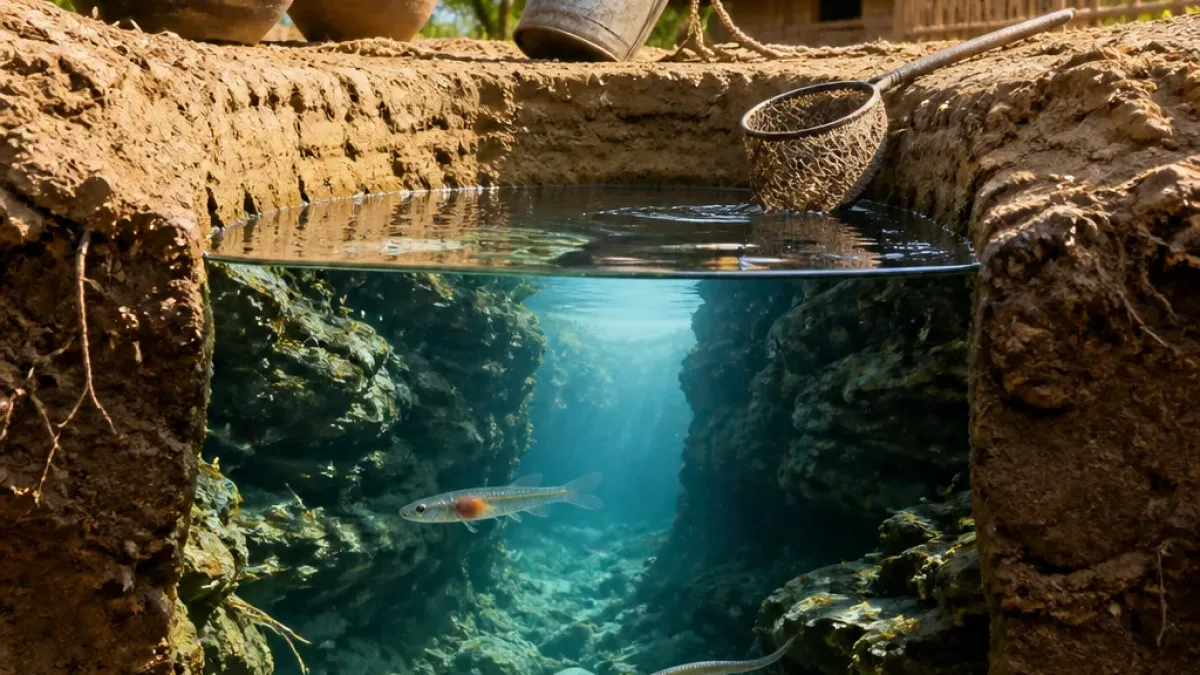
Two previously unknown subterranean fishes — a transparent, blind loach and a blind swamp eel — have been described from village wells in Assam, India, underscoring how little is known about groundwater ecosystems beneath populated areas.
Small discoveries, big implications
The loach, named Gitchak nakana, is around 2 cm long and so transparent that its blood and internal organs give it a striking red appearance. The eel, named Rakthamichthys anchi, is a much larger, slender species; the holotype measured about 310 mm.
Both species are blind and adapted to life below ground. They were collected from wells used by local communities, some of which are kept very clean and are used for drinking, the researchers report.
“This time I sent the picture to my supervisor and we brought a specimen to the lab,”
The quote above is from Wimarithy K. Marak, a resident of Goalpara district in Assam who encountered the loach as a child and again in 2021 after she became a researcher. She said villagers had initially treated the small pink creature as a worm; only later did she recognise it as a distinct fish and collect a specimen for scientific study.
How they were found
According to the reporting, the first specimen of Gitchak nakana was collected in March 2021. Further searches of neighbouring wells initially did not produce additional specimens, so researchers asked residents to report any unusual finds.
In May 2024 a relative of Marak, while cleaning and fully draining a well, discovered what looked like a worm; that specimen proved to be the eel Rakthamichthys anchi. The two species were formally described in papers published earlier this year.
What this tells us about groundwater biodiversity
Experts note that deeper groundwater systems in Assam and northeast India remain only partially mapped and are poorly understood beyond 200 m depth. The discoveries add to growing evidence that subterranean habitats harbour specialised fauna that can coexist with human water use.
Co-author Kangjam Velentia told the reporting that the exact localities were deliberately withheld from the publications because of concerns that revealing the sites might put the populations at risk.
Conservation and monitoring concerns
Researchers warn that impacts observed on surface water — such as pollution — percolate into groundwater and can affect subterranean species. Because the newly described fishes were found in wells used for drinking, their presence raises practical questions about how to balance human water needs with the protection of poorly known underground biodiversity.
Key points researchers emphasise include:
- The need to monitor groundwater habitats where human activity and wells intersect subterranean ecosystems.
- Understanding the pathways by which surface pollution reaches deeper aquifers and the species that depend on them.
- Maintaining careful site confidentiality where small, vulnerable populations are discovered to avoid disturbance.
| Species | Common description | Specimen size | Collection date |
|---|---|---|---|
| Gitchak nakana | Transparent, blind loach | ~2 cm | March 2021 |
| Rakthamichthys anchi | Transparent, blind swamp eel | ~310 mm (holotype) | May 2024 |
These findings emphasise that groundwater is not an empty, lifeless space but an ecosystem with specialised and often fragile species. Protecting such subterranean biodiversity requires routine monitoring of water quality, careful management of pollution sources and collaboration with local communities who use wells.
For South African readers and policy-makers, the Assam discoveries serve as a reminder that biodiversity can extend into the aquifers our communities depend on. Scientific attention to groundwater — mapping, monitoring and integrating ecological considerations into water-resource planning — is essential to safeguard both human health and little-known forms of life.