
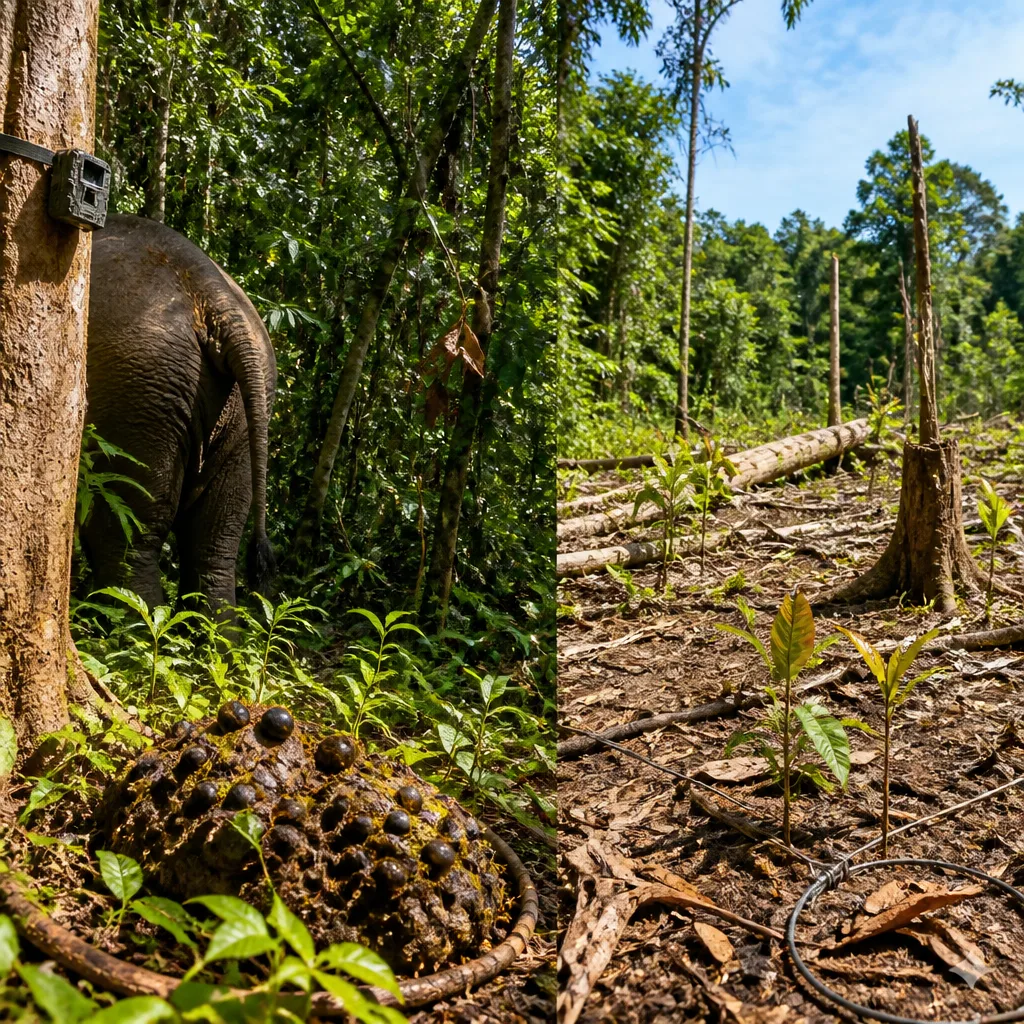
A nine-year study led by the UCLA Congo Basin Institute and published in Science Advances in 2025 has found that African forest elephants perform a dual role in the regeneration of West African ebony (Diospyros crassiflora) — they both disperse seeds over long distances and, unexpectedly, their dung protects seeds from predators. Across parts of the Congo Basin where elephants have been hunted out, researchers recorded 68% fewer ebony saplings than in areas with elephant populations.
Elephants as planters and protectors
The study combined field observations, experiments along a gradient of hunting pressure, and camera-trap footage at fruiting ebony trees. Researchers confirmed that forest elephants eat the fruit and carry seeds in their digestive tracts for kilometres before depositing them intact on the forest floor. That dispersal function, long suspected for many large-fruited forest trees, was expected. What surprised the team was the additional protective effect provided by the dung.
With the fleshy pulp digested and seeds subsequently buried or embedded in manure, small mammals and other seed predators have greater difficulty locating the seeds. The authors describe this relationship as a previously unrecognised mutualism — a two-way interaction that benefits both elephant and tree species.
“Practically no young saplings in the parts of the forest without elephants,”
The sentence above paraphrases the observation of lead author Vincent Deblauwe, a tropical forest ecologist associated with the institute, who told UCLA’s newsroom that the team had expected smaller geographic differences but instead found a stark absence of young ebony in hunted zones.
Why the effect matters
Two features of the finding make it consequential for long-term forest composition and the provision of ecosystem services. First, the study found a deficit of saplings, not adult trees. Mature ebony stands remain where they existed before intensive hunting, but without recruitment the population will age and decline over time. Second, forest elephants preferentially consume fruit from carbon-dense, slow-growing hardwoods — the same trees prized for heavy timber. That selective feeding and seed-protection behaviour suggests that the loss of elephants could bias future forests away from these high-carbon species.
- Duration of research: nine years.
- Study species: West African ebony (Diospyros crassiflora).
- Key quantitative result: 68% fewer young ebony saplings in areas without elephants.
- Methods: field experiments across hunting gradients and camera traps at fruiting trees.
The authors emphasise that because adult ebony remains, the absence of saplings is not immediately obvious to passers-by or loggers. That invisibility raises the risk of delayed, irreversible shifts in forest composition that may only become apparent decades from now.
Implications for conservation and forest management
From a policy perspective, the study strengthens the case that protecting large frugivores such as forest elephants is integral to safeguarding certain tree species and the services they deliver — for instance, carbon storage and the sustained availability of valuable hardwoods. It also suggests that conservation strategies focused solely on preventing tree cutting may miss a crucial biological process: natural regeneration mediated by animals.
The research indicates several practical points for forest managers and conservation planners to consider without prescribing specific interventions beyond the study's scope:
- Maintain or restore populations of large seed dispersers where possible, recognising their role beyond simply moving seeds.
- Monitor sapling recruitment, not only adult tree numbers, as an early indicator of regeneration health.
- Use camera-trap and exclosure experiments to understand local seed-predator dynamics and the protective function of dung in seed survival.
These findings are relevant across Central and West African forest landscapes and resonate with broader debates in ecological science about the cascading consequences of megafaunal loss. For South African readers and conservationists, the study is a timely reminder that animal–plant interactions can determine the long-term structure and economic values of forests, even when adult trees still stand.
| Metric | Study finding |
|---|---|
| Duration | 9 years |
| Sapling reduction where elephants absent | 68% |
The study adds to a growing body of evidence that conserving keystone animals is not only an ethical or aesthetic aim but a practical necessity for maintaining ecosystem functions. It also highlights how subtle ecosystem processes — for example, dung acting as a protective ‘armour’ for seeds — can be crucial for regeneration, yet easy to overlook in conventional forest surveys emphasising only tree counts and timber volumes.









