
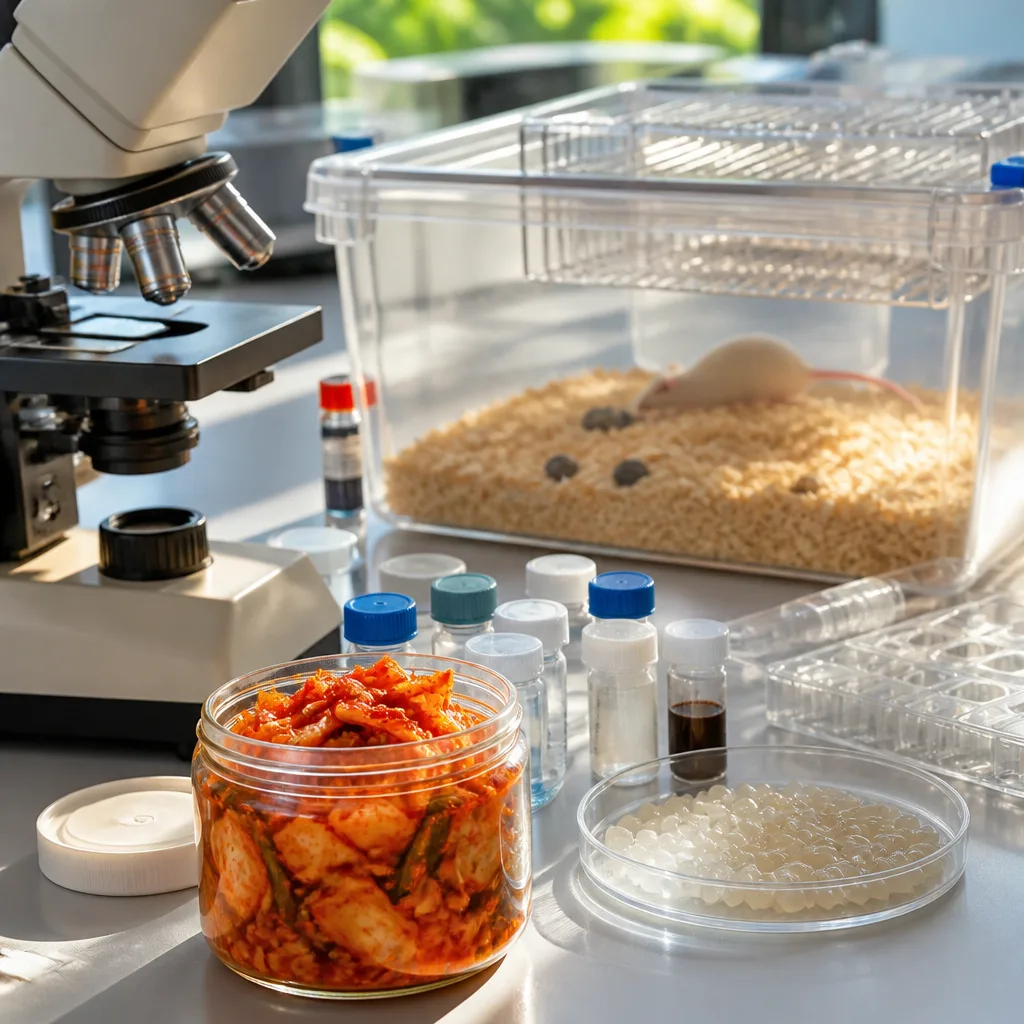
A lactic acid bacterium isolated from kimchi bound polystyrene nanoplastics under conditions that mimic the human gut and, in a germ‑free mouse model, more than doubled the amount of nanoplastics recovered in faeces, researchers at the World Institute of Kimchi (WiKim) have reported.
What the researchers did and found
The team led by Drs Se Hee Lee and Tae Woong Whon examined the ability of a kimchi‑derived strain, Leuconostoc mesenteroides CBA3656, to adsorb polystyrene nanoplastics (PS‑NPs). Nanoplastics are defined as plastic particles smaller than 1 micrometre (μm), produced when larger plastic items break down. Because of their minute size, these particles can enter the body through contaminated food and water and may cross the intestinal barrier, with the potential to accumulate in organs.
Under standard laboratory conditions the kimchi strain showed an adsorption efficiency of 87%, comparable to a reference lactic acid strain, Latilactobacillus sakei CBA3608, at 85%. Crucially, when the experiment was repeated under simulated human intestinal conditions the two strains diverged markedly.
| Strain | Adsorption in standard conditions | Adsorption under simulated intestinal conditions |
|---|---|---|
| L. mesenteroides CBA3656 | 87% | 57% |
| L. sakei CBA3608 (reference) | 85% | 3% |
The maintained binding capacity of CBA3656 in gut‑like conditions suggests it can stably attach to nanoplastics in the intestinal environment, unlike the reference strain whose adsorption fell sharply.
Animal results and what they mean
In germ‑free mice given the kimchi strain, both males and females showed more than a twofold increase in the amount of nanoplastics detected in faeces compared with mice that did not receive the probiotic. This outcome indicates the bacterium may assist excretion of nanoplastics by carrying or binding them within the gut, rather than allowing them to remain or cross into tissues.
These experiments provide initial evidence that certain microbes derived from fermented foods could interact with environmental micropollutants beyond their established role in food fermentation.
Limitations and context
While the results are promising, several important caveats apply. The experiments used polystyrene nanoplastics as a model particle and a germ‑free mouse system, which helps isolate interactions between one microbe and nanoplastics but does not reproduce the full complexity of the human gut microbiome. Human intestinal conditions are more variable and contain a diverse community of microbes, food residues and host factors that can influence both bacterial behaviour and particle fate.
Moreover, the study demonstrates a biological interaction and increased faecal recovery of nanoplastics in animals; it does not yet show reduced accumulation in organs, nor has it been tested in humans. Translating a laboratory or animal finding into a safe, effective human probiotic intervention requires further research, including studies that account for the existing microbiome, dosage, safety and long‑term effects.
- Key experimental findings: CBA3656 adsorbed 87% of PS‑NPs in vitro and retained 57% adsorption in gut‑like conditions.
- In vivo outcome: Administration of CBA3656 to germ‑free mice more than doubled nanoplastic recovery in faeces versus controls.
- Implication: Fermented‑food microbes may offer a biological route to reduce intestinal nanoplastic retention, but human relevance remains to be tested.
The research adds to growing attention on nanoplastics as an environmental and health concern and explores a biological mitigation strategy. Any prospective probiotic approach would need rigorous clinical assessment and regulatory review before being considered for human use.
Reporting of the findings was made by the World Institute of Kimchi, a government‑funded research institute under the Ministry of Science and ICT.









