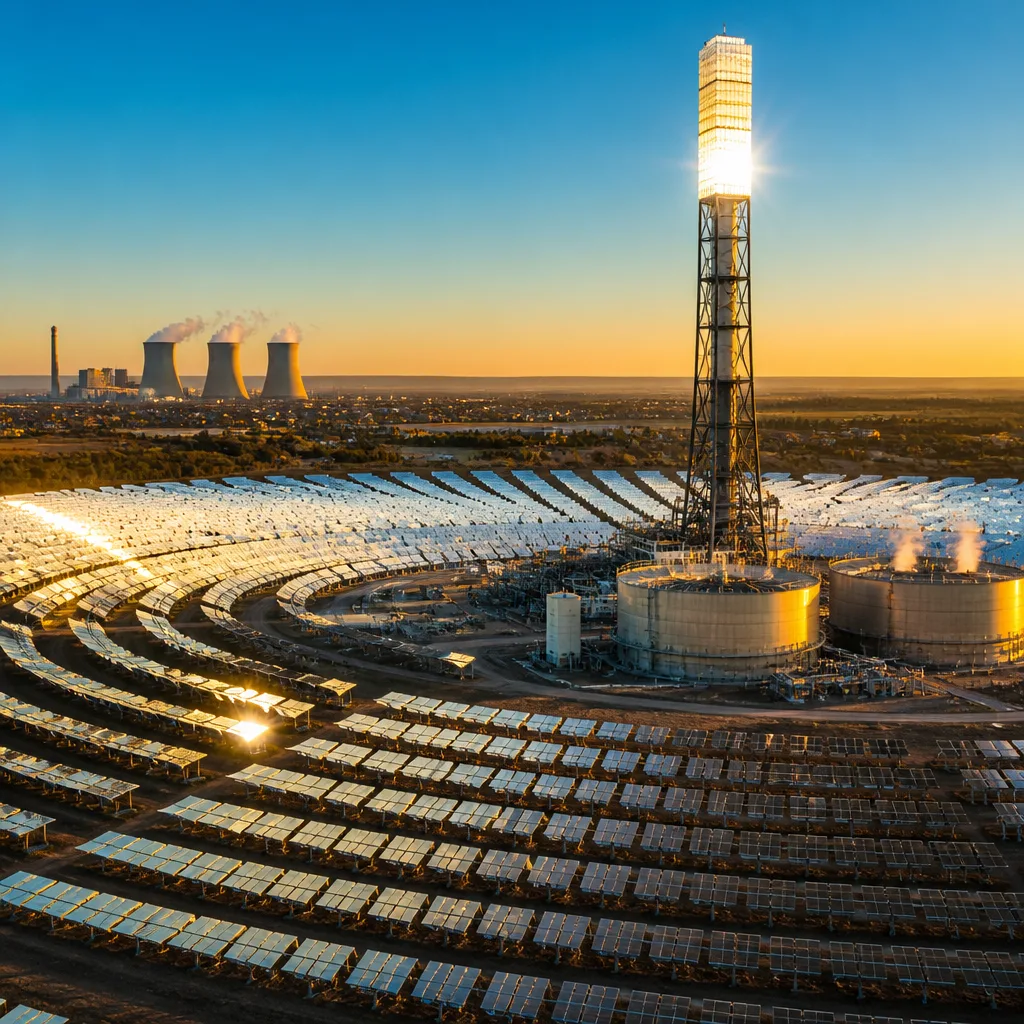
South Africa has the climate and direct sunlight to support concentrating solar power (CSP), yet the technology has been largely sidelined in national energy planning, according to reporting by energy researchers. CSP plants concentrate sunlight into heat that produces steam to drive turbines and can store thermal energy to generate electricity after sunset — a feature that could help replace retiring coal capacity.
Why CSP matters
There are two main ways of making electricity from the sun. Ordinary photovoltaic (PV) panels convert sunlight directly into electricity during daylight hours. Concentrating solar power uses mirrors to focus direct normal irradiance (DNI) into concentrated heat, which produces steam to turn turbines. Crucially, CSP systems can store that heat and supply electricity once the sun has set.
South Africa’s dry climate, clear skies and low cloud cover give it some of the world’s best DNI, the source reported, ranking it second only to Chile’s Atacama Desert. Despite that advantage, the country has not approved new CSP projects since 2014.
What has been built so far
Private companies built several CSP plants through the government’s renewable energy procurement programme. Together, these installations produce about 600 megawatts of electricity — enough to power roughly 350,000 to 400,000 average three‑bedroom homes each year, according to the source.
Yet the national energy plan has prioritised cheaper daytime PV generation, the reporting says, comparing costs of daytime-only solar with the higher upfront cost of CSP that also provides dispatchable, stored energy.
- Advantage of CSP: built‑in thermal storage that allows electricity generation after sunset, improving reliability.
- Advantage of PV: lower immediate cost per kilowatt-hour for daytime generation.
- South Africa’s position: excellent DNI, existing CSP capacity (~600 MW), but no new CSP approvals since 2014.
Policy and grid consequences
The focus on cheapest daytime kilowatt-hours in procurement decisions has, the reporting argues, undervalued the reliability that CSP can deliver. As South Africa faces the retirement of ageing coal plants and the ongoing challenge of matching supply with demand, technologies that provide predictable, dispatchable power — including through thermal storage — change the calculus for system planning.
Integrating CSP into the grid requires recognising its value beyond levelised cost comparisons that favour daytime PV. The source highlights research from Stellenbosch University’s Solar Thermal Energy Research Group modelling how CSP systems integrate with the national grid and assessing construction costs; the group’s perspective is that South Africa effectively abandoned a technology that is especially easy to connect to the grid and which supplies reliable power into the evening.
| Feature | Photovoltaic (PV) | Concentrating Solar Power (CSP) |
|---|---|---|
| Primary output | Daytime electricity | Heat converted to electricity; can be stored |
| Storage | Requires batteries (additional cost) | Thermal storage intrinsic to many designs |
| South Africa status | Widespread deployment | Existing ~600 MW; no new projects approved since 2014 |
What this means for ordinary electricity users
For households and businesses facing load‑shedding and an uncertain supply future, the policy choice between cheaper daytime power and more expensive but dispatchable technologies is material. CSP’s ability to generate into the evening could reduce reliance on fossil backup or batteries if deployed at scale. The source contends that placing too much weight on short‑term cost-per‑kilowatt-hour comparisons risks undervaluing system resilience.
The reporting suggests a reassessment of procurement criteria and planning assumptions could make better use of South Africa’s DNI advantage and existing expertise. As the country retires coal plants and seeks replacement capacity over the next two decades, the mix of technologies chosen now will shape how quickly and affordably reliable electricity returns.
Bottom line: South Africa has natural and research advantages for CSP, and existing capacity that demonstrates the technology’s potential — but national policy and procurement decisions have so far favoured cheaper daytime PV over dispatchable solar with built‑in storage.