
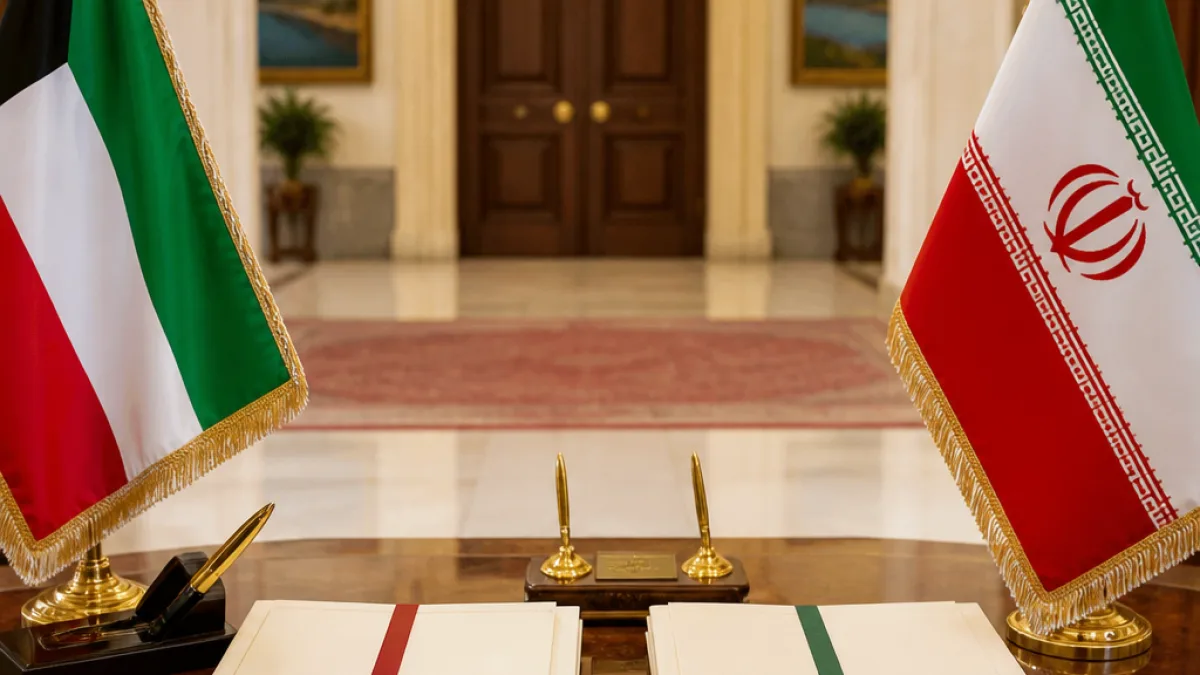
Kuwait summoned Iran’s ambassador on Wednesday and issued a formal protest after the Iranian embassy challenged a Kuwaiti court ruling involving three men convicted of collaborating with Iran and Lebanon’s Hezbollah.
Kuwait’s Foreign Ministry said Deputy Foreign Minister Hamad Suleiman Al-Mashaan called in Ambassador Mohammad Toutounchi over a statement issued by the Iranian embassy earlier in the day. The ministry described the statement as an unacceptable intrusion into Kuwait’s domestic affairs and said it threatened the sovereignty of the Gulf state and the independence of its courts.
The dispute follows a court decision on Monday in which three men were sentenced to death. They were convicted of working with Iran and Hezbollah and of plotting to assassinate senior Kuwaiti officials, including First Deputy Prime Minister and Interior Minister Sheikh Fahad Al-Yousef Al-Sabah.
A dispute over sovereignty and the courts
Kuwait said it would not accept outside pressure or intervention in judgments handed down by its courts. It urged Tehran to observe international law, the United Nations Charter and the 1961 Vienna Convention on Diplomatic Relations.
The Kuwaiti ministry placed particular emphasis on the diplomatic principles of good neighbourliness and non-interference in the affairs of other states. Its response framed the matter not only as a disagreement over the criminal case, but also as a question of how countries conduct themselves towards one another through official diplomatic channels.
“Kuwait strongly rejects any interference in rulings issued by its courts.”
Iran’s embassy rejected the allegations against its citizen and denied that the individual had taken part in a plan to kill Kuwaiti officials or threatened Kuwait’s national security. It said the person had not been in Kuwait for the past decade.
Iran rejects the allegations
In its statement, the embassy accused Kuwait of maintaining what it called a negative approach towards Iran. It referred to what it described as repeated and unfounded claims of Iranian involvement in Kuwaiti affairs, and said accusations against Iranian citizens breached international law and the principle of good neighbourliness.
Iran’s diplomatic mission also linked the dispute to wider regional tensions. Referring to military attacks by the United States and Israel on Iran, it called on countries in the region to pursue responsible policies aimed at preventing further escalation. The statement therefore combined a direct denial of the allegations with a broader warning about the consequences of rising tensions across the region.
| Issue | Kuwait’s position | Iran’s position |
|---|---|---|
| Court ruling | The convictions and sentences are matters for Kuwait’s judiciary. | The allegations involving an Iranian citizen are rejected. |
| Diplomatic conduct | Iran is accused of violating sovereignty and judicial independence. | Kuwait is accused of making false and repeated claims. |
| Regional security | Tehran should respect international diplomatic norms. | Regional governments should act to prevent further escalation. |
Regional implications
The confrontation remains centred on the court case and the exchange of official statements, but it touches on wider concerns about security, sovereignty and accountability in the Gulf. Kuwait’s decision to summon the ambassador indicates that the government regarded the embassy’s comments as serious enough to require a formal diplomatic response rather than a public rebuttal alone.
For Iran, the embassy’s denial seeks to distance the country and its citizen from the alleged plot while objecting to what it sees as a pattern of accusations. For Kuwait, the priority is to defend the authority of its judicial system and reject any suggestion that foreign governments may influence its court decisions.
- Kuwait summoned Iran’s ambassador and handed him a formal protest.
- Three men were sentenced to death after convictions linked to an alleged plot against Kuwaiti officials.
- Iran denied involvement by its citizen and called for measures to prevent wider regional escalation.
The competing positions leave the immediate diplomatic dispute unresolved. Kuwait has demanded respect for its sovereignty and courts, while Iran has maintained that the allegations are baseless. The next stage will depend on whether the two governments contain the disagreement through diplomatic channels or allow it to deepen existing tensions in the region.