
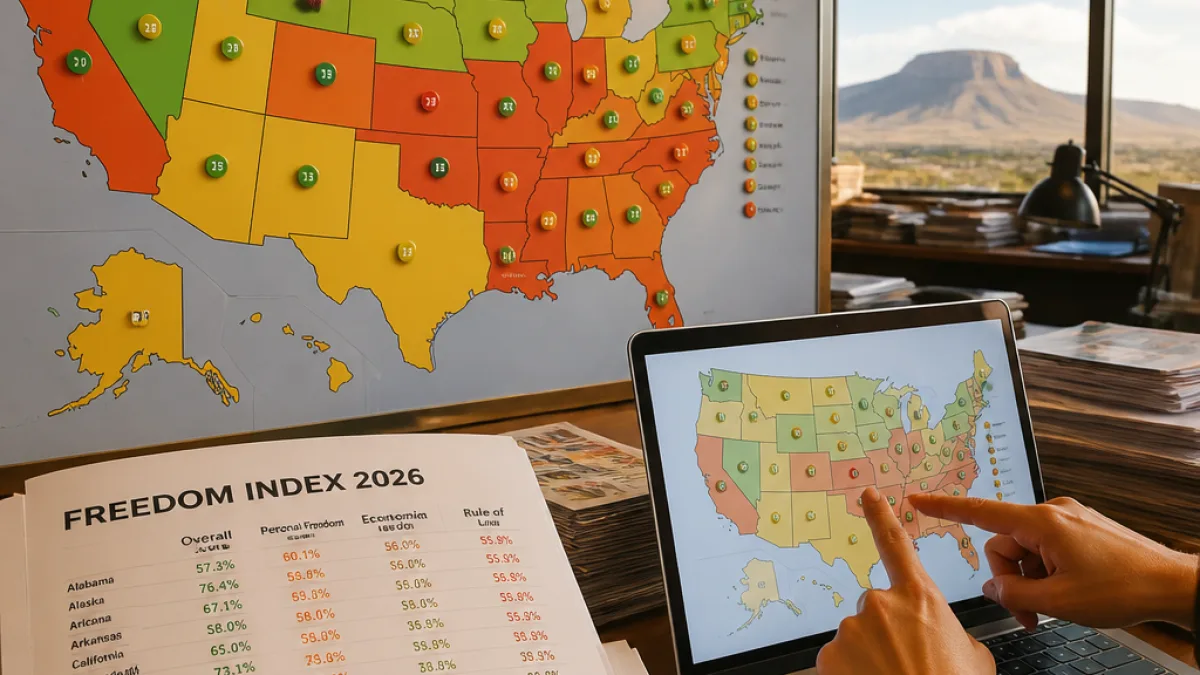
The Cato Institute has published an updated edition of its Freedom in the 50 States index for 2026, a comprehensive measure that combines 97 policy indicators across economic and personal freedom. The new release also introduces a novel element: grades for governors, designed to capture the direction of state-level policy under their leadership.
What the index measures
The index aggregates 97 separate policy measures into 10 categories split between economic and personal liberty. Each metric carries equal weight in the composite score, reflecting the report’s premise that different freedoms are of comparable public importance. This approach makes the index a broad gauge of the policy environment rather than a count of single-issue victories.
Key findings in the 2026 edition include an overall restraint in top-tier performance: according to the report, no state scored above roughly 76% in virtually any category. The only exception was Firearm Freedom, where eight states achieved perfect scores in the measures used by Cato.
"Not a single state scored better than 76 percent in almost any category (except for Firearm Freedom, eight states did score 100 percent in that)."
Governors now graded
For the first time the index assigns letter grades to governors for how they have advanced economic and personal freedom. The governor scores act less as a fixed judgement on state policy and more as an indicator of the direction in which a leader is steering their state. The report notes that a governor presiding over an already pro‑freedom status quo may receive a different evaluation than one attempting substantial reforms in a less permissive environment.
Context and implications
Because all metrics are equally weighted, strong performance in one area can offset restrictions elsewhere. This means a jurisdiction with strict rules in one domain could still post a healthy overall score if it is permissive across several other areas. The authors present the index as a tool to observe policy tendencies rather than a definitive moral ranking.
- Scope: 97 policy measures across 10 categories.
- New element: governor-level grades to reflect policy direction.
- Headline result: near-universal ceiling on category scores; few states approach full marks.
How to use the data
The institute has made the results accessible through an interactive Data Dashboard and maps, enabling deeper local or comparative analysis. The report’s authors say readers can drill into the component measures to see where particular states gain or lose points, and to examine the balance between economic and personal freedom in each jurisdiction.
What to watch next
The Cato team signalled more analysis to follow. The modelling and the new governor grades invite further scrutiny from policy analysts, political commentators and state-level officials who may wish to contest or emulate elements of the rankings. For readers in South Africa’s Free State and elsewhere, the report provides a useful comparative framework when thinking about the balance between regulation and liberty at sub‑national levels.
| Feature | Notes |
|---|---|
| Measures | 97 policy indicators across 10 categories |
| New addition | Governor grades |
| Top scoring category | Firearm Freedom (eight states scored 100%) |
| Overall ceiling | No state scored better than ~76% in most categories |
The index is both a snapshot and a conversation starter: it quantifies where states stand on a broad range of policies, then invites stakeholders to debate whether those policies advance collective objectives. Observers should treat the governor grades as directional indicators rather than definitive endorsements or rebukes. The Cato team has promised further commentary and deeper dives into the dataset in coming weeks.
Reporting based on the Cato Institute’s 2026 Freedom in the 50 States release and accompanying data tools.