
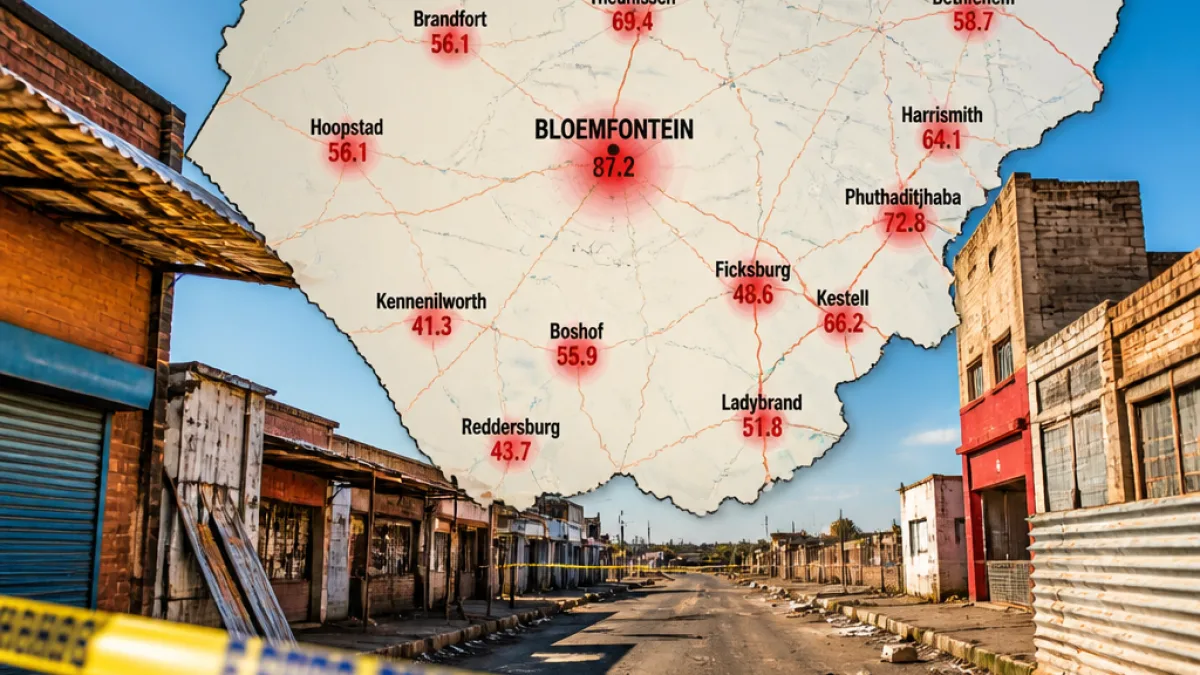
The Free State faces a sustained and worsening crime challenge that threatens both community safety and economic prospects, according to the 2050 Free State Vision report. Violent crime — particularly murder, sexual offences and stock theft — remains concentrated in specific municipalities, placing pressure on families, local businesses and public services.
Where the violence is worst
The report highlights exceptionally high murder rates in parts of the province. In some municipalities the rate exceeds 40 murders per 100,000 people. The worst-affected areas listed in the report are:
- Matjhabeng: 52 murders per 100,000
- Masilonyana: 48 murders per 100,000
- Mangaung: 46 murders per 100,000
Sexual offences are also alarmingly high across the province. The report gives a provincial average of 145 sexual-offence incidents per 100,000 people, with Masilonyana recording a rate of 259 per 100,000, well above the provincial norm.
| Municipality | Murder rate (per 100,000) | Sexual offences (per 100,000) |
|---|---|---|
| Matjhabeng | 52 | — |
| Masilonyana | 48 | 259 |
| Mangaung | 46 | — |
Impact on communities and the economy
High levels of violent crime and gender-based violence (GBV) have immediate social consequences: loss of life, trauma for survivors and families, and greater demand on health and social services. Economically, persistent insecurity suppresses investment, reduces tourism and raises the cost of doing business as firms factor security into operating expenses.
Rural areas also suffer: stock theft undermines farmer livelihoods and food security, while high crime in towns drives households and small enterprises to relocate or withdraw from formal economic activity. The report warns that unless violence is reduced, broader development goals for the province will be harder to achieve.
Government and civic responses
Provincial authorities are taking a mix of awareness, support and law-enforcement measures. Free State Treasury MEC Ketso Makume led a gender-based violence and femicide (GBVF) awareness campaign at Naval Hill in Bloemfontein on behalf of Premier MaQueen Letsoha-Mathae. The campaign included a public pledge against violence directed at women and children.
"The handling of rape complaints has improved," the report says, adding that there is greater awareness among male police officers regarding the sensitivity required when assisting survivors.
Social development officials have been working to ensure survivors know where to seek assistance after an attack and to improve public information about reporting procedures and available support services. Civil society also remains active: more than 200 men, including organised bikers, gathered at Hoffman Square in Bloemfontein on 27 September to join initiatives against GBVF. Participants included the Free State social development MEC, a local pastor and the Red Cross Free State.
- Awareness campaigns led by provincial officials to reduce GBVF
- Efforts to improve police handling of rape complaints and survivor support
- Community mobilisation events involving religious leaders, NGOs and local groups
What this means for residents
For residents, the data underlines the importance of knowing where and how to access support following violent incidents. Provincial departments and partner organisations are expected to publish contact details and referral pathways for survivors; victims should be encouraged to report to their nearest police station and seek medical and psychosocial assistance promptly.
Local business owners and farmers must also factor security into their planning. Where stock theft is a concern, farmers can work with police and agricultural unions on prevention strategies, while small businesses can seek local business-community security forums for co‑ordinated responses.
Room for improvement
The report stresses that recorded improvements in how rape complaints are handled are a positive step but not an endpoint. Better policing, faster investigations, improved forensic capacity and stronger community-police partnerships are among measures that experts say will be necessary to drive down the high rates reported in several municipalities.
As the province moves toward longer-term development targets, reducing violent crime and bolstering victim support are likely to remain central priorities for government, civil society and affected communities.
Reporting and support contacts are typically available from the provincial social development office, local SAPS stations and the South African National Council on Alcoholism and Drug Dependence (SANCA) and Red Cross branches. Residents should check official provincial communications for up-to-date referral information.














