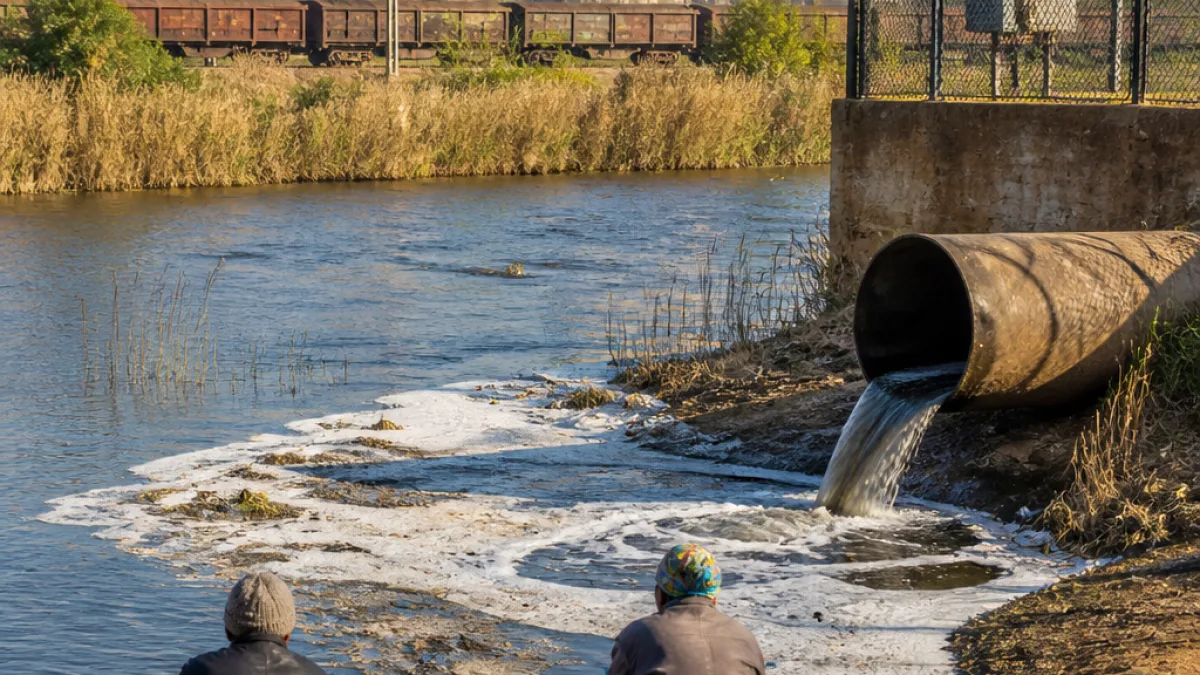
Kroonstad, one of the Free State's largest towns and a key agricultural and rail junction, is facing renewed scrutiny after auditors identified problems at the town's wastewater treatment works that have coincided with raw sewage reaching local rivers.
What the auditors found
The Auditor‑General of South Africa (AGSA) has recorded four material irregularity findings for the Moqhaka local municipality — which includes Kroonstad and Viljoenskroon — since 2019. One of the findings, issued in June 2026, specifically concerned the wastewater treatment facilities serving Kroonstad and Viljoenskroon.
The AGSA finding forms part of a broader picture of persistent financial and service delivery challenges facing the municipality, which, according to the report, serves an estimated population of about 155,000 people across more than 58,000 households.
Local impact: health, environment and livelihoods
Raw sewage spilling into rivers presents immediate risks to public health and to downstream users who rely on river water for farming and informal uses. The area around Kroonstad is an important agricultural zone where crops such as maize and wheat are produced and where several farms and game reserves support both livelihoods and tourism.
While the AGSA report focuses on financial and governance failings, the consequences are tangible: ecosystems and recreational areas around dams such as Bloemhoek and Serfontein, and access to safe water for households and farms, can be affected when wastewater infrastructure fails.
Why Kroonstad matters
Kroonstad sits north of Bloemfontein, acting as a transport junction on the rail corridor linking Cape Town, Johannesburg and Durban. It is also among the Free State’s more industrialised towns and functions as a regional centre for manufacturing, logistics and agriculture. Infrastructure failures in such a node therefore have wider knock‑on effects for supply chains and regional economic activity.
What the municipality has faced
The AGSA’s repeated findings point to systemic governance and financial control problems within the larger Moqhaka municipality. Material irregularities are formal findings by the auditor that indicate significant departures from financial management and procurement rules — matters that require corrective action and can result in further oversight or investigations.
Residents have, over the years, reported interruptions to basic services and concerns about the condition of municipal infrastructure. The wastewater treatment works finding in June 2026 is the latest in a series of red flags that raise questions about maintenance, budgeting and the municipality’s ability to deliver core services.
Immediate questions for local leaders
- What remedial steps will Moqhaka municipality implement to stop sewage entering rivers?
- Has the municipality applied for emergency funding or technical support to restore the wastewater works?
- What monitoring and testing are in place to assess water quality for downstream users?
These are matters the public expects the municipal leadership and the Free State provincial government to clarify promptly. The AGSA finding requires that detected irregularities be addressed and that progress be reported.
Context: community amenities and tourism at risk
Beyond risks to health and agriculture, failing wastewater systems can affect tourism assets near Kroonstad, including game farms and lodges that depend on natural water resources. Areas around the Bloemhoek and Serfontein dams are used for recreation and camping and could be impacted by contamination.
| Item | Detail |
|---|---|
| AGSA material irregularity findings since 2019 | 4 (including one in June 2026 concerning wastewater works) |
| Estimated population (AGSA) | ~155,000 |
| Households (AGSA) | ~58,000 |
What residents should know and do
Households downstream of wastewater works should avoid direct contact with discoloured or odorous water and not use it for drinking, food preparation or washing. Boiling such water does not remove chemical contaminants, so where municipal water is compromised, alternative safe water sources should be sought and authorities notified.
Civic organisations and community leaders can press the municipality and the provincial government for timely public updates on remedial work, water‑quality test results and planned investments in the wastewater system.
The AGSA finding is a procedural trigger: it obliges the municipality to respond and to take corrective measures. The scale of those measures, and the speed with which they are implemented, will determine whether Kroonstad’s rivers and downstream users can be protected and whether confidence in municipal service delivery can be restored.
Tebogo Motaung
Free State correspondent, reporting from Bloemfontein.