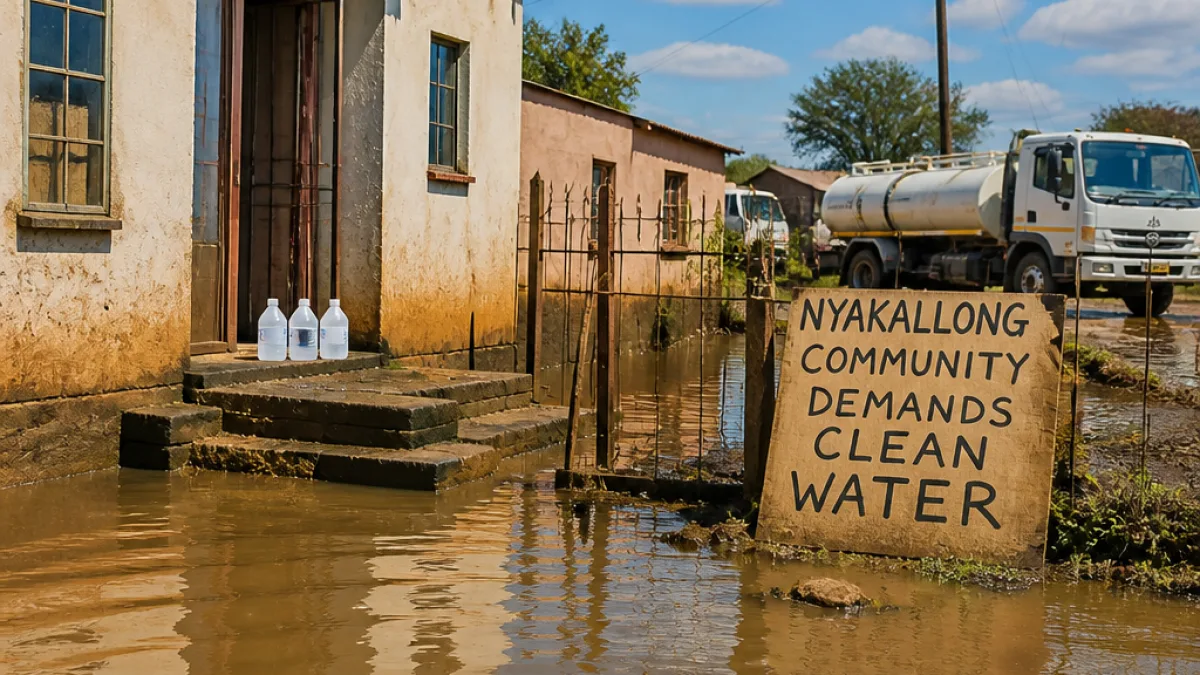
NYAKALLONG, Free State — For more than three years residents of Nyakallong have been living with what they describe as poisoned water and raw sewage flooding yards and homes after mining discharge overwhelmed local infrastructure.
Daily life flooded by sewage and contaminated water
Sixty-eight-year-old Mmathabo Mabaso has watched her house and health decline since 2022, when water from nearby mining operations was pumped into the Voëlpan Dam — known locally as the “stinkpan”. The inflow, residents say, eventually flooded a sewerage pumping system and sewage began to back up into yards and houses.
Houses in affected streets are waterlogged and many residents report persistent headaches, breathing difficulties and aggravated asthma. Mabaso said her home — which she built with her savings — is now unfit for living and that her furniture is ruined by damp and foul water.
“When it rains heavily, the entire house is flooded with foul-smelling water. No one should live like this. We are just waiting to die here,”
She also blamed the mining industry for long-term harms: her husband, she said, died in 2018 from silicosis contracted while working for Harmony Gold.
Investigations and court findings
The crisis has attracted formal scrutiny. The South African Human Rights Commission (SAHRC) has investigated conditions in the area, and the Free State High Court in Bloemfontein has issued a ruling against Matjhabeng local municipality related to the situation.
Independent testing by a community monitoring team and the Bench Marks Foundation in 2024 found elevated concentrations of arsenic, lead, copper, silicon and uranium in samples taken from the area, and concluded that water from Harmony Gold’s target mine contained total dissolved solids in high quantities, which the report said are dangerous to humans.
What residents say about responsibility
Residents interviewed for the reporting described repeated attempts to get relief from municipal authorities and the mine, but say those efforts have produced few practical results. They say pumps and sewerage systems remain vulnerable and that flooding events continue to trigger sewage overflows.
- Immediate impacts: raw sewage in yards and homes, damaged property, respiratory symptoms among residents.
- Contaminants detected: arsenic, lead, copper, silicon, uranium, and high total dissolved solids in mine-related water, according to the 2024 tests.
- Official action: SAHRC investigation and a Free State High Court ruling against Matjhabeng municipality.
Health and environmental concerns
The 2024 findings by community monitors and the Bench Marks Foundation raised concerns about possible health risks from exposure to multiple contaminants and from prolonged contact with highly mineralised mine water. Those findings have been repeatedly cited by residents demanding urgent remediation and long-term solutions.
| Detected substance | Noted in 2024 testing |
|---|---|
| Arsenic | Reported presence |
| Lead | Reported presence |
| Copper | Reported presence |
| Silicon | Reported presence |
| Uranium | Reported presence |
| Total dissolved solids | Recorded in high quantities |
The Bench Marks Foundation report and community testing do not appear to have led to full remedial action accepted by residents. The High Court ruling against Matjhabeng suggests legal recognition of municipal failings, but residents say the on-the-ground reality has not improved.
Practical consequences and questions for authorities
For households such as Mabaso’s the consequences are immediate: unusable outdoor space, damp interiors and ongoing health complaints. For the wider area there are questions about drinking-water safety, the integrity of sewerage systems and the responsibility of mining companies and municipal authorities to prevent contamination and to restore safe conditions.
Residents and civil society monitoring groups have called for:
- Immediate containment and clean-up of contaminated water and sewage;
- Transparent, regular water quality testing made public to show where risks remain;
- Clear remediation plans from Matjhabeng municipality and Harmony Gold, with timelines and independent oversight.
The situation in Nyakallong sits at the intersection of mining impacts, municipal service failure and public health. The SAHRC investigation and the Free State High Court ruling provide formal recognition of the problem; residents say they now need urgent, practical action to make their homes safe.
Requests for comment were made to Matjhabeng municipality and Harmony Gold in prior reporting; their positions are recorded in public statements and court filings cited in the original community and media reports. Continued monitoring by independent groups and oversight bodies will be required to track whether legal and investigative findings translate into repairs and relief for residents.
Where to seek help: Community members who believe their water is contaminated should document symptoms and property damage, retain test results if available, and approach local clinics for health advice. Legal remedies may be available following court findings; community organisations and the SAHRC can provide direction on next steps.