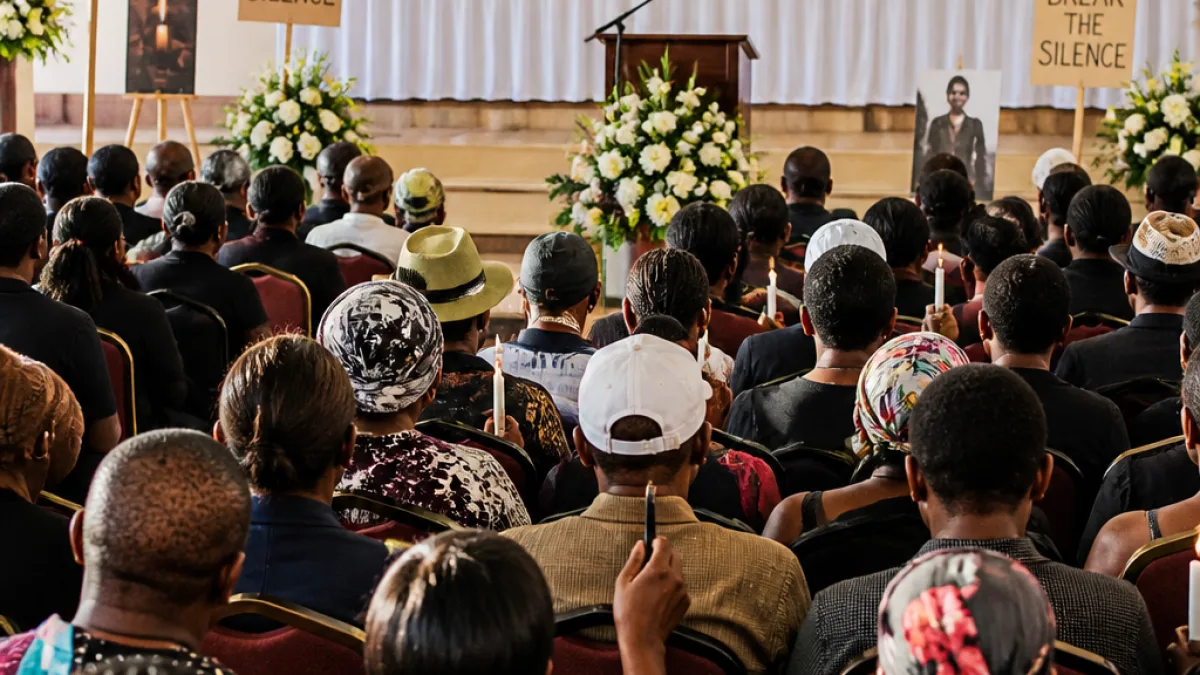
SPRINGS — Gauteng Health MEC Faith Mazibuko used the platform of a local funeral on Tuesday to plead for communities to confront gender‑based violence head on, urging women to stop suffering in silence and calling on men to actively protect women and children.
Shock and solidarity at a funeral
Mazibuko delivered her appeal during the memorial service for Dineo Motapane, one of nine women recently murdered in the Ekurhuleni metro, according to the provincial official. Her remarks framed the killings as a collective failure that requires a community response.
"Let us break the silence. Stand up against abuse. Talk about abuse. Stand up as women. Talk to one another. Let's encourage one another,"
She also made a direct appeal to men: "We call upon all men now. Stand up, madoda sabelani. It can't be right that women are dying in front of you or in your hands. You can't abuse a woman. You can't abuse a child. Women's lives matter. Women's rights are human rights."
From words to community action
Mazibuko framed the statement as a communal responsibility: she urged women to support one another and for men to refuse to tolerate abuse in their homes and neighbourhoods. At the funeral, the call for mutual vigilance echoed among mourners who described a sense of exhaustion and a need for practical measures to protect vulnerable people.
The MEC's comments place fresh focus on Ekurhuleni, where the recent spate of killings has shaken communities and drawn attention to the persistent problem of violence against women in the province. While her remarks were moral and rhetorical in tone, they also underline a gap between public exhortation and effective protection for at‑risk women.
Community response and next steps
Residents spoken to after the service said they welcomed the provincial attention but want concrete interventions: faster police responses, better support at clinics and community‑based protection measures for survivors of domestic abuse. Faith leaders and local activists said they would press for stronger coordination between government departments, community organisations and the police.
- Community vigilance: Encourage neighbours to report suspected abuse and to check on vulnerable households.
- Peer support: Women are urged to talk openly about abuse and to share information about safe spaces and legal remedies.
- Male accountability: Men are called on to intervene where they see violence and to support survivors.
Police statistics or a coordinated provincial response plan were not detailed at the funeral. Mazibuko's call is likely to increase pressure on provincial safety and social development structures to produce measurable short‑term actions.
Context: a province grappling with gender‑based violence
Gauteng has seen high levels of gender‑based violence for years, with civil society repeatedly urging government to act more decisively. The MEC's remarks at Motapane's funeral bring public attention back to those demands and underline the need for both immediate and long‑term responses to protect women and children.
| Issue | Detail |
|---|---|
| Recent murders in Ekurhuleni | 9 women (as referenced by the MEC) |
| Public call | Women to "break the silence"; men to intervene and protect |
The funeral setting sharpened the immediacy of Mazibuko's message: this was not a speech delivered in a conference hall but a plea made at a graveside to people who knew the victim and feared for their own safety. That proximity, activists say, can generate powerful local momentum if it is followed by organised action.
For survivors and families, words alone are not enough. Local organisations and residents told reporters they want clear, resourced plans — from improved police follow‑up to expanded counselling and survivor support at health facilities. The MEC's speech signals a political willingness to name the problem; community leaders will now watch for substantive follow‑through.
As Ekurhuleni mourns more women, the province faces a test: whether public appeals will translate into accessible services, faster investigations and stronger community protection. Until those changes appear, many will continue to fear that calls to "break the silence" remain an insufficient response to a crisis playing out in neighbourhoods across Gauteng.