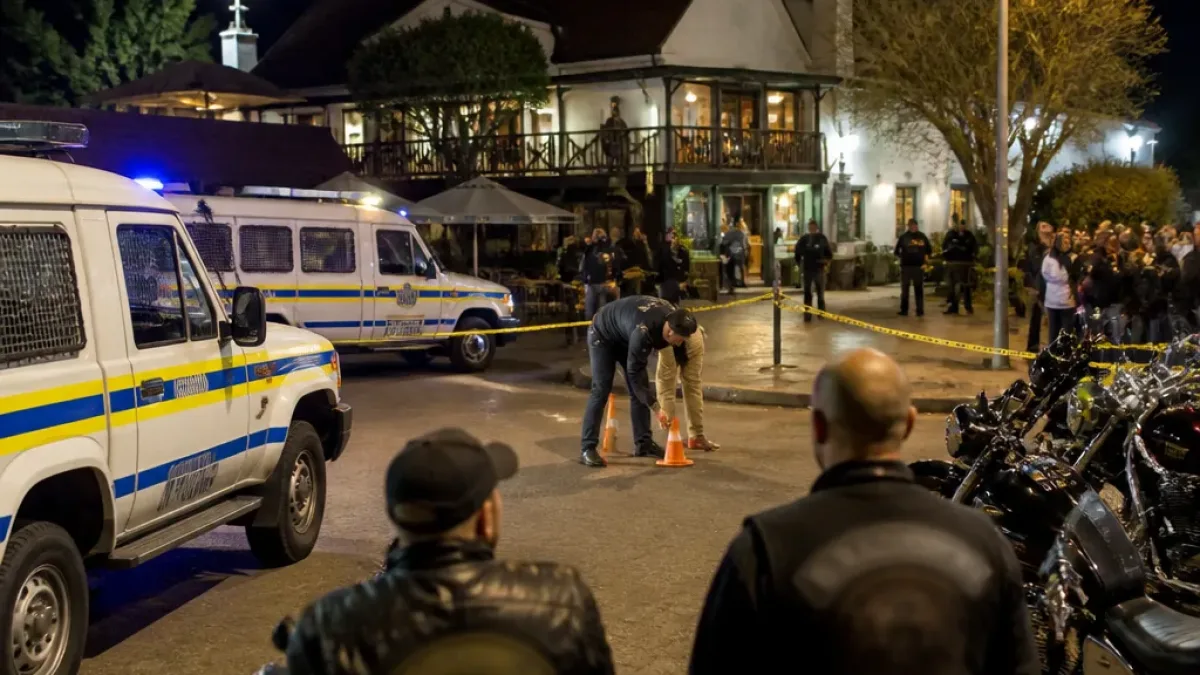
PRETORIA — The fatal shooting outside the Little Britain Pub in Waterkloof Ridge earlier this month that claimed the life of Baden Watson (54) has intensified scrutiny of motorcycle clubs in South Africa amid reports of alleged links to international outlaw motorcycle gangs.
Allegations of Bandidos presence and recruitment
Photographs circulated on social media showing individuals connected to local motorcycle clubs wearing clothing bearing Bandidos emblems have prompted concern. The Bandidos Motorcycle Club, also referred to as Bandido Nation, is an international outlaw motorcycle organisation that law-enforcement agencies in several countries have linked to organised crime, according to reporting on the incident.
While the club has a recorded history of violent incidents abroad, the reporting emphasises that there has been no formal announcement that any South African club has been officially patched over into a Bandidos chapter.
“This is not just another shooting,” Willem Petzer, who has researched the matter, said. “What we’re seeing here is that one of the world’s most violent international motorcycle gangs, the Bandidos, is establishing a chapter in Pretoria and actively recruiting members from local clubs.”
Petzer’s assessment, cited in the coverage, frames the episode as more than an isolated act of violence and warns of the potential for organised-crime links to alter the nature of local motorcycle-club culture.
Local motorcycle-club culture and why the potential infiltration matters
South Africa is home to hundreds of social motorcycle clubs whose members gather for long-distance riding and camaraderie. The reporting underscores that organised crime is not part of the country’s traditional motorcycle-club culture, a distinction that makes any alleged infiltration a particular source of alarm for communities and law enforcement.
- Victim: Baden Watson, 54
- Location: Little Britain Pub, Waterkloof Ridge, Pretoria
- Claimed concern: Photographs of Bandidos emblems and alleged recruitment of local members
Authorities have not publicly confirmed a Bandidos chapter in South Africa. At the same time, international action against the group is highlighted in the reporting: Australia recently arrested suspects in an investigation linked to alleged drug trafficking, and US legal action has targeted members accused of crimes including murder and arson.
| Item | Detail |
|---|---|
| Reported international membership range (US indictment) | Approximately 1 500 to 2 000 |
The coverage notes that an indictment in the United States described the Bandidos as a self‑proclaimed outlaw motorcycle organisation with a membership estimated at about 1 500 to 2 000 in the United States. It also cites recent arrests and investigations overseas as evidence of the group’s alleged criminal reach.
For South Africa, the concerns carry operational implications for the SAPS and specialised units such as the Hawks. If international outlaw groups seek footholds by recruiting from social clubs, policing will require not only criminal-investigation capacity but also cross-border intelligence cooperation.
Community leaders and club members who value the social and recreational aspects of motorcycling have reason to be vigilant. The reporting stresses the difference between recreational motorcycle clubs and outlaw organisations, and warns that the latter’s proven ties to organised crime overseas could bring new patterns of violence and criminal enterprise if they take root locally.
At this stage, the situation remains under public scrutiny rather than formally resolved: no official confirmation of a Bandidos chapter in Pretoria has been announced and police statements referenced in the reporting are limited. The killing of Baden Watson has, however, underlined the potential public‑safety consequences if international outlaw motorcycle gangs succeed in recruiting within South Africa.
Further inquiries by law enforcement and clear communication with communities and motorcycle clubs will be important to distinguish ordinary social club activity from any organised‑crime infiltration and to prevent escalation.