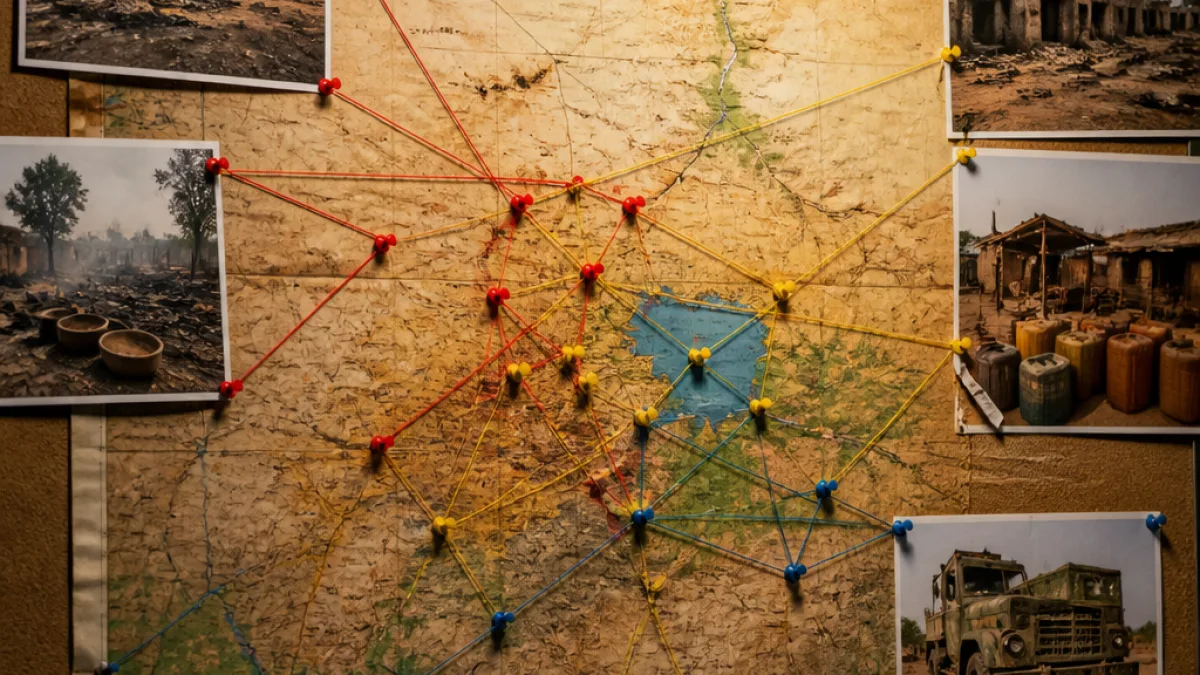
West Africa’s violent landscape is not a single insurgency but a mosaic of rival organisations, each with different aims, methods and weaknesses. Recent analysis shows these actors range from ideologically driven jihadist groups to criminal gangs and hybrid formations that blend both. Their competition and local strategies are reshaping security and governance across the Sahel and the Lake Chad basin.
Distinct groups, distinct strategies
Researchers identify three broad clusters of actors. In the central Sahel, Jama'at Nusrat al-Islam wal-Muslimin (JNIM), an al‑Qaeda affiliate, remains dominant in parts of Mali and Burkina Faso. Its main rival there is the Islamic State Sahel Province (ISSP). Around Lake Chad and north‑east Nigeria, the Islamic State West Africa Province (ISWAP) has eclipsed Boko Haram as the principal jihadist force. In north‑west Nigeria, the picture is more complex: groups such as the Lakurawa and criminal gangs described locally as bandits operate and sometimes overlap.
The differences matter. Where some groups lean on ideological recruitment, others pursue predation and criminal profit. In several areas, armed outfits have moved beyond hit‑and‑run attacks to shape local economies and governance.
How JNIM and ISWAP exert influence
JNIM has wielded economic pressure as a core tactic. Analysts point to a fuel blockade that disrupts overland supply routes; those routes carry an estimated 95% of Mali’s petroleum imports. The blockade was reportedly reimposed on Bamako at the end of April 2026, illustrating how non‑state actors can inflict widespread hardship without occupying capitals.
ISWAP, by contrast, has sought to build local legitimacy where central governments have failed. The group has been described as filling gaps in governance and basic service delivery in parts of north‑east Nigeria — a strategy that helped it overrun at least 16 military bases in Nigeria during the first half of 2025.
Strengths and limits
Armed groups have real strengths but also clear limits. One recent estimate places JNIM at about 6,000 fighters and argues it lacks the legitimacy to rule most urban centres or much of southern Mali by consent. Analysts judge JNIM incapable of seizing and holding national capitals long term. Meanwhile, internecine fighting between JNIM and ISSP has intensified; in parts of Burkina Faso that violence now rivals or exceeds attacks aimed at state forces.
Ground control can also change quickly. A reminder of that fluidity is the Tuareg‑led Front de Libération de l’Azawad (FLA) retreat from Kidal in early October (year not specified in the source), after which the city reportedly returned to Malian army control — a reversal underlining the ebb and flow of territorial control.
Hybrid actors and overlapping violence
Some groups defy neat categorisation. Lakurawa, for instance, is described by analysts as a hybrid formation that emerged around 2016–2017 in Sokoto State, drawing fighters from across borders. In north‑west Nigeria, the overlap between politically framed militancy and criminal banditry complicates responses: attacks can be driven by ideological motives, by profit, or by both.
- Economic tactics: fuel blockades and control of trade routes can cripple cities without territorial occupation.
- Service provision: filling governance vacuums gives some groups local support or acquiescence.
- Fragmentation: rivalries between jihadist affiliates produce violence that is sometimes directed more at competing groups than at the state.
Why this matters beyond the Sahel
The region’s insecurity has broader implications. Disrupted trade routes, the collapse of local markets, forced displacement and the erosion of state authority feed humanitarian crises and regional instability. For communities caught between armed factions and weak state services, the daily consequences include restricted movement, loss of livelihoods and heightened risk of recruitment into armed groups.
| Group | Main area of activity | Noted tactic |
|---|---|---|
| JNIM | Central Sahel (Mali, Burkina Faso) | Fuel blockades; territorial pressure |
| ISSP | Central Sahel | Rivalry with JNIM |
| ISWAP | Lake Chad basin, north‑east Nigeria | Filling service gaps; seizing bases |
| Lakurawa / bandits | North‑west Nigeria | Hybrid criminal/insurgent activity |
For policymakers and practitioners, responses must be tailored to each actor’s incentives and local realities. Military pressure alone may blunt attacks but will not restore services or livelihoods that reduce recruitment. Conversely, governance and economic measures may erode local support for some groups but do little against those driven by transnational ideological networks.
The fragmentary nature of these armed formations complicates any single‑track solution. Effective responses demand a combination of security, political engagement and development interventions calibrated to local conditions — and a realistic assessment of what different groups can and cannot sustain.
These findings underscore a harsh reality for affected communities: whether violence is framed as jihadist, criminal or hybrid, its human toll is local and immediate. The challenge for states and regional partners is to address both the symptoms of violence and the structural gaps that armed actors exploit.