Governors from Nigeria’s North‑West geopolitical zone have taken a coordinated pitch to the international community to fund and support a newly adopted regional plan aimed at tackling insecurity, building resilience and expanding economic opportunity.
Framework presented in New York
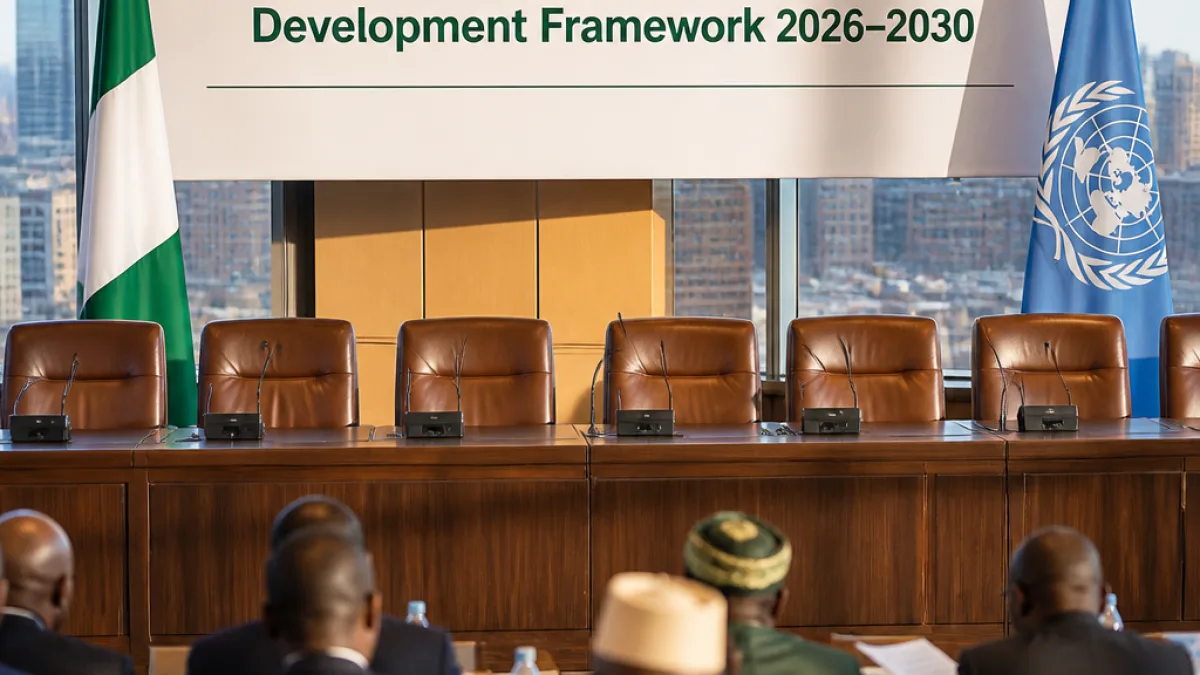
The North‑West Peace, Security and Development Framework (2026–2030) was presented to development institutions, international financiers and private investors on the margins of the 81st session of the United Nations General Assembly in New York, the United Nations Development Programme (UNDP) said in a statement.
The framework, adopted by the seven states of Jigawa, Kaduna, Kano, Katsina, Kebbi, Sokoto and Zamfara in March 2026, seeks to shift responses away from fragmented, state‑by‑state measures and toward coordinated regional action. The governors said security efforts must be matched with investments that address the root causes of instability: poverty, unemployment, displacement and weak public services.
International partners and private capital targeted
UNDP convened the event in partnership with the Northwest Governors’ Forum. Attendees included UN officials, development partners, representatives of international financial institutions, private‑sector leaders and members of the diplomatic community, the agency said.
The framework was developed with UNDP technical support and funded through the German government’s North‑West Prevention Facility Project. Its purpose, according to UNDP, is to prepare bankable projects designed to attract a mix of public funding, development assistance and private investment.
- Priority sectors identified include agriculture and livestock, renewable energy, trade infrastructure, technology and social services.
- Population reach: the North‑West is home to more than 60 million people and is central to Nigeria’s food systems and regional commerce.
- Approach: combine stabilisation operations with economic opportunity and institutional strengthening.
“Security must be accompanied by opportunity. Stabilisation must be accompanied by development. And public investment must create space for responsible private capital,”
The quotation above was attributed to Governor Dikko Radda of Katsina State, who chairs the Northwest Governors’ Forum and has urged coordinated donor support and private investment into underserved communities.
Why coordination matters
Speakers at the New York event emphasised that many of the drivers of instability cross state borders. Climate shocks, displacement, strains on livelihoods, limited access to essential services and unemployment do not respect administrative boundaries, the statement said. The governors argued that regional coordination will allow them to pursue larger infrastructure and economic projects—such as commercial corridors and cross‑state agricultural value chains—that single states would struggle to deliver alone.
The forum’s Director‑General, Maryam Yahaya, said the framework developed from a 2024 North‑West Peace and Security Summit held in Katsina and was now being presented to potential partners for implementation support and financing.
What donors will be asked to fund
Organisers said the framework includes project pipelines designed to be attractive to different kinds of funders: concessional finance for public infrastructure, blended finance arrangements that combine development finance with private capital, and grants to strengthen institutions and social services. UNDP framed the process as an effort to prepare projects that meet international standards for investment and development effectiveness.
| Area | Focus |
|---|---|
| Agriculture & livestock | Value chains, food security, livelihoods |
| Renewable energy | Rural electrification, off‑grid solutions |
| Trade infrastructure | Corridors, markets, cross‑border trade |
| Technology & social services | Digital inclusion, health, education |
Challenges and expectations
Participants at the high‑level event underscored that attracting finance will require clear accountability mechanisms, strong institutions and improved coordination between state governments and development partners. Governor Radda called on development institutions to align support across the seven states and for businesses and financial institutions to invest in underserved communities.
UNDP said the initiative aims to turn the framework into actionable projects that can leverage both public and private capital. The governors framed their appeal as a test of the international community’s willingness to back an integrated approach to stabilisation—one that links security with sustainable development and economic opportunity.
For a region that underpins much of Nigeria’s agricultural output and internal trade, the success of the framework will depend on translating donor interest and investment pledges into concrete, on‑the‑ground interventions that create jobs, restore services and reduce drivers of conflict.