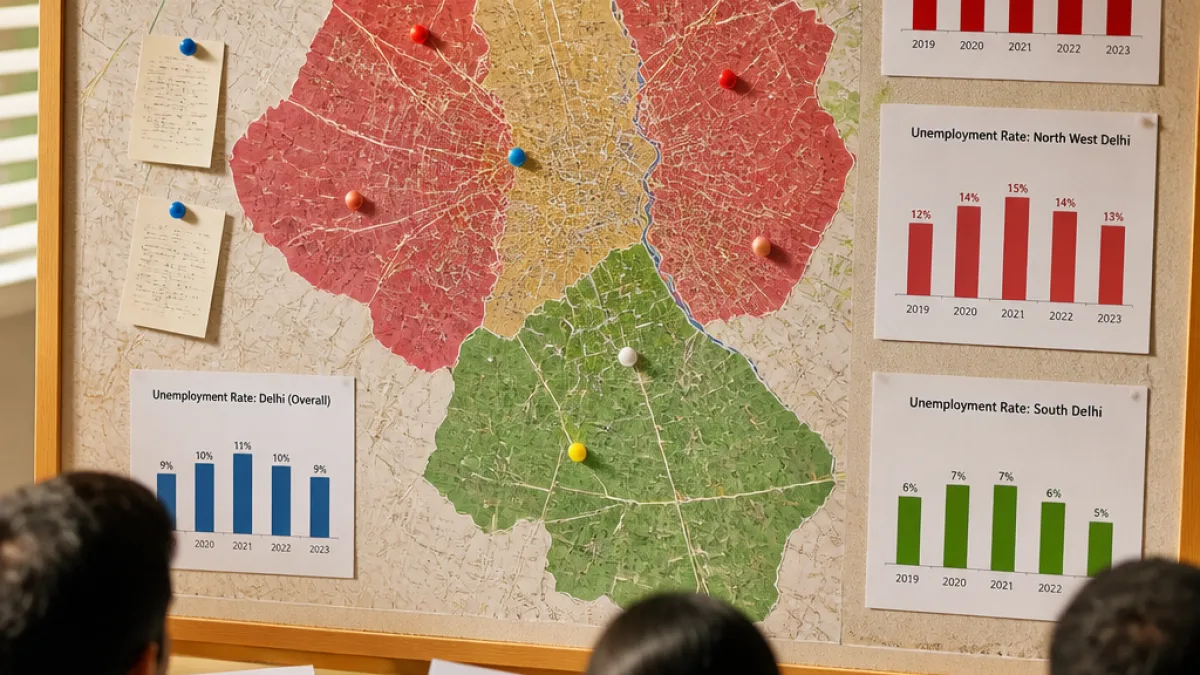
New Delhi — District-level results from the Periodic Labour Force Survey (PLFS) for 2025 show a sharp north–south divide in the labour market of the national capital. East Delhi recorded the highest unemployment rate at 8.3%, followed by North West Delhi at 7.4%, while wealthier southern districts reported much lower joblessness.
Wide disparities across districts
The PLFS breakdown, released by the statistics ministry, shows a stark contrast within the same city. South Delhi, South West and Central districts reported unemployment rates of 3.8%, 3.2% and 3.5% respectively. Analysts say such intra-city inequalities reflect differences in the labour market structure, access to formal employment, and the concentration of service and corporate jobs in the south.
Beyond unemployment, the survey also presents the labour force participation rate (LFPR) for persons aged 15 and above — the share of people either working or actively seeking work. The LFPR was higher in the northern districts, mirroring higher unemployment levels, while South Delhi recorded the lowest LFPR at 41%.
Women’s participation remains low
One of the most striking findings is the persistently weak participation of women in the workforce across all districts. The PLFS estimates female LFPR in every district at under 20%, a figure well below the national female LFPR of 30.7%. North East district has the lowest female LFPR at 9.8%, followed by North West at 10.7%.
The low rates reflect deep structural barriers: care responsibilities, social norms, safety concerns, and the shortage of decent, flexible employment opportunities near residential areas. These trends point to a continuing need for targeted interventions to support women’s entry and retention in the labour market.
High NEET rates in education hubs
The survey also reports on the NEET ("not in employment, education or training") rate, a useful measure to capture young people who are neither working nor in education. Districts known for higher education and coaching infrastructure—particularly North and North West Delhi—recorded elevated NEET rates. North district showed a NEET rate of 42.9%, followed by South at 36.1% and North West at 35.4%.
"Not in employment, education or training" captures those who are neither working nor enrolled in any educational institution and are often engaged in unpaid domestic work or preparing for government examinations.
Female NEET rates were substantially higher than male NEET rates across all districts, signalling that many young women are out of both paid work and formal learning—again underlining the unequal burden of unpaid care and household responsibilities.
What this means for policy and local communities
The PLFS district data provides a granular view that state and municipal policymakers can use to design targeted employment, training and social-support programmes. For northern districts with higher unemployment and NEET rates, priorities may include:
- Localised skills and vocational training aligned to market demand;
- Support for small and medium enterprises to create nearby jobs and reduce commuting barriers;
- Childcare and safety initiatives to enable greater female workforce participation;
- Career guidance and bridging programmes for NEET youth focused on employability and entrepreneurship.
For affluent southern districts, the challenge is different: integrating underrepresented groups—especially women—into a labour market dominated by formal, office-based roles that may not suit those with caregiving duties.
Data limitations and next steps
These PLFS district-level results were derived from the annual 2025 survey. While they offer valuable localised snapshots, analysts caution that short-term seasonal factors and survey design choices can affect district estimates. Continued, regular district-level monitoring will be important to track trends and evaluate the impact of local interventions.
The statistics ministry’s release invites urban planners, labour departments, training institutions and civic authorities to use the new granular data to tailor programmes closer to the needs of neighbourhoods. For communities and workers, the figures underline the urgency of labour-market access, especially for women and young people in the northern parts of the capital.