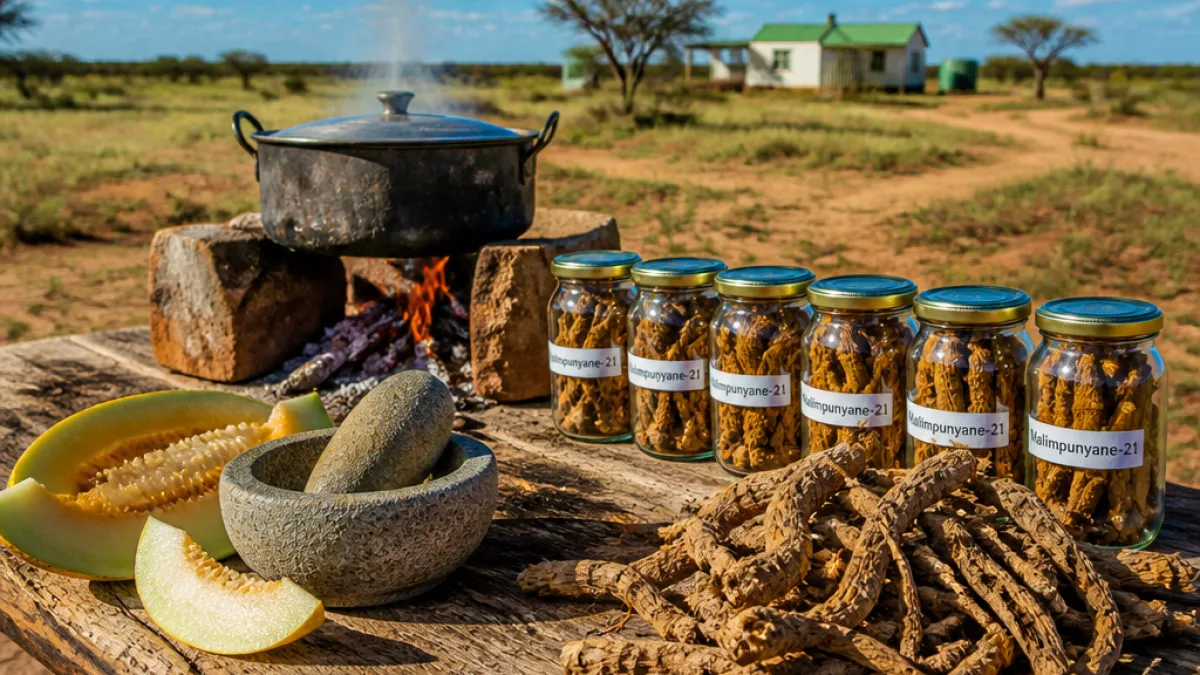
Kuruman — A childhood shaped by walks in the veld and the hands-on lessons of a grandmother has become the backbone of a new indigenous food brand from Kuruman. Irene Dioka, who grew up in Makhubong Heuningvlei, has launched Malimpunyane-21, a 100% natural range that centres on motlopi (Boscia albitrunca) root coffee and products made from lerotse melon.
From memory to market
Dioka learned to process motlopi from her grandmother, Thushoyaone Pitso, who raised her. The process of preparing motlopi — traditionally crushed with stones, sun-dried and roasted over an open fire — remained with her through years away from the household, including a period spent in a children’s home after her grandmother’s death.
She later worked as a waste picker for the department of environmental affairs. When that work ended and after the devastating loss of her baby in 2021, Dioka returned to the villages and to those memories. The techniques and recipes she had observed in her grandmother’s home became a source of purpose and an avenue for income.
“I wish she was still here to see how far I have come in business. Her passion, love and care shaped me, and I carry that with me years after her death,”
Dioka remembers family members who helped sustain the practice: her uncle Kapulele Dioke harvested motlopi roots while her grandmother did the processing. Those household activities were also a rudimentary business model — producing coffee-like motlopi and preserving lerotse melon as jam.
What Malimpunyane-21 offers
The brand markets traditional products made with minimal processing and no artificial additives. According to the report, Dioka produces motlopi root coffee and lerotse melon jam, and experiments with dairy-based items such as yoghurt — all inspired by recipes she observed in her grandmother’s home.
- Motlopi (Boscia albitrunca): prepared by crushing, sun-drying and open-fire roasting to produce a coffee alternative rooted in Nama and local practices.
- Lerotse melon preserves: turned into jam and used as a baking ingredient, demonstrating culinary adaptability.
- Low-impact sourcing: Dioka says she aims to create income without taking too much from nature, using indigenous plants sustainably.
| Product | Source/Method |
|---|---|
| Motlopi root coffee | Crushed with stones, sun-dried, open-fire roasted |
| Lerotse melon jam | Traditional household preserve reused for baking and sale |
Heritage, sustainability and small-business potential
Dioka’s approach links cultural heritage with a small-business model. The Food For Mzansi report notes she arrived at the idea after realising that indigenous plants could provide livelihoods without excessive extraction from the environment. Her story illustrates two broader trends visible across the Northern Cape and other rural areas: the commercialisation of traditional foods, and the search for sustainable income streams that build on local ecological knowledge.
For consumers, indigenous products offer a distinct flavour profile and a cultural story. For producers and communities, they can provide diversification of income, especially when conventional employment is scarce.
Challenges and practical considerations
Turning traditional processing methods into a sustainable and scalable business entails regulatory and practical hurdles. Producers of food products must consider food safety standards, labelling and market access. Sourcing of wild or semi-wild plants requires attention to sustainable harvesting practices to avoid depletion of local populations.
Dioka’s emphasis on not taking “too much from nature” recognises this balance. While the report does not detail how she manages supply chains or compliance, her model underlines the importance of community knowledge, careful harvesting and low-impact processing methods.
Local significance
Malimpunyane-21 is also a reminder of how everyday household knowledge — the recipes and practices maintained by elders — can have economic value when combined with entrepreneurship. Dioka’s story highlights personal resilience and the role of women in conserving culinary traditions and creating small enterprises in the Northern Cape’s small towns and villages.
As interest in indigenous foods grows locally and nationally, projects such as Dioka’s may find niche markets among consumers seeking natural products with provenance and a story. For communities in and around Kuruman, such initiatives point to alternative livelihoods grounded in cultural and ecological knowledge rather than extractive practices.
The account of Dioka and Malimpunyane-21 was reported by Food For Mzansi.