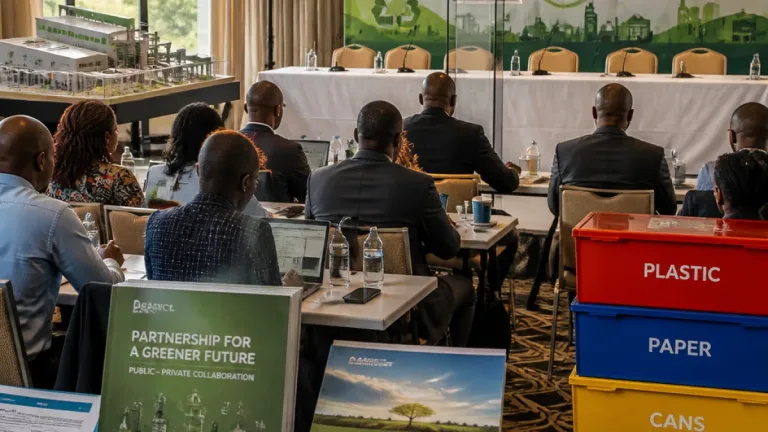
More than 750 business leaders, investors, policymakers and United Nations representatives concluded a two‑day UN Global Compact Leaders Summit in New York this week, focused on moving corporate sustainability commitments from ambition to measurable action. Delegates highlighted the need for companies to embed resilience and sustainability into strategy and operations rather than treating them as separate initiatives.
From commitments to operational delivery
The summit, held during the UN General Assembly high‑level week, framed sustainable growth and resilience as core to long‑term competitiveness in an era of geopolitical uncertainty, economic volatility and rapid technological change. Across plenaries, workshops and action sessions, participants discussed how business, governments and investors can collaborate to remove barriers that no single company can solve on its own.
Addressing delegates, Sanda Ojiambo, CEO and Executive Director of the United Nations Global Compact, argued that short‑termism is not a defensible corporate response to pressure. In her remarks she said:
“Resilience is built when purpose is strong, relevant and embedded in the decisions that shape company strategy and business value. That means translating principles into how companies invest, operate, manage risk and build for the long term. Sustainability is not separate from business performance; it is part of how companies remain competitive and resilient in a changing world.”
Summit priorities and implications for business
The event centred on the UN Global Compact’s 2026–2030 strategy, which aims to mobilise sustainable business at a scale capable of delivering meaningful outcomes for companies, people and the planet. Discussions were organised around six interlinked themes:
- Leadership and integrity — corporate governance and ethical conduct as foundations for sustainable practice.
- Climate and nature — accelerating decarbonisation and nature‑positive strategies.
- Human rights and decent work — ensuring labour standards and rights across value chains.
- Sustainable finance — aligning finance and capital allocation with long‑term environmental and social goals.
- Business resilience — managing systemic risks from geopolitics, tech disruption and supply chains.
- Market systems and collaboration — public‑private cooperation to address shared obstacles.
For South African firms and investors, the summit’s emphasis on measurable outcomes speaks directly to growing domestic expectations: regulators, institutional investors and large corporate buyers increasingly demand concrete evidence of emissions reduction, nature stewardship and human rights due diligence. While the summit did not set new international rules, its focus on measurable action reinforces trends already visible in corporate reporting and investor stewardship.
Practical steps and what to watch
Speakers and panels stressed practical pathways companies can take to convert commitment into delivery. These included clearer targets linked to investment decisions, integration of climate and nature risk into enterprise risk management, stronger supply‑chain due diligence and collaboration between firms, investors and public authorities to scale solutions.
Key operational measures discussed that South African businesses and their stakeholders should monitor include:
- Standardising metrics and reporting to enable comparability and to reduce greenwashing risks.
- Redirecting capital toward low‑carbon assets and nature‑positive activities through sustainable finance instruments.
- Embedding human‑rights and decent‑work assessments into procurement and supplier management.
| Summit focus | Expected corporate response |
|---|---|
| Climate and nature | Stronger targets, financed transition plans, nature‑positive investments |
| Leadership and integrity | Board oversight, linked incentives, anti‑corruption measures |
| Sustainable finance | Use of sustainability‑linked loans, green bonds, investor engagement |
Speakers at the summit repeatedly emphasised that collaboration — among companies, investors and governments — is essential to tackle systemic challenges such as supply‑chain decarbonisation or biodiversity loss. For South Africa, where many sectors are closely linked to natural resources and where labour and social conditions are politically sensitive, the summit’s action orientation raises the bar for corporate planning and reporting.
While the UN Global Compact’s 2026–2030 strategy sets a high‑level ambition, businesses face concrete choices about capital allocation, risk management and corporate governance if they are to show measurable progress. The summit underlined that sustainability is now a strategic business issue that affects competitiveness, investor access and licence to operate — not a peripheral compliance exercise.
WE NEWS does not provide financial advice; firms and investors should consult their advisers and regulators when translating sustainability commitments into investment and operational decisions.