
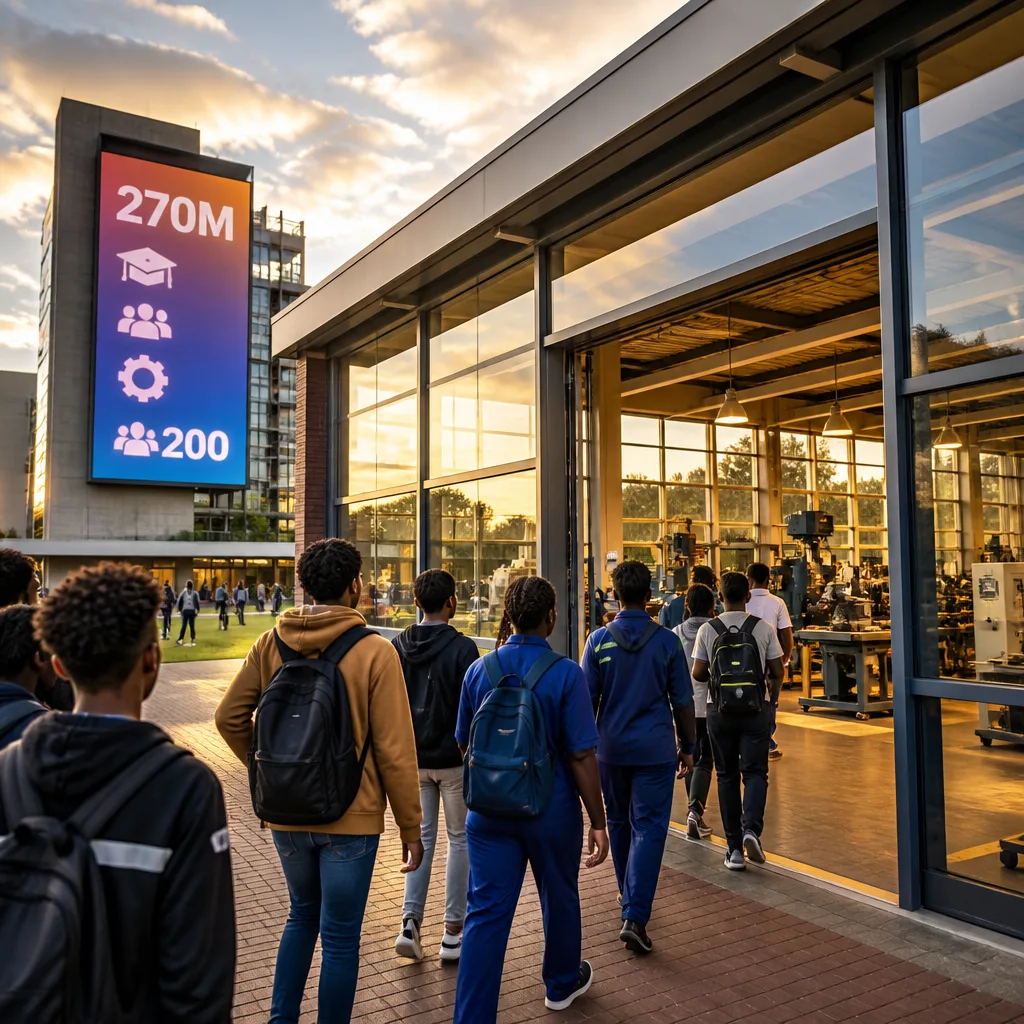
China’s Ministry of Education reported on 24 September 2026 that 270 million people have now received higher education, underscoring the country’s rapid expansion of tertiary learning and a policy pivot toward skills and applied training, according to state media.
Data, workforce and research roles
Vice Minister of Education Wang Guangyan told media that universities led about three‑quarters of the projects recognised by China’s three highest national science and technology awards in 2025, signalling that traditional research universities remain central to major scientific breakthroughs.
“Universities led about three‑quarters of the total projects recognised by China’s three highest national science and technology awards in 2025,” Wang Guangyan said.
At the same time, Wang highlighted the contribution of vocational education to the labour market: vocational institutions provided more than 70% of new skilled workers. The comments signal a dual approach — sustaining university research while rapidly scaling vocational training to meet industry needs.
University reform under the 15th Five‑Year Plan
Officials described government recommendations to deepen university reform. Institutions will be encouraged to develop along one of three pathways — research, applied, or skills‑oriented — based on their strengths and missions.
Guo Peng, director of the Development and Planning Department at the Ministry of Education, said the 15th Five‑Year Plan for 2026–2030 aims to support the development of about 200 high‑level applied universities. Guo added that skills‑oriented universities will be expected to strengthen cooperation with industry sectors such as advanced manufacturing and modern services to supply highly skilled workers.
| Item | Figure |
|---|---|
| People with higher education | 270 million |
| Projects led by universities (2025 national awards) | ~75% |
| New skilled workers supplied by vocational education | >70% |
| Planned high‑level applied universities (2026–2030) | ~200 |
What this means for South Africa and the region
While these are Chinese policy decisions, they are relevant to South African education planners and employers. The scale of China’s higher education expansion — now numbering in the hundreds of millions — demonstrates how national strategies that combine university research capacity with large vocational pipelines can rapidly reshape the skills landscape.
For South Africa, where skills shortages in manufacturing, digital services and technical trades remain persistent, the Chinese model offers a prompt to consider how tertiary pathways are aligned to labour market demand. The Chinese emphasis on applied universities and stronger industry collaboration mirrors policies already being discussed in several countries seeking to produce more work‑ready graduates and reduce the time between training and employment.
- South African policymakers may examine how to scale skills training while preserving research capacity at universities.
- Stronger partnerships between industry and tertiary institutions could help close skills gaps in priority sectors.
- Careful planning is needed to ensure quality and equitable access as vocational pipelines expand.
These choices have consequences for learners and teachers. Rapid expansion without investment in curriculum, teacher development and quality assurance risks creating certification without meaningful competency. Conversely, targeted growth that supports practical experience, apprenticeships and employer‑led curricula can improve graduate employability.
The Chinese announcement is an example of a national strategy that deliberately differentiates institutional missions — research, applied and skills‑focused — to meet diverse social and economic goals. For South Africa, the challenge remains to balance similar objectives within constrained budgets while ensuring that more learners are equipped to enter productive work.
Reporting from state media was cited for the figures and policy aims; officials’ remarks reflect China’s stated priorities for 2026–2030 but do not detail implementation timelines beyond the planning period.