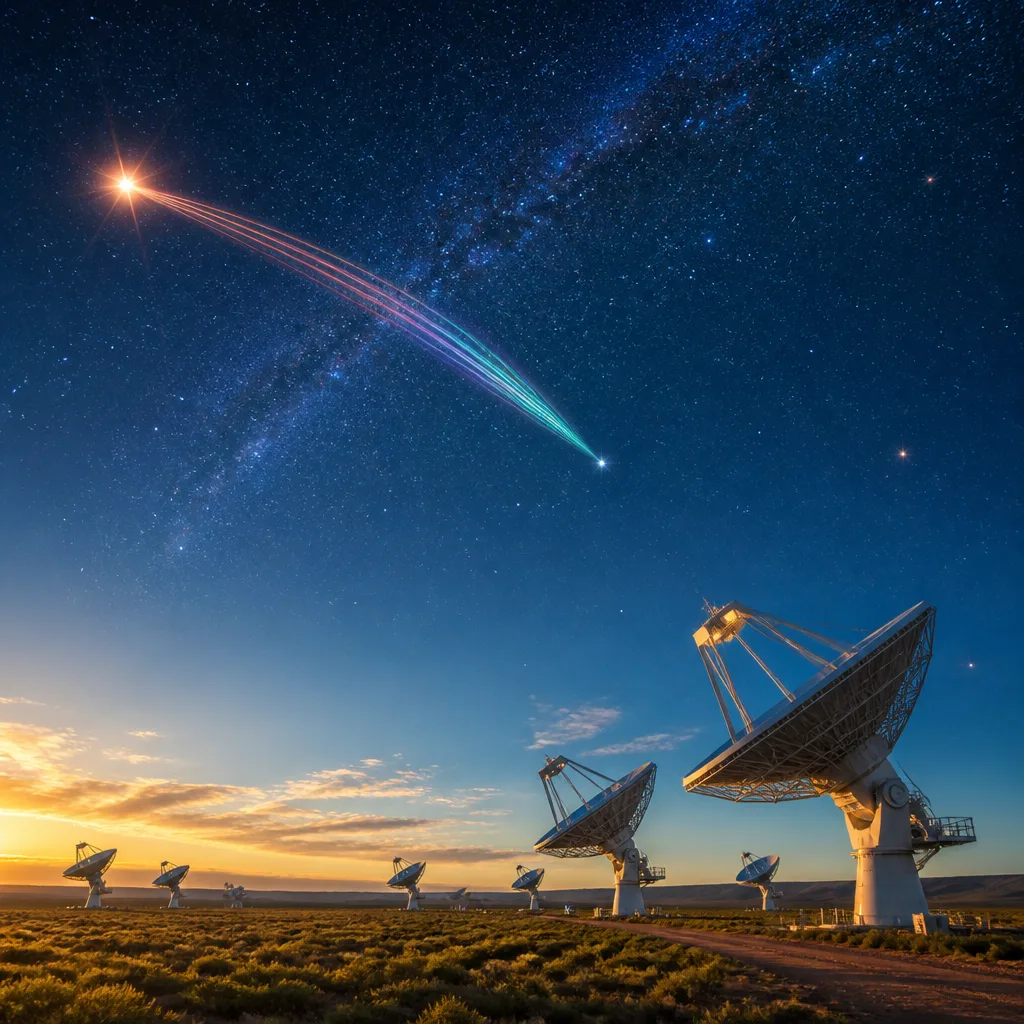
South Africa’s MeerKAT radio telescope has been used to detect faint, repeating radio signals that researchers say originate from the exoplanet Beta Pictoris b, located about 63 light years from Earth. The result, posted as a preprint on arXiv, marks a notable step in using radio astronomy to study the magnetic environments of planets beyond the Solar System.
How the source was identified
Previous claims of radio detections in other star systems were ambiguous because the signals could not be definitively assigned to the planet rather than the host star. In this study, the research team used an observational technique that compared radio images of the star–planet system with the positions of distant quasars. Quasars act as effectively fixed background markers on the sky; by aligning the radio maps with those markers, the team was able to register the radio emission precisely against the known positions of the star and its planet.
When the radio maps were layered over the reference frame defined by the quasars, the radio bursts aligned with the position of Beta Pictoris b rather than its host star. The planet is a gas giant estimated at roughly 10–12 times the mass of Jupiter. The team describes the detected emission as most consistent with auroral radio emissions, analogous to the aurorae produced by interactions between charged particles and a planet’s magnetic field.
Why radio emission from exoplanets matters
Radio waves from planets can reveal properties that are difficult to measure in other ways. In particular, such emission carries information about a planet’s magnetic field and how the planet interacts with charged particles from its host star. Those interactions affect atmospheric escape, space-weather conditions around the planet and, for smaller rocky worlds, factors relevant to habitability.
Detecting radio emission from exoplanets therefore provides a new observational handle on planetary magnetism and star–planet coupling. The MeerKAT detection adds to an emerging set of methods — including transit spectroscopy and direct imaging — that astronomers use to probe exoplanet environments.
- Instrument: MeerKAT radio telescope (South Africa)
- Target: Beta Pictoris b (gas giant, ~10–12 Jupiter masses)
- Distance: ~63 light years
- Signal type: Faint, repeating radio bursts, consistent with auroral emission
- Report: Study available on the preprint server arXiv
| Property | Value |
|---|---|
| Host system | Beta Pictoris |
| Planet | Beta Pictoris b |
| Planet mass | ~10–12 Jupiter masses |
| Distance | ~63 light years |
| Observatory | MeerKAT (South Africa) |
Context and caution
The study presents a promising approach, but it remains an early result. The work is available as a preprint, which means it has not yet completed peer review. The authors themselves took extra care to register the radio images against distant quasars in order to rule out the host star as the source. That methodological step addresses a major difficulty that has limited confidence in earlier radio claims.
Even so, independent confirmation — ideally with additional instruments or repeated observations — will be important to establish the phenomenon firmly and to characterise the emission in more detail. Future work can constrain the planet’s magnetic-field strength, the mechanism powering the radio bursts and how the emission varies with time and with the planet’s orbital and rotational phases.
Implications for exoplanet science
If radio detections from exoplanets become routine, astronomers will gain a direct probe of planetary magnetism across a range of planet types and evolutionary stages. That could help answer questions such as:
- How common are strong magnetic fields among gas giants and smaller planets?
- How do stellar winds and flares influence planetary atmospheres via magnetic interaction?
- What role do magnetic fields play in protecting atmospheres that might be relevant to habitability?
The MeerKAT result illustrates how South Africa’s radio astronomy facilities can contribute to high‑impact research on extrasolar planets. As the detection is followed up and debated in the scientific literature, it may open a new observational frontier for understanding planets beyond the Solar System.
Note: The findings discussed here are reported in a study available on the preprint server arXiv and should be treated as provisional pending peer review and independent confirmation.