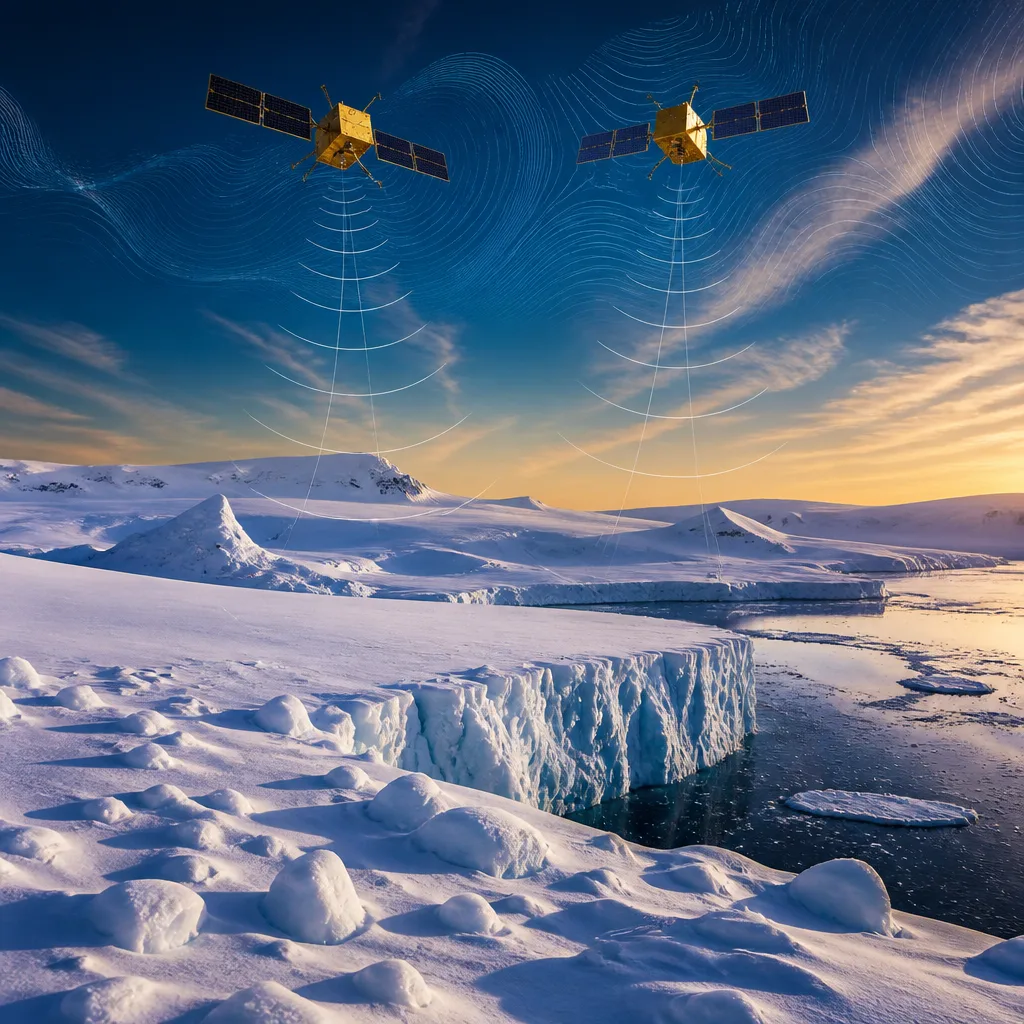
East Antarctica accumulated an unexpected and substantial mass of ice between mid-2021 and early 2023 — about 695 billion tonnes — according to a study led by the Institute of Oceanology of the Chinese Academy of Sciences (IOCAS) and published in Nature. The team used satellite gravimetry, ice-core and accumulation records, and atmospheric modelling to identify the cause and to stress that the event is temporary.
What happened and how scientists traced it
Gravity-sensing satellites from the GRACE mission detect changes in Earth’s gravity field caused by the redistribution of mass — including ice. GRACE measurements showed that between July 2021 and April 2023 East Antarctica gained the equivalent of 695 billion tonnes of ice, an amount the authors describe as the largest such gain observed since the satellites began monitoring in 2002. The area affected is roughly the size of Spain and stretches about 800 km.
The research group combined the gravimetric data with records of snow accumulation preserved in ice cores and with atmospheric circulation simulations. These independent lines of evidence pointed to a common origin for the extra moisture: persistent warming of a tropical region known as the tropical warm pool, located where the western Pacific meets the eastern Indian Ocean.
From the tropical warm pool to Antarctic snowfall
In brief, sustained warming in the tropical warm pool between 2021 and 2023 helped generate a large-scale pattern of atmospheric waves called a Rossby wave train. Rossby waves are planetary-scale undulations in the atmosphere that can transport energy and influence weather thousands of kilometres away. In this case the wave train propagated southwards, altering atmospheric circulation in a way that shunted additional moisture and colder conditions toward East Antarctica, boosting snowfall and ice accumulation.
- Scale of the gain: 695 billion tonnes of ice (largest since 2002 for GRACE).
- Geographic extent: about the size of Spain; ~800 km in extent.
- Cause identified: sustained tropical warm pool warming triggering a Rossby wave train that increased moisture delivery to East Antarctica.
Temporary gain, persistent risks
The authors emphasise that the gain is temporary. Antarctic mass balance has been negative in recent decades: on average the continent has been losing about 140.5 billion tonnes of ice per year over the past two decades, with West Antarctica melting much faster than East Antarctica. Nevertheless, East Antarctica is often described as a potential long-term risk because it contains enough ice to raise global sea levels by around 52 metres if fully lost — a theoretical figure that underlines the continent’s importance for future sea-level rise.
Because the 2021–2023 gain relates to atmospheric circulation rather than a long-term cooling of Antarctica, the authors warn that this episode does not offset ongoing mass losses elsewhere or the long-term trend driven by climate warming. Instead it illustrates how changes in tropical ocean temperatures and atmospheric wave patterns can produce large, rapid swings in Antarctic mass on interannual timescales.
| Metric | Value |
|---|---|
| Ice mass gain (East Antarctica, Jul 2021–Apr 2023) | 695 billion tonnes |
| Average Antarctic mass loss (past two decades) | 140.5 billion tonnes/year |
| Potential sea-level equivalent (East Antarctica total) | 52 metres |
Why this matters to South Africa and the world
For South Africa — a nation with an extensive coastline and infrastructure vulnerable to sea-level rise — the study is a reminder that Antarctic mass trends are not monotonic and that remote ocean–atmosphere interactions can temporarily mask or amplify regional signals. Policymakers and planners need to interpret short-term variations in the context of multi-decadal trends when assessing future coastal risk.
Finally, the episode showcases the value of sustained satellite monitoring and the importance of integrating multiple data sources — gravimetry, ice-core records and atmospheric modelling — to understand rapid changes in the polar system. While the recent mass gain is an interesting counterpoint to persistent Antarctic ice loss, it does not change the underlying challenge: a warming planet is altering ice sheets and the sea-level budget in complex ways that demand continuous observation and careful interpretation.