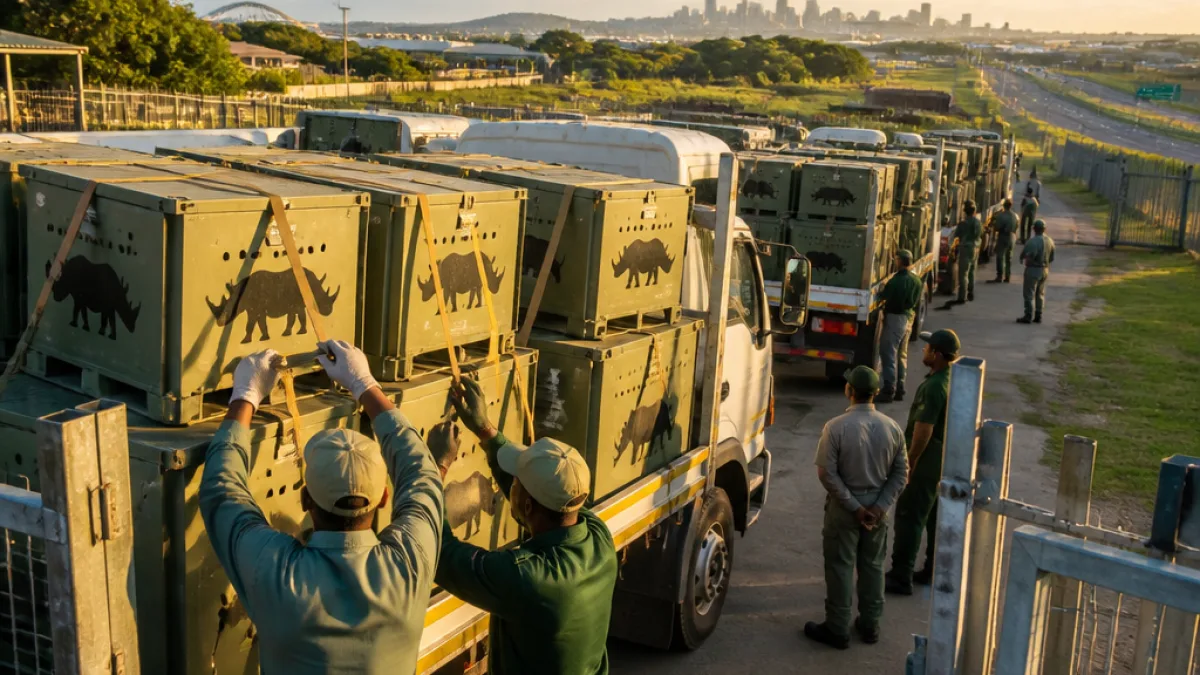
Twenty black rhinos have been translocated from KwaZulu‑Natal to a remote location in Botswana as part of a regional conservation drive to rebuild the species in areas hard hit by poaching.
Cross‑border move organised by BRREP
The move was completed in early September under WWF South Africa’s Black Rhino Range Expansion Project (BRREP). Ezemvelo KZN Wildlife confirmed the animals were sourced from seven game reserves and assembled to form a genetically diverse founder population for the new site.
Before the translocation, Botswana’s black rhino population was estimated at about 25 animals. The arrival of 20 more effectively doubles that number in the country, according to figures from the International Rhino Foundation cited by conservation partners. The foundation classifies the black rhino as critically endangered.
Why move rhinos across the border?
Conservationists say the transfer addresses several challenges: concentrated, high‑density populations in certain South African reserves; a growing shortage of sufficiently large, secure habitats inside South Africa; and catastrophic population losses from poaching in parts of Botswana, particularly around the Okavango Delta.
- Establishing new, geographically separate populations reduces the risk of a single poaching event or disease outbreak wiping out large numbers of animals.
- Combining individuals from multiple reserves supports genetic diversity in the founder group.
- Expanding the species’ range across suitable, secure habitat gives rhinos more room to breed and recover.
Operation and logistics
The 20 rhinos were captured in KwaZulu‑Natal in early June and spent time in quarantine within a boma before the relocation itself. The operation involved two separate 36‑hour road trips to reach the undisclosed, remote destination in Botswana. The exact site has not been made public to protect the animals from poaching threats.
| Stage | Timing |
|---|---|
| Capture in KZN reserves | Early June |
| Quarantine in boma | Following capture (duration not specified) |
| Road transfers | Two separate 36‑hour journeys |
| Arrival | Early September |
Part of a longer regional strategy
BRREP has been working since 2003 to find large tracts of habitat—typically areas of about 20 000 hectares or more—where black rhinos can be given space to breed and eventually expand into the surrounding landscape. The project has previously carried out cross‑border translocations; its first such operation was in 2019, when rhinos were moved to Liwonde National Park in Malawi.
Conservationists and provincial authorities say establishing new populations across the region is essential to long‑term recovery. Botswana’s losses from poaching have been concentrated in areas near the Okavango Delta, and rebuilding numbers there helps restore the species’ regional resilience.
Security and future monitoring
To reduce risks, the destination in Botswana remains undisclosed and the animals were moved to a secure, remote area. The new population will be monitored to track health, breeding success and movements as the rhinos settle.
While the immediate result is a substantial numerical boost for Botswana, conservation partners stress that long‑term success depends on sustained anti‑poaching measures, habitat management and continued cooperation between range countries and provincial conservation authorities.
The translocation underscores the logistical and veterinary expertise required to move large, dangerous wildlife safely across long distances. It also highlights the role of collaborative, cross‑border planning in protecting species whose ranges do not conform to national boundaries.
For communities in KwaZulu‑Natal and conservation teams across the region, the transfer is a reminder of both progress made and the ongoing threats that continue to shape rhino conservation strategies.