Hilton College in the KwaZulu‑Natal Midlands has long been shorthand for expensive private schooling — but when it comes to the value of the land under elite campuses, size alone can be misleading.
Big estates, modest land prices
Recent reporting that compared the physical extents of prominent independent schools with market land values highlights that large rural properties do not automatically translate into greater wealth on the balance sheet. Hilton’s grounds span roughly 1 600 hectares and include a private nature reserve. Its annual school fee for boys is reported at R451 557 for the current year.
By contrast, some urban schools with much smaller campuses sit on land that is worth multiples of Midlands farmland when measured at market rates. The piece, published by an independent outlet, contrasts fees — which are a visible, consumer-facing number — with the hidden, enduring value of real estate ownership beneath cricket fields and school quads.
How the rankings change when you look at land value
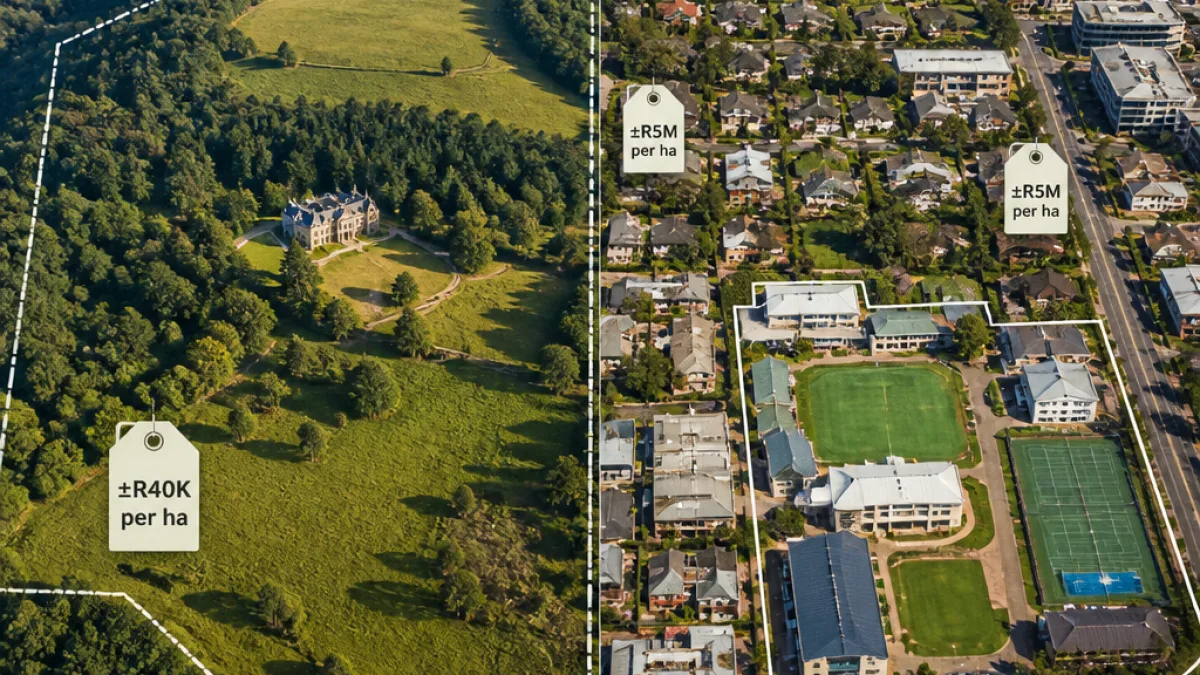
When you sort schools by hectares, rural campuses dominate. But translating hectares into rand requires applying appropriate land rates, and those rates vary sharply by location and land use. KwaZulu‑Natal farmland, even when scenic, generally trades at substantially lower per‑hectare prices than urban or suburban stands in Gauteng or the Cape.
The reporting notes that farming land in the Midlands commonly lists between R15 000 and R120 000 per hectare, depending on water rights, accessibility and permitted use. Using that range, Hilton’s 1 600ha estate would produce a broad land‑value estimate between R24 million and R192 million. That range shows that acreage can be impressive without necessarily equalling prime urban land values.
| School | Approx. land (ha) | Noted annual fee (if reported) |
|---|---|---|
| Hilton College (KZN Midlands) | 1 600 | R451 557 |
| Michaelhouse (KZN Midlands) | 680 | — |
| St Andrew’s College (Makhanda) | 310 | — |
| St Stithians (Sandton) | 105 | — |
Why the distinction matters
- Fees are a flow — what parents pay year to year — while land is a stock of value that can appreciate or be leveraged.
- Location drives per‑hectare value more than raw size: urban stands and school campuses in high‑demand metros command far higher prices than rural farmland.
- Not all school land is fungible; conservation easements, heritage status, sporting infrastructure and institutional use limit how property can be subdivided or sold.
That last point is significant for policymakers and the public. A large conservation‑style estate in the Midlands may have high ecological and amenity value but it will rarely trade at the same per‑hectare level as developable land in Johannesburg or Cape Town.
Local context: the Midlands versus metro markets
In the KwaZulu‑Natal Midlands, lifestyle estates and agricultural parcels often list at the lower end of the reported per‑hectare band. The article cited recent property listings to illustrate this: examples of 600ha and 1 730ha properties near Bergville and Dargle were advertised at under R20 000 per hectare. Smaller, well‑located lifestyle plots fetch more, pushing toward the top of the range where services and access are stronger.
For parents and the public, the headline figures for school fees will likely remain the dominant measure of exclusivity and affordability. But understanding the land beneath schools gives a different picture of institutional wealth and resilience to economic shifts. A school that owns land in a growing metro may sit on a concealed capital advantage relative to a rural peer that relies primarily on annual fees.
As debate continues about access to quality education and the role of private institutions in a country with stark inequality, the distinction between fees and underlying land value is worth noting. It reframes conversations about who benefits from education markets, and where long‑term capital sits in the landscape of private schooling.
The analysis was reported by an independent media outlet that compared campus sizes, fee levels and recent land listings. It serves as a reminder that visible costs — like tuition — tell only part of the story about wealth in South Africa’s schooling sector.