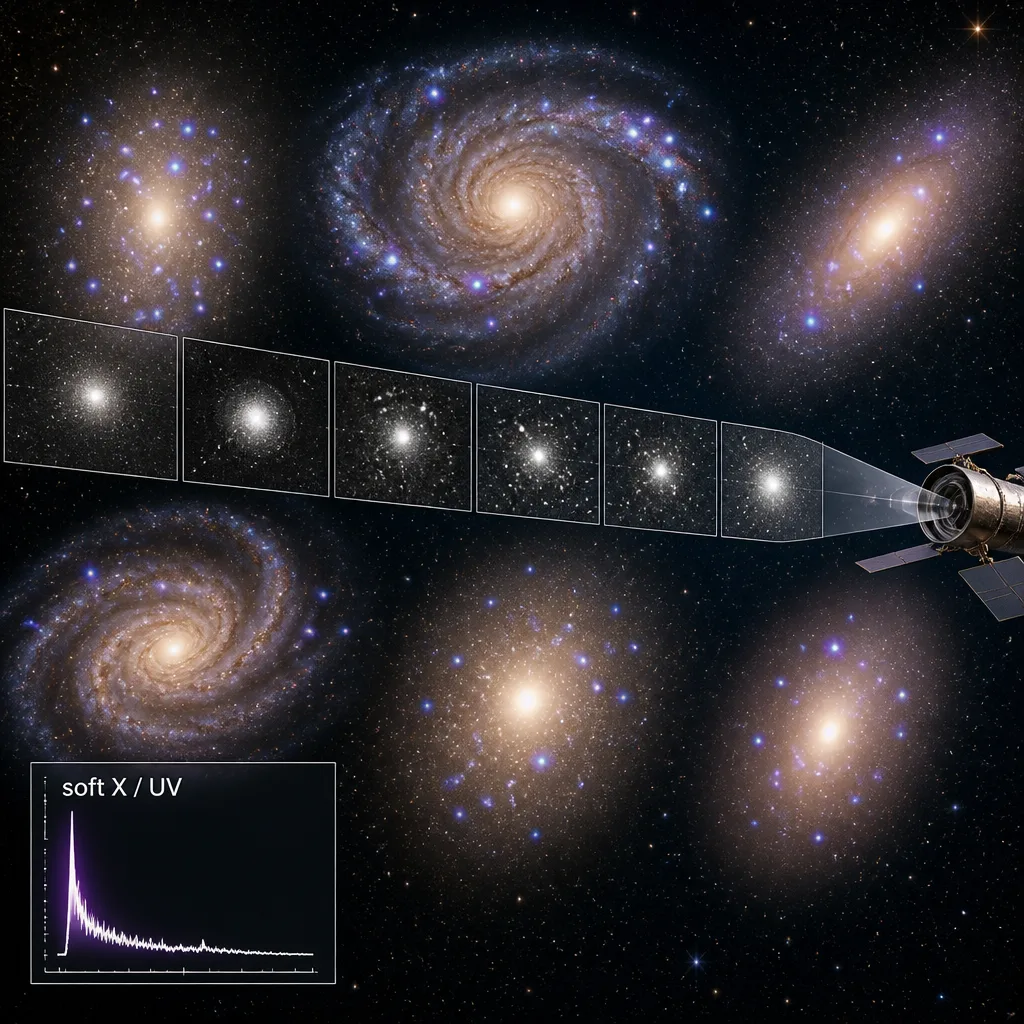
A team analysing archival Chandra X-ray Observatory images has identified a previously unrecognised class of objects that emit unusually low-energy X-rays but are expected to produce intense ultraviolet (UV) radiation. The study, published in Nature Astronomy, reports 84 such objects — termed hypersoft X-ray sources — across six galaxies, including the spiral galaxies M31 (Andromeda) and M101 (Pinwheel), and four elliptical galaxies.
What was found and how
Researchers searched publicly available Chandra data for objects that appear in images capturing the lowest-energy X-rays, yet are absent from images that map higher-energy X-rays. That contrast — strong emission at the softest end of Chandra’s band and little or no emission at higher energies — produced the sample the team calls hypersoft X-ray sources.
The objects were located in very different environments: both regions of active star formation and places dominated by older stellar populations. Because soft X-rays lie close to energetic ultraviolet light on the electromagnetic spectrum, the investigators infer that these systems also produce substantial amounts of UV radiation.
What they might be
The nature of these objects is not yet determined. According to the paper, the systems could be binaries in which a compact object — a black hole, neutron star or white dwarf — accretes matter from a companion star. In such systems, material stripped from the companion heats up and emits X-rays before it settles onto the compact object or crosses the event horizon in the case of a black hole.
The team emphasises that further observations and multiwavelength follow-up are required to test these ideas and to distinguish between white-dwarf, neutron-star or black-hole scenarios. The discovery suggests that a population of binary systems producing energetic UV radiation has remained largely unnoticed because they are faint or absent at higher X-ray energies targeted by many surveys.
Why this matters
The authors propose that these hypersoft sources could help explain two long-standing questions in astrophysics. While the published report does not detail those questions, the general importance is clear: identifying previously hidden populations of accreting binaries changes estimates of how much high-energy and ultraviolet radiation galaxies produce, and it informs models of binary evolution and compact-object demographics.
- Sample size: 84 hypersoft X-ray sources identified.
- Galaxies surveyed: Six galaxies — two spirals (M31, M101) and four ellipticals.
- Data used: Public archival observations from the Chandra X-ray Observatory.
| Parameter | Value |
|---|---|
| Number of sources | 84 |
| Host galaxy types | 2 spirals (M31, M101); 4 ellipticals |
| Primary instrument | Chandra X-ray Observatory (archival data) |
This is an archival discovery: the researchers did not collect new Chandra observations but re-examined existing images. Mining archival data is a common and powerful approach in astronomy because sensitive facilities like Chandra have large, long-term databases capable of revealing unexpected phenomena when analysed with fresh techniques.
Next steps and open questions
Key follow-up actions will include targeted observations at other wavelengths — especially ultraviolet and optical spectroscopy — to characterise the companions and the accretion flows, and deeper X-ray exposures to better constrain the spectral shapes. Pinning down whether these sources are dominated by white dwarfs, neutron stars or black holes requires measurement of their luminosities, variability, and, ideally, orbital periods.
The discovery is a reminder that even well-studied galaxies such as Andromeda still harbour surprises, and that archival astronomy remains a fertile route to new science. If hypersoft sources prove to be a significant and previously hidden contributor to UV output in galaxies, that will have consequences for how astronomers model the radiation fields that affect star formation and the interstellar medium.
For now, the classification of hypersoft X-ray sources provides a new category for observers to seek and for theorists to explain. The coming years should see coordinated observational campaigns aimed at revealing the physical engines behind these soft, UV-bright systems.