
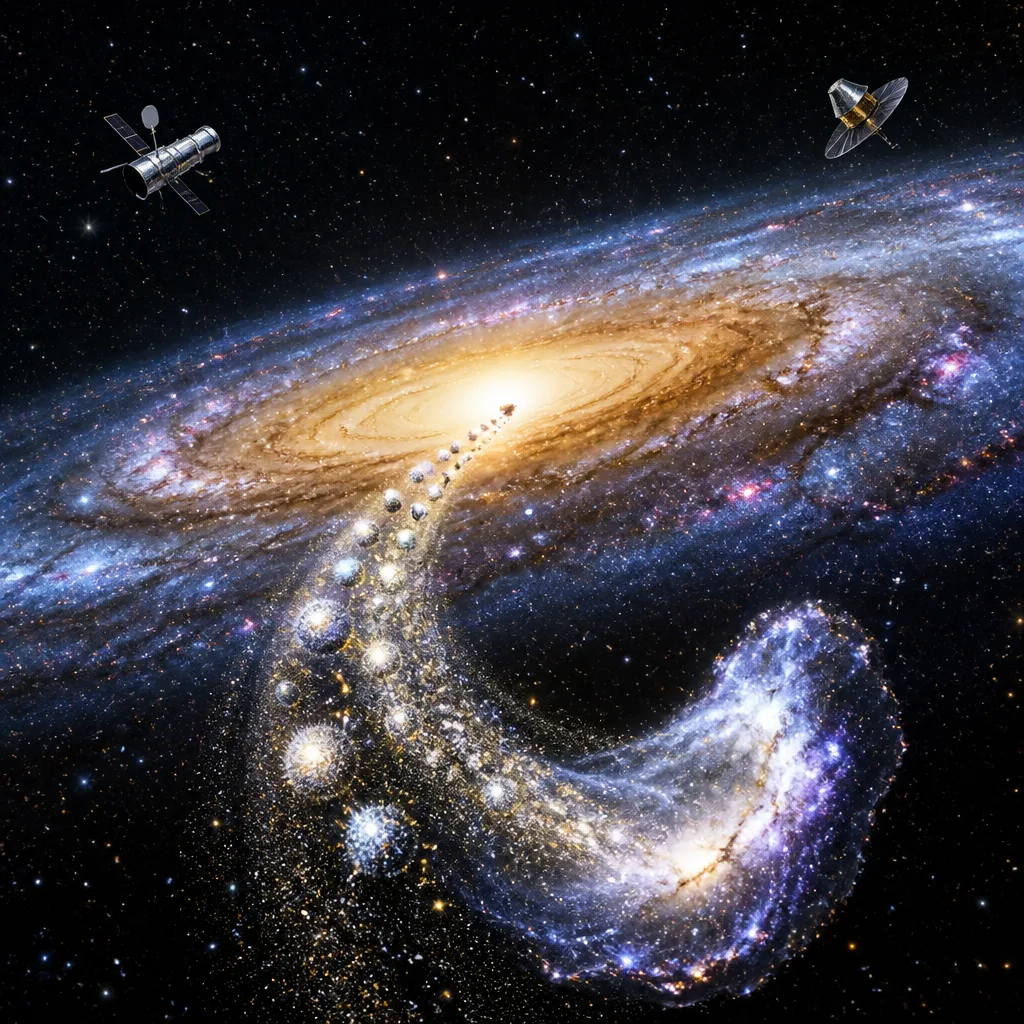
Astronomers say precision imaging from the Hubble Space Telescope, combined with astrometric data from ESA's Gaia mission, shows that the Milky Way absorbed a dwarf galaxy about 11.8 billion years ago. The finding, published in Nature Astronomy, identifies a population of ancient globular clusters traced to that dwarf system, which researchers have named LKH (Low-energy-Kraken-Heracles).
What the team found
The research team analysed 39 globular clusters located within 20 000 light‑years of the Galaxy's centre. Using Hubble's high-resolution imaging to measure cluster ages and chemical composition — together with Gaia's motions — they separated a distinct group of clusters that the authors attribute to the accreted dwarf galaxy.
“In this paper, we discover where the first significant batch of bricks came from: a dwarf galaxy that we call LKH,” said Davide Massari, lead author, Astrophysics and Space Science Observatory of Bologna, according to the team statement.
By dating the star clusters and linking them kinematically to a common origin, the team concluded that the Milky Way devoured LKH at about 11.8 billion years ago — pushing the known epoch of a major accretion event back by approximately 1.8 billion years compared with earlier work.
Why this matters
Galaxies grow by internal star formation and by merging with other systems. Identifying when and how the Milky Way accreted material gives direct insight into its early assembly and the environments in which its oldest stars formed. The new result suggests a significant merger occurred very early in the Galaxy's life — less than 2 billion years after the Big Bang — and that some of the oldest globular clusters now in the Milky Way were born in that smaller galaxy.
Study co-author Chiara Zerbinati, University of Bologna, said the combination of Hubble’s depth and Gaia’s precise motions allowed the team to distinguish the LKH-born clusters from the native population. According to the statement, that separation made it possible to date the accretion and estimate its mass contribution.
Methods and evidence
- High-resolution Hubble imaging provided precise ages and metallicities (chemical content) for the clusters.
- Gaia supplied accurate positions and motions that linked clusters to a common orbital family.
- Comparison with surveys and models allowed researchers to infer that the clusters originated in an accreted dwarf galaxy rather than forming in situ.
The paper places emphasis on the complementarity of space observatories: Hubble’s imaging depth and Gaia’s astrometry are mutually reinforcing when reconstructing the Galaxy’s fossil record.
Context and consequences
The result refines the timeline for the Milky Way’s early growth and sets a new target for models of galaxy formation. If major accretion events occurred earlier than previously thought, theoretical descriptions of how gas cooled and stars formed in the early Milky Way environment may need to be adjusted.
For South African astronomy, which engages with data from international facilities and participates in large survey science, the work illustrates the value of combining multiple datasets to tackle fundamental questions about cosmic history. It also provides clear, datable benchmarks that simulations and local observational programmes can test.
| Parameter | Value |
|---|---|
| Estimated time of accretion | 11.8 billion years ago |
| Advance on prior timeline | ~1.8 billion years earlier |
| Clusters analysed | 39 globular clusters |
As always with studies of ancient stellar populations, uncertainties remain. Age dating of globular clusters carries systematic errors, and the assignment of clusters to specific progenitors depends on models of orbital evolution and chemical enrichment. The authors present a coherent picture supported by multiple lines of evidence, but future observations and improved models will test and refine the claim.
For now, the study offers a clearer narrative of the Milky Way’s formative years: a young Galaxy that grew not only by making its own stars but by swallowing a sizeable neighbour very early in cosmic history.









