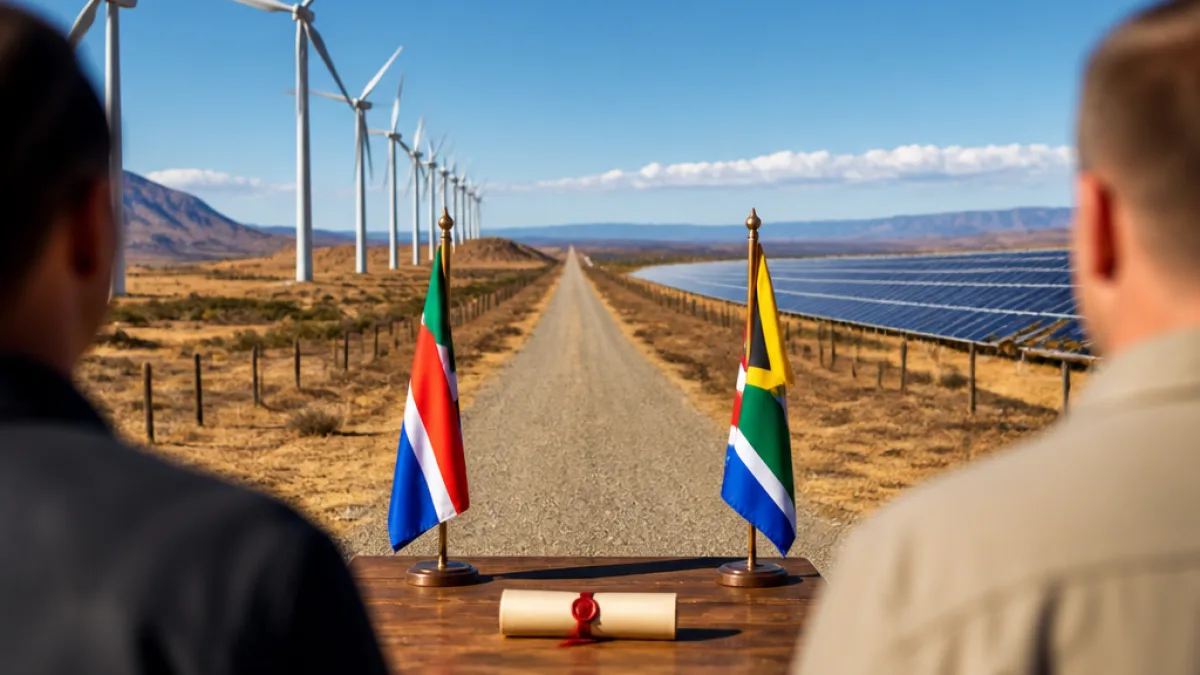
The Eastern Cape and Northern Cape provincial governments have signed a memorandum of understanding (MoU) establishing a long-term interprovincial cooperative framework to manage and support the Koruson renewable-energy development that straddles their common border. The agreement, reported by engineeringnews.co.za, aims to co‑ordinate work on renewable projects, sustainable development and economic growth between the two provinces.
Project overview and partners
Koruson comprises two linked projects, Koruson 1 and Koruson 2, being developed by international and South African partners.
| Project | Capacity | Components | Lead developer |
|---|---|---|---|
| Koruson 1 | 420 MW | Coleskop, Phezukomoya, Sankraal wind farms (140 MW each); 1.5 GW Main Transmission Station | EDF Power Solutions (lead); local partners include H1 Holdings, Gibb‑Crede and a community trust |
| Koruson 2 | 520 MW | Hartebeesthoek and Umsobomvu wind farms (140 MW each); Mooi Plaats solar PV (240 MW); connected via 400 kV substation | Envusa Energy (lead); local partners include Pele Green Energy and a community trust |
The development involves France‑based EDF Power Solutions and South African renewable company Envusa Energy, itself a joint venture between Anglo American and EDF Power Solutions. Koruson 1’s wind farms are sited outside Middelburg and Noupoort, and Koruson 2’s components are in the Hydra supply area.
What the MoU covers
The interprovincial framework is intended to align provincial oversight and cooperation across a number of practical areas. According to the reporting, the MoU includes collaboration on:
- community development and local economic benefits;
- stakeholder engagement and social licence matters;
- security, safety and emergency response coordination;
- planning and permitting processes linked to cross‑border infrastructure.
The agreement seeks to smooth operational and regulatory issues that can arise where large infrastructure projects cross provincial boundaries, ensuring consistent engagement with local communities and shared responsibilities for safety and security.
“The projects will go a long way to help government’s efforts of energy security in South Africa and in the two provinces in particular,” said Advocate Justice Bekebeke, director‑general in the Northern Cape Office of the Premier, according to the report.
Transmission and offtake arrangements
Koruson 1 includes a 1.5 GW main transmission station, while Koruson 2 is connected to private offtakers through a 400 kV main transmission substation developed as part of Koruson 1. These transmission assets are central to how the two projects will feed electricity into the grid and to private buyers, and they underscore the cross‑provincial nature of the development.
Local impact and provincial priorities
Provincial authorities have positioned the Koruson development as contributing to energy security and reducing the impact of loadshedding. The MoU aims to ensure that benefits such as jobs, community investment and local procurement are coordinated and maximised for affected towns and farming communities near the project footprint.
Local community trusts are listed as partners in both Koruson 1 and 2, reflecting a structured approach to community participation in revenue and benefit sharing. The project partnership also includes South African renewable firms and engineering consultancies, signalling an emphasis on local industry participation alongside international finance and expertise.
What happens next
With the MoU now in place, provincial administrations will be expected to develop joint mechanisms for stakeholder engagement, safety planning and economic development tied to Koruson. The transmission infrastructure already in place for Koruson 1 will support Koruson 2’s offtake agreements, but detailed implementation plans and schedules will depend on the developers and provincial co‑ordination processes set up under the MoU.
The information in this report is based on reporting by engineeringnews.co.za.