
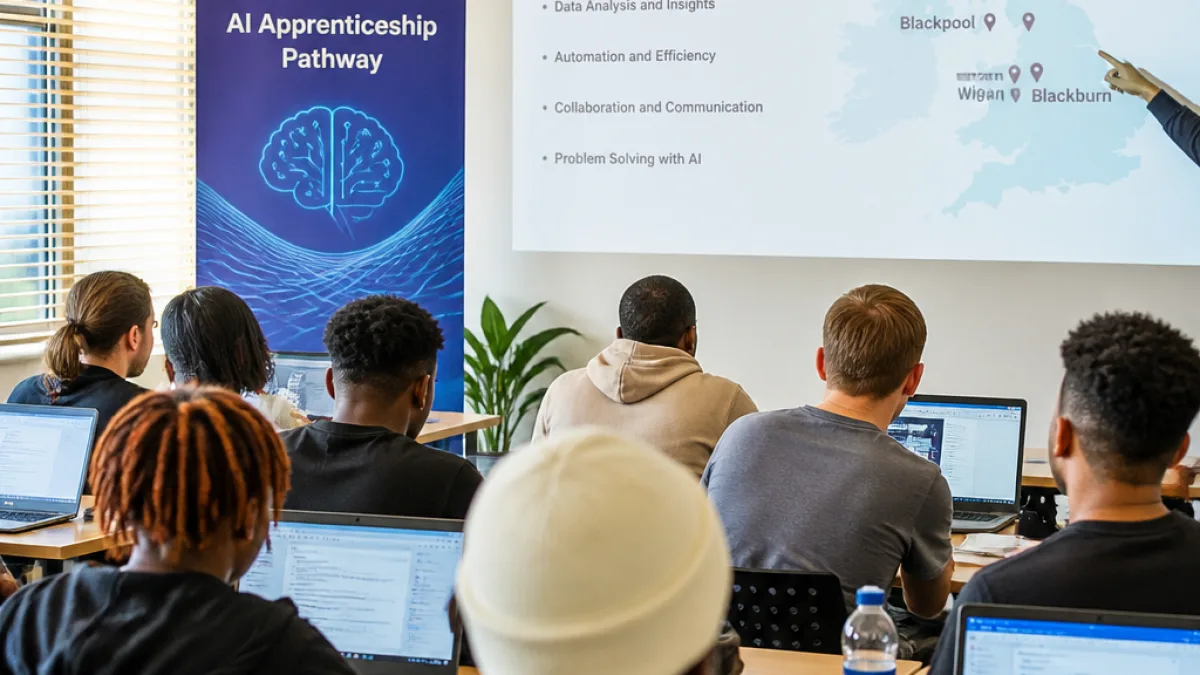
The UK government-backed pilot TechFirst AI Apprenticeship Pathway has begun a three-week summer bootcamp across the North West of England, training up to 70 young people aged 16–21 who are out of work or at risk of unemployment after leaving school. The programme is being delivered by training provider IN4 Group and aims to link classroom AI skills with workplace-ready behaviours and apprenticeship opportunities.
Who is involved and where the recruits come from
Participants come from communities including Wigan, Blackburn and Blackpool. IN4 Group, an approved training provider with industry partnerships, is leading delivery. Employers and public sector organisations across the region will assess recruits for apprenticeship roles at the end of the programme. Named employers taking part include JD Sports and Heinz, alongside a number of local small and medium enterprises.
What the bootcamp teaches
According to programme information, classroom time will combine technical and workplace competencies. Training modules cover:
- the development of AI tools;
- using AI to generate draft guides and documentation;
- responsible deployment of AI, including human oversight and quality control;
- office tools and systems;
- professional communication and teamwork;
- time management, organisation, problem-solving and working under pressure.
"Young people in every postcode deserve the opportunity to a great start to their adult life, and we are tackling the youth unemployment crisis head on," said Lisa Nandy, Secretary of State for Digital, Culture, Media and Sport.
Tech minister Kaniskha Narayan framed the pilot as preparation for a labour market already changing because of automation and AI: "This new scheme is about giving them the skills they need to thrive in the AI workplace," he said.
Scale, duration and unanswered questions
The pilot will run for three weeks and is targeted at young people who are unemployed or at risk of unemployment. While the headline figure of up to 70 participants has been reported, the programme has not published a detailed breakdown of selection criteria, the precise number in the initial cohort, or how many apprenticeship places each employer can guarantee. There is also no formal confirmation that every candidate who completes the bootcamp will be placed into an apprenticeship.
| Feature | Reported detail |
|---|---|
| Provider | IN4 Group |
| Duration | Three weeks |
| Participants | Up to 70, aged 16–21 |
| Locations named | Wigan, Blackburn, Blackpool |
| Employers involved | JD Sports, Heinz, local SMEs |
Why this matters for young people and employers
The pilot responds to long-standing concerns about youth unemployment and the changing skills employers demand as AI tools enter routine business processes. The training combines technical understanding of AI with practical workplace skills intended to make candidates more readily employable in early-career roles. For employers, the pathway is presented as a test-bed for recruiting entry-level staff who already understand how to work alongside AI systems and maintain human oversight.
IN4 Group reports being an approved training provider for major cloud platforms and says it has worked with more than 500 employers and helped over 6,000 people into technology roles, details that may have informed government selection of the provider for the pilot.
Local lessons and broader context
While this pilot is being delivered in the English North West, its aims resonate with labour markets elsewhere, including South Africa’s North West province, where transitions from school to work remain challenging for many young people. Programmes that blend technical skills with workplace readiness are increasingly seen as critical to improving employment prospects for school leavers.
However, questions about long-term sustainability remain. Short, intensive interventions can help open doors, but durable employment outcomes typically depend on a pipeline of apprenticeships or jobs, robust selection procedures and employer commitments that match the scale of training supplied.
As governments and training providers test models that combine AI literacy with employability skills, the results from this pilot — particularly data on how many participants convert to apprenticeships and remain in work after 12 months — will be important indicators of whether schemes of this type can be scaled effectively.
For now, the TechFirst pilot offers a targeted opportunity for a small group of young people to build AI-capable resumes and to be considered for industry apprenticeships. Clearer reporting on outcomes and employer placements would help evaluate its true impact on youth employment.












