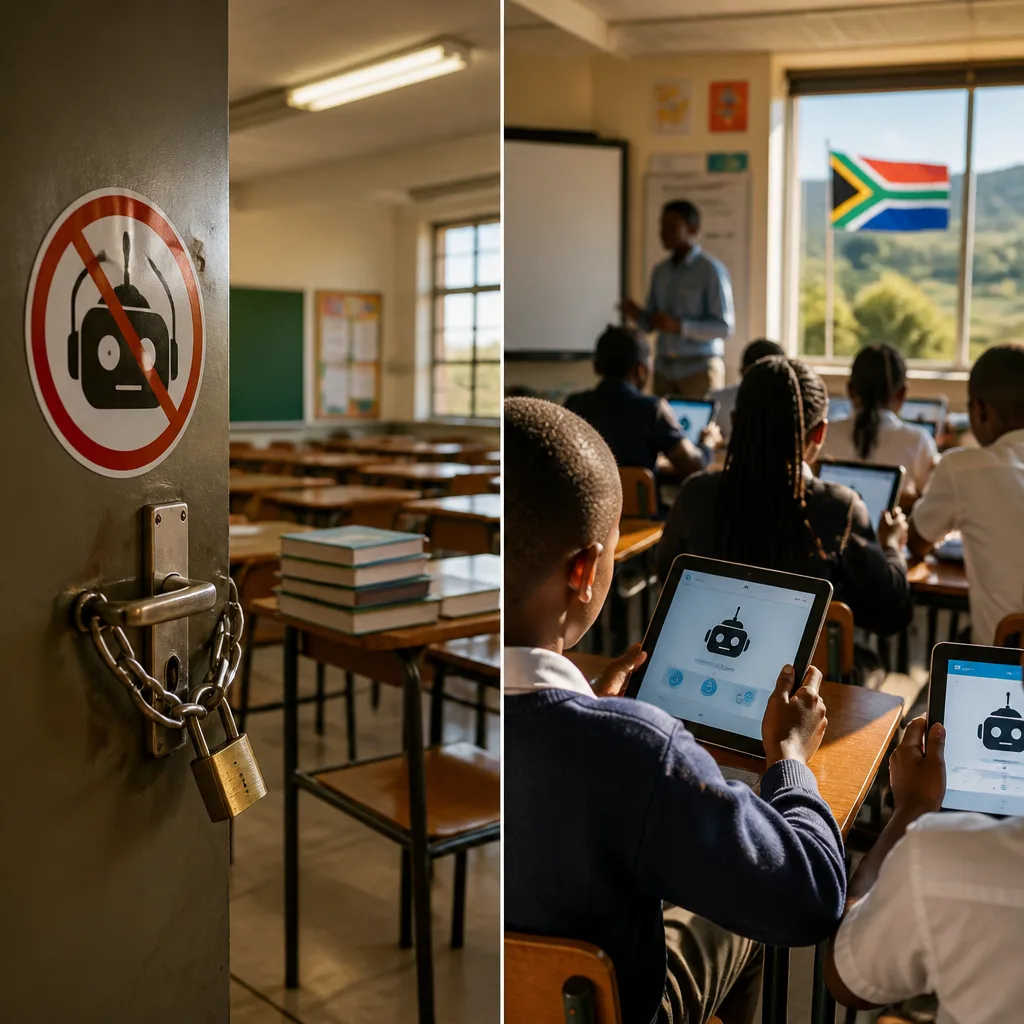
School systems around the world are adopting sharply different policies on artificial intelligence in classrooms, a divergence that presents useful lessons for South African education planners contending with safety, equity and curriculum implications.
Two models: prohibition and guided integration
In recent weeks, at least two large US education authorities moved to restrict learners' access to AI tools. One district has imposed a blanket ban on classroom AI for the current school year across all grades, and a mayor announced a broad moratorium prioritising "real, human instruction", according to recent reporting. By contrast, a high-performing European country has introduced a tailored AI tool for 16-year-olds, describing it as a guided resource that supports learning rather than substituting for it.
“The tech industry wants us to believe that A.I.-powered early education is not only inevitable, but necessary. We do not see it that way.”
That statement accompanied the announcement of a moratorium intended to centre student safety and classroom-based pedagogy. Meanwhile, Estonia’s education ministry has emphasised that banning AI will not prevent learners from using it, and has chosen to offer a specialised, supportive model co-developed with a major AI firm.
What the approaches mean for schools and classrooms
The decisions abroad crystallise three core tensions that South African education stakeholders must weigh:
- Safety and oversight — Bans and moratoria are driven by concerns about data privacy, harmful content and the potential for AI to amplify misinformation or deepen plagiarism.
- Access and equity — Blanket bans may protect learners but risk entrenching digital divides if wealthier families continue to access AI privately while public schools prohibit it.
- Pedagogy and teacher roles — Estonia’s approach treats AI as a coaching tool to be integrated under adult supervision, shifting the debate from prohibition to how educators can use AI to strengthen critical thinking and assessment design.
Those trade-offs have immediate classroom consequences. Teachers must decide whether to police AI use, redesign assessment to reduce opportunities for misuse, or be reskilled to deploy AI as a learning scaffold. School leaders face policy choices that will affect curriculum delivery, learner support and relationships with edtech providers.
Practical options for South African policymakers
South Africa has a complex schooling landscape: resource constraints, unequal device access, and varied teacher digital fluency. The international examples suggest a menu of pragmatic steps rather than a single solution.
- Commission rapid guidance that clarifies acceptable classroom AI uses, with input from teachers, unions and SACE (or relevant professional bodies).
- Run controlled pilots in a representative sample of schools to test a guided AI model for tasks such as formative feedback and research skills — with strict data-protection safeguards.
- Adapt assessment practices for high-stakes exams to emphasise critical thinking, oral tasks and in-class demonstrations where appropriate.
Policymakers should also consider the consequences of a blanket ban: while it reduces immediate risk, it may push learners to use unregulated AI outside school or widen inequities if private tutoring uses such tools.
| Policy | Potential benefit | Key risk |
|---|---|---|
| Ban/moratorium | Immediate reduction in misuse; protects data | Clandestine use; unequal access; missed pedagogical opportunity |
| Guided rollout/pilot | Controlled introduction; teacher development; pedagogical innovation | Requires resources, oversight and technical safeguards |
Any approach must be accompanied by teacher training, clear safeguarding protocols aligned to data-protection laws and transparent communication with parents and communities.
Putting learners at the centre
International experience underlines that the debate is not purely technological but fundamentally educational. The central question for South Africa should be how to prepare learners for a changing labour market while protecting their safety and ensuring equitable learning opportunities.
Whatever path is chosen, education authorities will need to be explicit about the competencies learners should develop when interacting with AI: critical evaluation of machine outputs, ethical awareness, and collaborative problem-solving. Those competencies can be incorporated into life orientation, computer studies and subject-specific projects without waiting for a full-scale national rollout.
As the global picture shows, there is no neutral position: inaction, prohibition and integration each shape learners’ futures differently. South African policymakers, educators and parents should use the emerging evidence to make deliberate choices that prioritise classroom learning and protect vulnerable students.