Kratom and its primary alkaloids are not controlled under the principal United Nations drug conventions, yet that absence does not equate to universal legality. States retain the authority to impose stricter domestic controls, and national responses to kratom vary widely — a patchwork that is attracting renewed scrutiny from health agencies and law enforcement.
International framework and WHO’s role
The 1961 Single Convention on Narcotic Drugs and the 1971 Convention on Psychotropic Substances do not currently list mitragyna speciosa (kratom), mitragynine or 7‑hydroxymitragynine (7‑OH). That status means the substances are not subject to the automatic international scheduling and control those treaties provide.
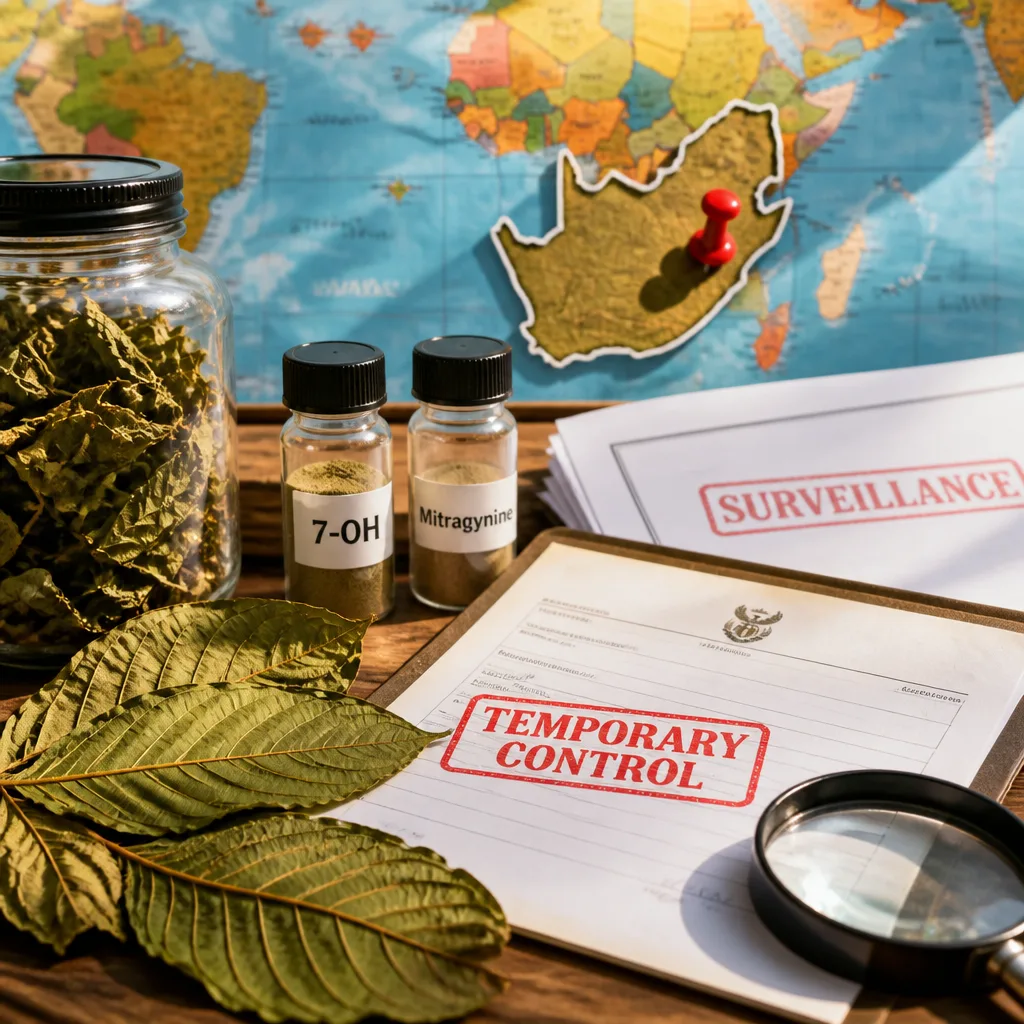
However, the World Health Organization’s Expert Committee on Drug Dependence has scrutinised kratom. During a 2021 pre‑review the committee concluded there was not yet sufficient evidence to proceed to a full critical review and kept the substances under surveillance. WHO materials continued that surveillance posture into 2025. A pre‑review, WHO emphasises, is a preliminary step used to judge whether the evidence base merits deeper examination — it is neither an endorsement of safety nor a final decision against international control.
Why botanical and synthetic derivatives are being treated differently
Regulatory debates have increasingly centred on the legal and scientific distinction between whole‑plant kratom and chemically concentrated or modified products. Botanical preparations typically contain lower natural concentrations of alkaloids, while processed derivatives can include much higher levels of 7‑OH or novel synthetic compounds.
- Botanical kratom: traditional plant material or simple extracts, often sold as leaves, powders or teas.
- Concentrated products: formulations with higher concentrations of specific alkaloids, or chemically altered substances, which may present different risk profiles.
That difference has driven targeted regulatory responses rather than blanket prohibitions in some jurisdictions.
Recent actions by United States federal authorities
In mid‑2026 US federal agencies moved to regulate specific kratom‑related compounds rather than banning botanical kratom outright. In July 2026 the Drug Enforcement Administration opened temporary scheduling proceedings for 7‑hydroxymitragynine above a certain concentration threshold, explicitly distinguishing the proposal from traditional plant material that contains lower, naturally occurring amounts.
The following month, in August 2026, federal authorities imposed temporary Schedule I status on three further compounds: mitragynine pseudoindoxyl, MGM‑15 and MGM‑16. These measures target particular chemical entities and formulations rather than declaring all kratom products illegal at federal level.
Public‑health incidents prompting closer attention
The regulatory moves took place against a backdrop of recent fatalities that have attracted public attention. In September 2026 two University of Mississippi students died in separate incidents; investigators reported discovering packaged kratom during both enquiries. Authorities have used those cases as part of the evidence base informing scheduling and enforcement debates.
| Actor | Action |
|---|---|
| World Health Organization (WHO) | 2021 pre‑review; substances kept under surveillance (continued in 2025) |
| US Drug Enforcement Administration (DEA) | July 2026: temporary scheduling proceedings for 7‑OH above a threshold |
| US federal authorities | August 2026: temporary Schedule I status for mitragynine pseudoindoxyl, MGM‑15, MGM‑16 |
Implications for policy and trade
The current situation illustrates how the absence of a global scheduling decision can lead to divergent national responses. Countries may lawfully enact stricter domestic restrictions than those in UN conventions, producing a mosaic of rules affecting possession, sale, importation and production. For regulators the central challenge is balancing public‑health protections with the need for clear, proportionate laws that differentiate between traditional botanical use and potent synthetic variants.
For South African regulators and health authorities the international debate is relevant even if kratom is not widely used locally. Developments in the US and WHO deliberations could influence import controls, customs screening and public‑health messaging. Monitoring both scientific evidence and policy trends abroad can help inform decisions on whether targeted controls — for specific compounds or high‑concentration products — are preferable to broad prohibitions that may be difficult to enforce or that inadvertently criminalise lower‑risk traditional preparations.
As WHO continues surveillance and national authorities act on evidence of harm associated with particular derivatives, the global regulatory picture is likely to remain unsettled. Policymakers, clinicians and customs officials will need to follow evolving science and law closely.