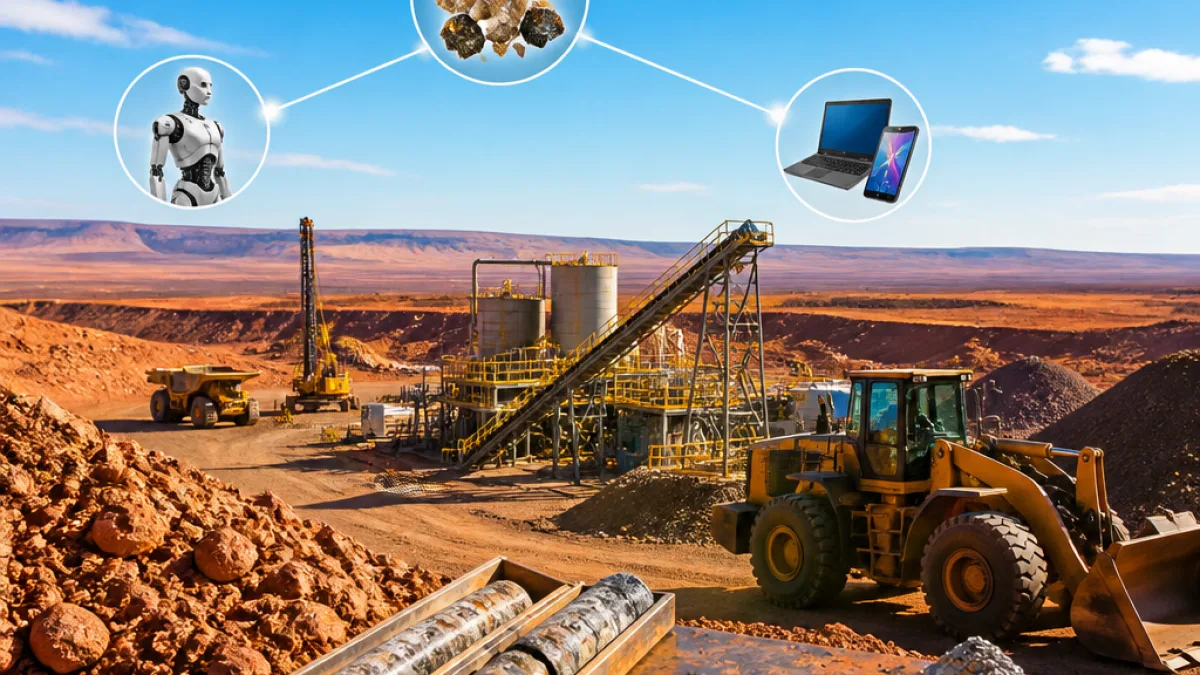
South Africa will need an investment of R7 billion to develop rare earth elements at the Zandkopsdrift project, a proposed operation in the Northern Cape that could place the country closer to global technology supply chains.
Minerals and Petroleum Resources Minister Gwede Mantashe disclosed the required investment in a written response to Parliamentary questions from IFP MP Nompumelelo Mhlongo. The project is intended to produce neodymium and praseodymium, two elements that can be processed into NdPr, a material used in powerful permanent magnets.
Why the minerals matter to technology
NdPr magnets are used where manufacturers need substantial strength from a relatively small component. Their applications include electric vehicle motors, wind turbine generators, hard drives and robotics. The same materials also have a role in consumer products such as headphones, speakers, microphones and haptic actuators.
In devices that produce sound, these compact magnets can help deliver strong audio output without requiring larger components. That makes the minerals relevant not only to major industrial equipment, but also to the small electronics used by consumers every day.
| Project detail | Information provided |
|---|---|
| Estimated investment | R7 billion |
| Location | Northern Cape |
| Planned rare earth elements | Neodymium and praseodymium |
| Potential jobs | 3,500 |
| Additional output | Manganese oxide for battery-grade manganese sulphate |
From extraction to higher-value production
The project is also expected to extract manganese oxide, which can be used in producing battery-grade manganese sulphate. This gives the development a second connection to the technology economy, as battery materials are central to electric mobility and energy-storage systems.
According to the minister, the project has been supported by the Department of Minerals and Petroleum Resources for approval by the European Union as a strategic project under its Critical Raw Materials Act. The department is working with the Industrial Development Corporation, which established the Critical Minerals Initiative Coordination Platform.
The department’s approach includes identifying projects under the localisation and value-addition pillar of its strategy, while mobilising funding for selected developments. Zandkopsdrift is one of the projects identified for support. The stated aim is not simply to remove minerals from the ground, but to connect South African resources with industries that require specialised materials.
“The Zandkopsdrift project was supported by the Department of Minerals and Petroleum Resources for approval by the EU as a Strategic Project under the Critical Raw Materials Act,”
What it could mean for South Africa
The proposed development could create 3,500 jobs, according to Mantashe’s response. That figure makes the project relevant beyond the technology sector, particularly in the Northern Cape, where mining remains an important part of the regional economy.
Its wider importance lies in the role played by rare earth materials in sectors that are expanding internationally. Electric vehicles depend on specialised components, while wind turbines and robotics require durable, high-performance magnets. A domestic project supplying some of these inputs could give South Africa a stronger position in industries associated with clean energy and advanced manufacturing.
However, the information released so far sets out the required investment, the planned minerals, the potential employment figure and the government support process. It does not provide a production start date, a construction schedule or details of how the R7 billion will be financed. Those factors will determine when, and to what extent, the project can move from a strategic proposal to an operating source of materials for the technology market.
For ordinary South Africans, the significance is therefore not an immediate change to the price or availability of a phone, electric vehicle or household device. The more direct issue is whether the country can convert its mineral resources into investment, jobs and local value addition while supplying materials needed by global technology and clean-energy manufacturers.