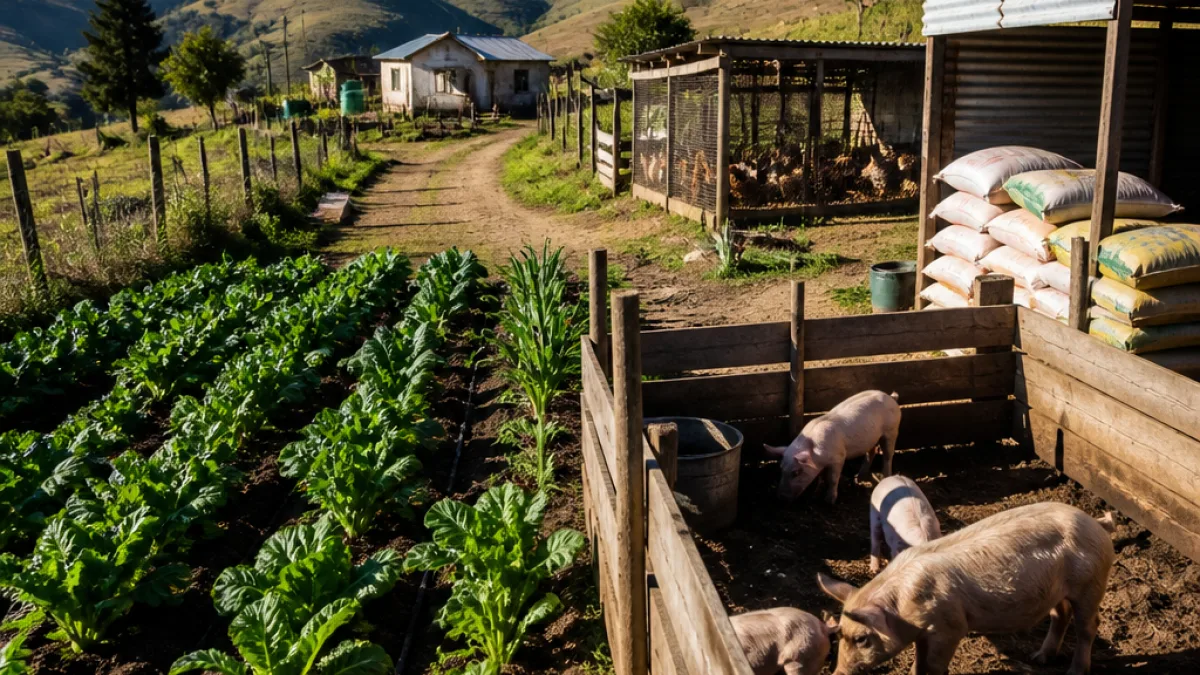
NGCOBO — When Sinalo Xhamlashe chose to leave his electrical engineering course, it was not a retreat but a return to a family tradition that has now become a small commercial success in the Eastern Cape. From a single hectare of vegetables cultivated during the Covid-19 lockdown, Xhamlashe’s operation has expanded into a diversified farm that includes livestock, a piggery and poultry production.
From backyard roots to commercial thinking
Born and raised in Ngcobo, Xhamlashe grew up in a household where subsistence homestead farming was the norm. The family garden and small-scale livestock kept food on the table and chores like watering crops were part of daily life. That lived experience shaped his agricultural instincts long before he entered formal studies.
He completed primary schooling at Silo SPS in Engcobo and matriculated in 2013 at Blythswood Institution in Ngqamakhwe. Attempts to join a university agriculture programme were unsuccessful, so he took an alternative route into technical education. Between 2016 and 2018 he completed NCV levels 2 to 4 in electrical engineering at Lovedale TVET College and in 2019 enrolled for the N4 NATED programme at Ikhala TVET College’s Ezibeleni Campus in Queenstown.
But the engineering path did not suit him. Xhamlashe reflected on the mismatch during his studies, saying the course demanded advanced mathematical ability that he realised he did not possess. He then pivoted back to what he describes as his true calling — agriculture.
Scaling up during crisis
It was during the restrictions of the Covid-19 lockdown that Xhamlashe established his initial commercial plot. Starting with one hectare of vegetables, he leveraged local knowledge and mentorship to begin selling produce rather than merely growing for household consumption. The small enterprise then diversified as opportunities and demand emerged.
The piggery component of Xhamlashe Projects began with only two Large White pigs. The unit produced a first litter of 14 piglets, a milestone that enabled reinvestment and growth. He has since added poultry and expanded livestock numbers, moving the operation along the continuum from subsistence to market-oriented production.
“I always knew that I loved agriculture growing up. It’s in the family; it runs in my blood; I inherited it,” Xhamlashe said, according to reporting by Food For Mzansi.
Support, mentorship and practical experience
Xhamlashe’s story highlights the role of practical mentorship and locally accessible support in scaling smallholder activity. While he did not qualify for a dedicated agricultural degree, the combination of ancestral knowledge, technical training elsewhere and hands-on trial and error provided the platform to build a viable business.
- Family knowledge: early exposure to homestead practices made basic farm management second nature.
- Technical training: TVET courses provided discipline and transferable skills, even if not directly agricultural.
- Market orientation: shifting from subsistence to selling produce during lockdown created an income stream and the impetus to diversify.
What this means for the Eastern Cape
The Eastern Cape has a large cohort of rural smallholders who could emulate parts of Xhamlashe’s trajectory: start small, diversify, and link into local markets. His experience underscores several practical lessons for policymakers and development agencies working in the province’s rural economy — notably the value of accessible mentorship, flexible training pathways, and support for on-farm enterprises such as piggeries and poultry that have relatively quick turnover.
For young people who do not meet formal tertiary entry requirements, the TVET sector remains an important route into productive livelihoods. Xhamlashe’s path also shows the potential of hybrid skills: discipline acquired in one field can be repurposed in another.
Practical takeaways for aspiring smallholders
Prospective farmers in the region can draw several practical pointers from Xhamlashe’s farm development:
- Begin with a manageable plot and build market links before scaling.
- Consider mixed enterprises (vegetables, poultry, pigs) to spread risk and generate multiple income streams.
- Seek local mentorship and training rather than waiting for formal agricultural qualifications.
| Year | Milestone |
|---|---|
| 2013 | Matriculated at Blythswood Institution |
| 2016–2018 | Completed NCV levels 2–4 in electrical engineering at Lovedale TVET College |
| 2019 | Enrolled for N4 NATED at Ikhala TVET College (Ezibeleni Campus) |
| Covid-19 lockdown | Started commercial vegetable production on 1 hectare |
| Subsequent | Added livestock, piggeries (started with 2 pigs and first litter of 14 piglets), and poultry |
Xhamlashe’s experience does not offer a blueprint that will work everywhere, but it does illustrate how rural entrepreneurship can be built on local assets and modest capital, supported by mentorship and incremental scaling. For the Eastern Cape — where agriculture remains central to livelihoods and rural resilience — such practical stories are useful guides for others seeking to transform backyard practice into commercial activity.
Reported by Food For Mzansi and summarised for local readers in the Eastern Cape.