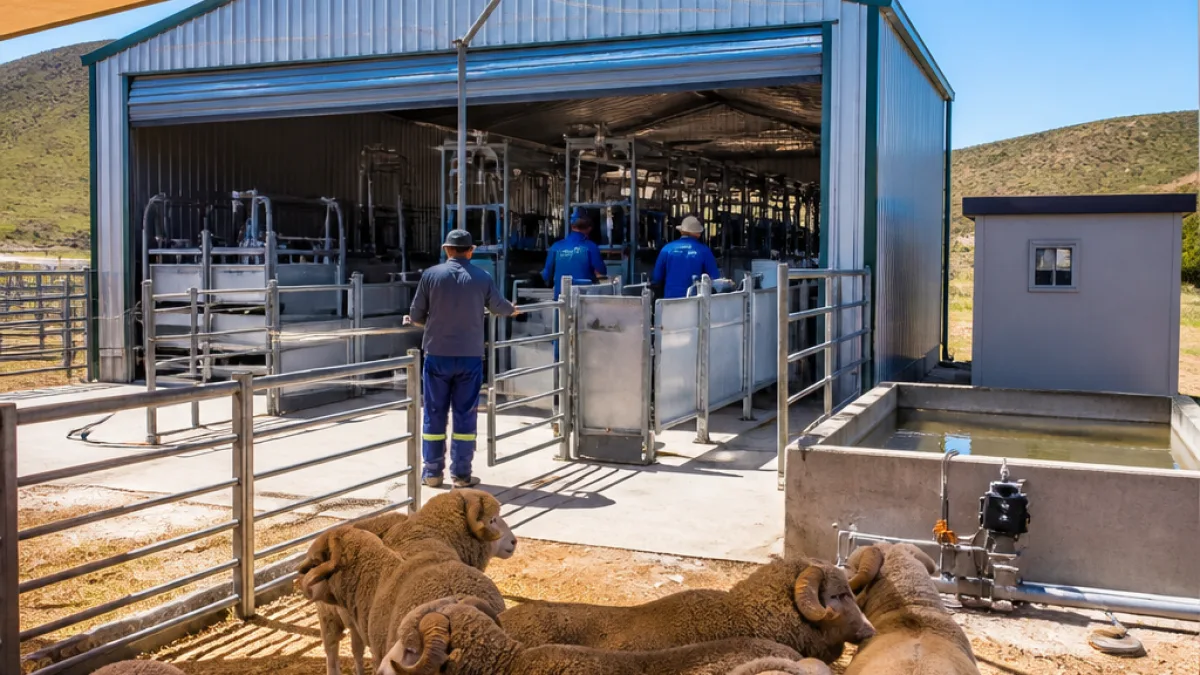
The Eastern Cape government has invested R1.4 million to construct a fully equipped shearing shed at Ngonyama Village, a move aimed at improving wool quality, reducing travel time for farmers and supporting commercial growth in the region.
New facility to cut travel and boost output
The facility handed over at an event in Ngonyama Village was funded by the provincial Department of Agriculture and includes a plunge-dipping tank, ablution facilities, an office, removable animal-handling equipment and perimeter fencing. The unit will be managed by the Masibambisane Woolgrowers Association, established in 2017.
The association comprises 48 members — 23 women and 25 men — who previously travelled more than 15km to a shearing shed in Xeni location. The new on-site shed will remove that journey, reduce logistical costs and provide a safer, purpose-built environment for sheep handling and shearing.
- Investment: R1.4 million to construct and equip the shearing shed.
- Breeding support: Department donated 10 Dohne Merino rams to strengthen flock genetics.
- Membership: 48 producers, nearly half of them women.
Recent season performance
| Metric | Figure |
|---|---|
| Sheep shorn (last season) | 3 409 |
| Wool bales produced | 19 |
| Sale proceeds (to CMW in Gqeberha) | R98 342 |
These figures were provided by the Department of Agriculture at the handover. Officials say the upgraded infrastructure is expected to improve both the quantity and quality of the wool clip, which could translate into higher returns when farmers sell collectively or pursue direct market access.
“Farmers should grow and be able to export their own wool for even better returns instead of only supplying other people. This structure should encourage you to roll up your sleeves and work for the development of the community and participate in the economic growth of the province,”
Those words were attributed to the MEC of Agriculture, who urged producers to seize the opportunity the new shed presents to move towards commercial, independent farming. The MEC also called for closer cooperation with law enforcement to protect the investment and livestock from theft and other rural crime.
Local reaction and context
The association’s chairman said the community had long relied on makeshift arrangements for shearing — even using homes as temporary sheds in past seasons — and welcomed the departmental intervention.
“Over the past nine to 10 years we were using our houses to shear sheep. We are hopeful that using this shed will increase the quality and quantity of wool,”
He also noted that previous ram donations from the department had already begun to improve the flock’s genetics and the quality of the wool produced. The latest gift of 10 Dohne Merino rams is intended to build on those gains and lift the commercial value of the clip.
Access to better infrastructure can lower post-production losses, speed up operations during peak shearing periods and make producer groups more attractive to buyers and ginners. For smallholder and emerging woolgrowers, collective assets such as well-equipped sheds can also facilitate training, compliance with animal health requirements and adherence to quality standards demanded by markets.
What this means for the community
For the members of Masibambisane, the immediate benefits are practical: fewer long trips to external facilities, safer handling of stock, and better hygiene and handling facilities that protect fleece quality. In the medium term, improved genetics and consolidated outputs could open opportunities to negotiate better prices or diversify into higher-value markets, including possible export channels if producers scale up and meet grading standards.
The handover was attended by the MEC and the executive mayor of Mbashe Local Municipality, signalling municipal support for the project. Officials described the investment as part of a broader effort to upgrade rural agricultural infrastructure and create conditions for smallholder commercialisation across the Eastern Cape.
For now, the focus is on operationalising the shed, scheduling shearing days and ensuring veterinary and extension support is in place so the producers can translate new assets into improved livelihoods.