The detection of atmospheric helium around the rocky exoplanet LHS 1140b has rekindled interest in how humanity might one day visit — or at least send instruments to — nearby star systems. The planet orbits a red dwarf about 48 light‑years from Earth and sits in its star’s habitable zone, where conditions could allow liquid water at the surface.
Why the helium finding matters
A team of astronomers reported signs of helium being lost from the upper atmosphere of LHS 1140b. While helium itself is not a biosignature, its presence points to a layered atmosphere where heavier compounds — including water vapour — could exist closer to the surface. For observers on Earth, characterised spectral features like helium give an accessible handle on a planet’s atmospheric structure and evolution.
From telescopes to tiny probes
Observatories can tell us a great deal, but they are limited to remote sensing. The recent developments in sensor miniaturisation, driven by consumer electronics, make a different approach plausible: sending millimetre‑scale or gram‑scale probes that carry cameras and chemical sensors to another star system.
Miniaturisation matters for two practical reasons:
- It is far easier, in terms of energy and cost, to accelerate a small mass to a high fraction of light speed than a large spacecraft.
- Miniature sensors and communications hardware reduce the power and thermal budgets those probes need, increasing the chance they survive interstellar transit.
Examples of enabling technologies include smartphone‑grade cameras and the experimental “smart dust” sensors that detect light, temperature and chemicals at millimetre scales. Research into such systems has accelerated as industry squeezed more capability into tiny packages for consumer products.
How a fly‑through mission would work
Current proposals most often describe a mission profile based on accelerating many small probes to mildly relativistic speeds — commonly cited numbers are 10–20% of the speed of light — and letting them coast for decades before flying through a target system. Because the probes would not be able to decelerate, they would perform a high‑speed fly‑through, collect in‑situ data, and then transmit results back towards Earth over years or decades.
| Parameter | Typical value |
|---|---|
| Distance to LHS 1140b | 48 light‑years |
| Proposed cruise speed | 10–20% of c |
| Mission travel time (approx.) | Decades to a century |
Breakthrough Starshot and the technical challenges
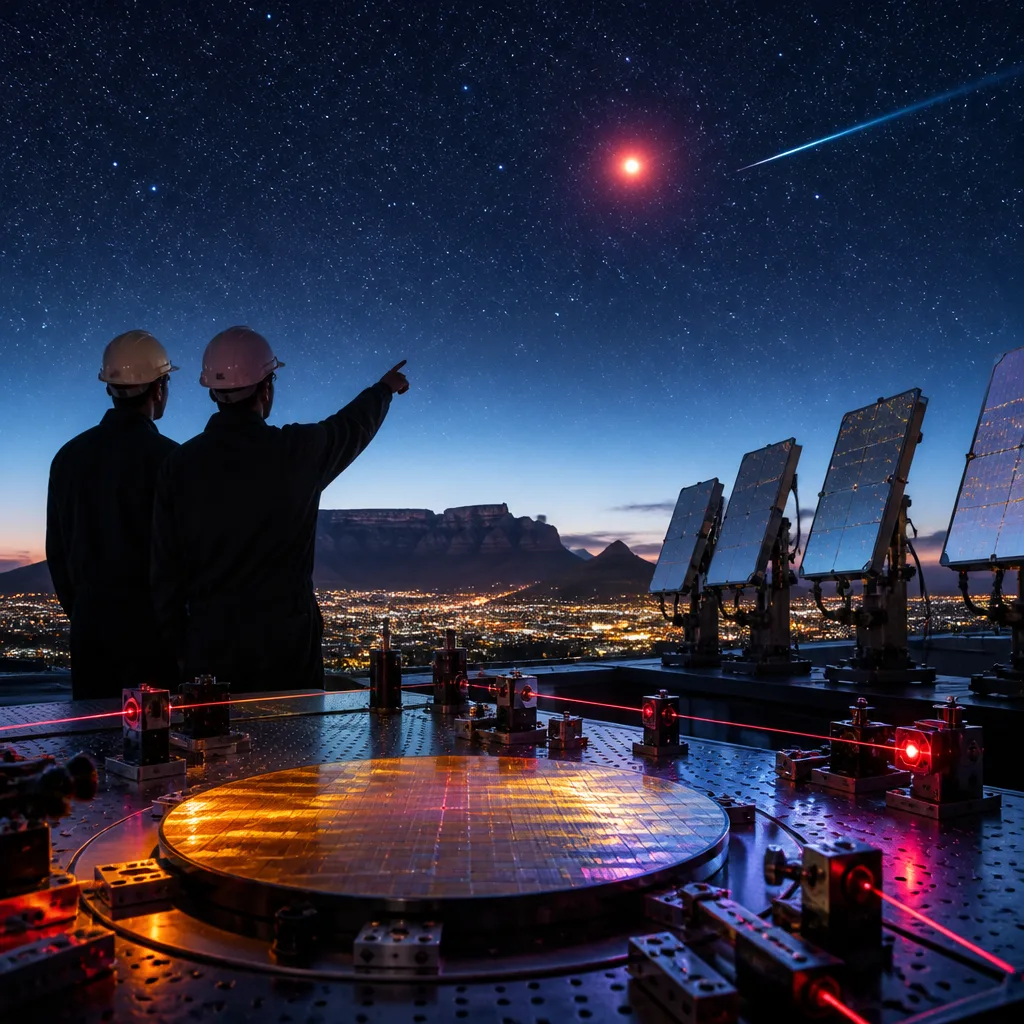
One notable effort to examine these ideas is the philanthropically funded programme Breakthrough Starshot, which has investigated the technologies needed for laser‑propelled, wafer‑scale spacecraft. The concept relies on ground‑ or space‑based high‑power lasers pushing extremely light sails, accelerating tiny probes to the required fraction of light speed.
Major technical hurdles remain. These include building reliable miniature instruments that survive interstellar space, designing communication systems capable of sending faint signals across decades and light‑years, and developing the laser infrastructure to accelerate the probes. There are also questions about data return strategies: probes would likely upload small, compressed packets back to Earth over very long periods rather than streaming continuous video.
Why this is relevant to South Africans
At first glance, interstellar missions feel remote. But the same engineering advances that make wafer‑scale probes conceivable are already changing life on Earth: ever‑smaller sensors power cheaper environmental monitoring, health devices and agricultural tools that matter to South African communities working with limited data and power budgets.
Thinking about tiny, fast probes also reframes expectations for exoplanet science. Instead of waiting for multi‑generational spacecraft, researchers can plan for a future of targeted fly‑through missions that supplement telescope observations. That changes how we prioritise targets — worlds like LHS 1140b, where a rocky body in the habitable zone shows atmospheric complexity, jump higher on the list.
The path from helium in a spectrum to pictures or chemical analyses from another star is long and uncertain. But the convergence of miniaturised sensors, advanced propulsion concepts and sustained research programmes means the idea of actually visiting nearby systems is moving from science fiction toward engineering study. For now, telescopes will remain our main tool; in coming decades, tiny probes could provide a radically different, direct way to study our cosmic neighbourhood.