Local students connect classroom learning to industry trends
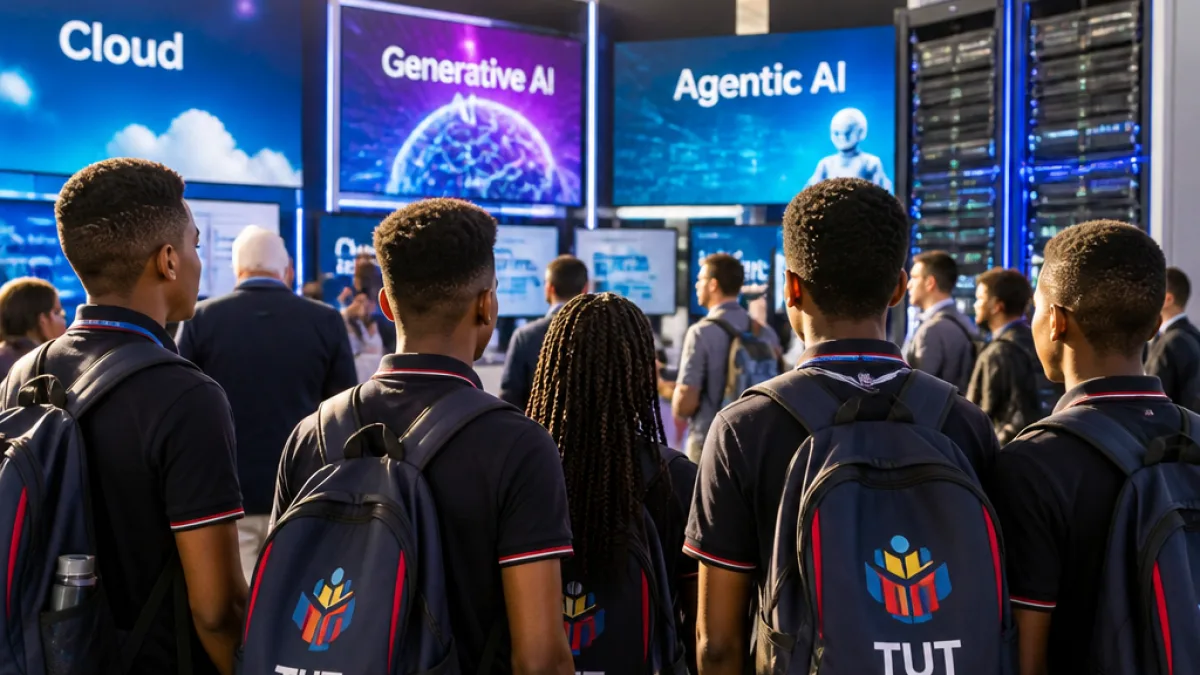
Computer Science students from Tshwane University of Technology's eMalahleni Campus attended the AWS Summit Johannesburg 2026 at the Gallagher Convention Centre, gaining direct exposure to developments in cloud computing, data analytics and artificial intelligence.
The visit brought students into contact with technology professionals, industry leaders and academics, providing practical context for topics covered in their curriculum. Presentations and demonstrations at the summit focused on Agentic artificial intelligence, Generative AI, data analytics and cloud modernisation, showing how organisations deploy these tools to tackle complex problems and speed up digital transformation.
For many students, the summit offered a chance to see how academic theory translates into applications aimed at improving efficiency and addressing societal challenges in South Africa. The event also gave them a look at the technical and soft skills employers are seeking in an increasingly digital economy, and how those skills can be used to support local communities.
"Rather than just fixing problems after they happen, we can now stop them before they even start. That was a huge takeaway for me," said Mpho Maake, a third-year Diploma in Computer Science student.
The summit was more than technical briefings. Students found the environment conducive to networking and informal exchange. Some highlighted how the relaxed setting—complete with live music—made it easier to engage with professionals and peers from across the sector.
What students saw and why it matters for eMalahleni
- Agentic AI: demonstrations showed autonomous decision-making systems that can perform tasks or suggest actions with limited human oversight.
- Generative AI: tools that create text, images or code, with potential to accelerate content production and prototype development.
- Data analytics: approaches to turn large datasets into usable insights for business and public-service decisions.
- Cloud modernisation: strategies to migrate legacy systems to cloud platforms for scalability and resilience.
Seeing these technologies in action helps students envisage how local government services, municipal planning and industry in Mpumalanga could benefit from better data use and cloud platforms. For a city like eMalahleni, where energy, mining and tourism intersect, the ability to process and act on data faster can influence service delivery, safety planning and economic opportunities.
| Topic at Summit | Practical focus |
|---|---|
| Agentic AI | Autonomous problem solving and predictive action |
| Generative AI | Content and code generation to speed development |
| Data analytics | Extracting insights from large datasets |
| Cloud modernisation | Migration and scaling of services |
Beyond technical exposure, the summit offered networking that can help students transition from campus into industry roles. Engaging with professionals at such events helps clarify the competencies employers want—ranging from cloud architecture and data literacy to teamwork and communication.
For eMalahleni residents watching university graduates enter the local job market, this kind of industry engagement is encouraging. It suggests that locally trained graduates are being exposed to cutting-edge practices and industry contacts that could benefit enterprises and public services in the region.
The trip to Johannesburg was organised to give students experience beyond the classroom and to strengthen links between academic learning and real-world application. As universities and industry increasingly collaborate on digital skills, such exposure may contribute to a more technology-capable workforce available to Mpumalanga employers.
Organisers say the event encouraged students to consider how technological tools might be used to address challenges facing South African communities, including those in eMalahleni. For many attendees, the summit transformed abstract lectures into visible solutions and career possibilities.